

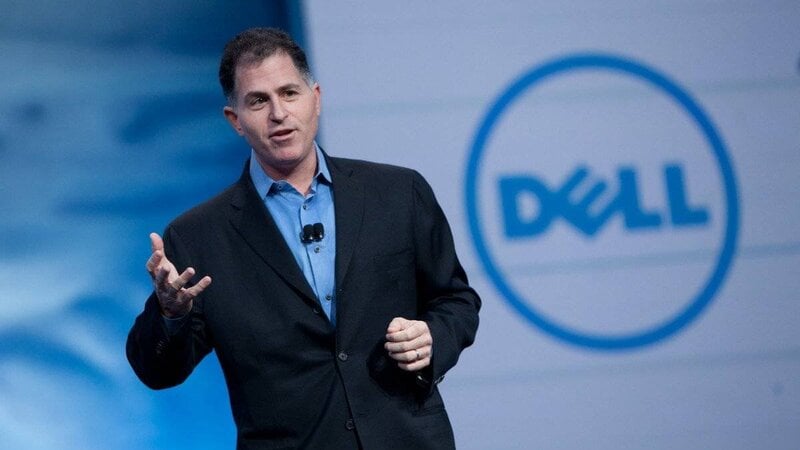
Michael Dell is one of the richest men in the world. According to the latest Forbes ranking, the founder and CEO of Dell Technologies is currently ninth in the global ranking.
Dell's success is due to his hardware and IT infrastructure empire. Ahead of him in the top 10 are major names such as Jensen Huang of Nvidia and Bernard Arnaul of LVMH, who still boast greater net worths today.
But who exactly is Michael Dell? Why did he become so rich? What is his current net worth? In this guide, let's look at everything you need to know about one of the most powerful men in the entire global landscape.
<sommaire|title=Who is Michael Dell and how much does he earn>
Who is Michael Dell?
Michael Dell was born in Houston, Texas, on February 23, 1965. Today, he is considered one of the most influential entrepreneurs in modern IT, especially after founding the IT giant Dell Technologies.
From his adolescence, Dell showed the first signs of boundless talent in the world of business and technology. While attending college in Texas, he began assembling and selling computers to customers, eliminating intermediaries. At 19, in 1984, he founded Dell Computer Corporation, specifically for direct sales and PC customization. A revolutionary move for the time, when intermediaries were obligatory.
A few years passed, and his company became one of the leading PC manufacturers in the world, so much so that in 1992, Dell was included in the Fortune 500 list as the youngest CEO ever. The early 2000s began with considerable difficulty for the company, until 2013.
That year, Michael Dell proceeded with the delisting of the company from the stock market, in a transaction worth approximately 25 billion dollars. From this point on, the strategy of the entire business surrounding the giant changed. In 2016, the acquisition of EMC was finalized for 67 billion dollars, and Dell Technologies was born, which remains an ecosystem of PCs, cloud, data centers, and cybersecurity to this day.
In addition to his company, Dell is very active in philanthropy with his Michael & Susan Dell Foundation, which focuses on education, healthcare, and poverty reduction.
Michael Dell's Net Worth
According to Forbes' latest estimates, Michael Dell is currently worth approximately $152 billion, making him ninth on the list of the world's richest people. His fortune has grown gradually, in tandem with the expansion of Dell Technologies.
How has it evolved over time? In the 1980s and 1990s, when Dell's career was still nascent, the first revenues began to pour in, leading to the first signs of a great empire in the making. This was confirmed by his inclusion in the Fortune 500 at just 27 years old, a testament to his esteem that marked the beginning of his influence and wealth at the corporate level.
After the decline recorded in the early 2000s, the 2013 stock buyout netted Dell around $25 billion. This was a significant step not only for the immediate figure, but above all because the company regained greater room for maneuver for new acquisitions.
Another key moment in 2021 was when Dell spun off VMware. The company's share price fluctuations contributed significantly to Dell's wealth. In 2023, Broadcom acquired VMWare, and Dell received both Broadcom shares and cash, a step that allowed Dell to diversify its assets.
It was in 2024 that Dell surpassed the $100 billion mark in assets, and today it continues to decline. This is despite the collapse of Dell and HP shares in a few days last year, an event that impacted its assets by billions of dollars.
Why is Michael Dell so rich?
Michael Dell is one of the most striking examples today of how it is possible to build and rebuild an empire from scratch. His wealth does not come from salaries or bonuses, but primarily from his controlling stake in Dell Technologies, from extraordinary transactions (such as the 2013 delisting), and from equity investments and private investments.
According to many analysts and experts, Dell's major difference from other founders is that he did not dilute his stake during the PC industry crisis, but rather restructured the business by taking the company off the stock exchange and regaining economic value.
The first fundamental phase was the direct PC sales model, between the 1980s and 1990s. During these years, with no intermediaries and the ability to work solely on order, margins and cash flow were higher than the competition. It's no coincidence that Dell became the world leader in the PC industry in just a few years.
As mentioned, the real turning point came during the PC crisis. Beginning in 2007, it led to a rapid decline in the US market due to Asian competition, declining margins, and a loss of stock market appeal. Many top CEOs decided to sell part of their shares, but Dell, on the other hand, had more strategic freedom and was able to restructure its business by delisting.
It's also worth mentioning the transformation of the company into an industry in the following years, with the acquisition of EMC and indirect control of VMWare. The spinoff and sale to Broadcom generated tens of billions in revenue and made Dell one of the world's richest men, eventually surpassing the $100 billion mark.
The Role of Dell Technologies for Michael Dell
Today, Dell Technologies is a group that operates in the fields of IT, servers and storage, data center infrastructure, cloud solutions, and AI and big data systems. It's an entire ecosystem that guarantees annual revenues of around $90-100 billion, with strong cash generation and a business focused on B2B.
It's no coincidence that today, Dell isn't one of the most talked-about tech companies. Unlike Apple, Samsung, and others, which launch their own devices and directly enter the B2C market, Dell operates in the background and maintains a solid structure.
There are 3 reasons in particular that allow Dell Technologies to play such a significant role in Michael Dell's wealth. First and foremost, obviously, the large share of the company's capital that he owns. Any growth in the company's value, therefore, is reflected in his personal wealth.
As a second factor, business diversification should be mentioned. Dell is an infrastructure provider, an indirect beneficiary of the AI, cloud, and data center boom, and is therefore less volatile than software. All of this ensures its value remains more stable and defensible.
Finally, we must consider the leverage effect of various financial transactions such as the delisting, the acquisition of EMC, and the spinoff of VMware, all decisions that have created multiplied value.
Michael Dell's Other Business Activities
Dell Technologies is not the only source of income for Michael Dell today; on the contrary, the founder of the tech company has sought to diversify his portfolio, investing and profiting from it.
First of all, he maintains his own family office, DFO Management, which stabilizes his assets and reduces his dependence on Dell stock alone.
It also has stakes in luxury real estate, hospitality, and financial investments, all of which diversify risk and guarantee revenue.
Original article published on Money.it Italy. Original title: Chi è e quanto guadagna Michael Dell, uno dei 10 uomini più ricchi al mondo