

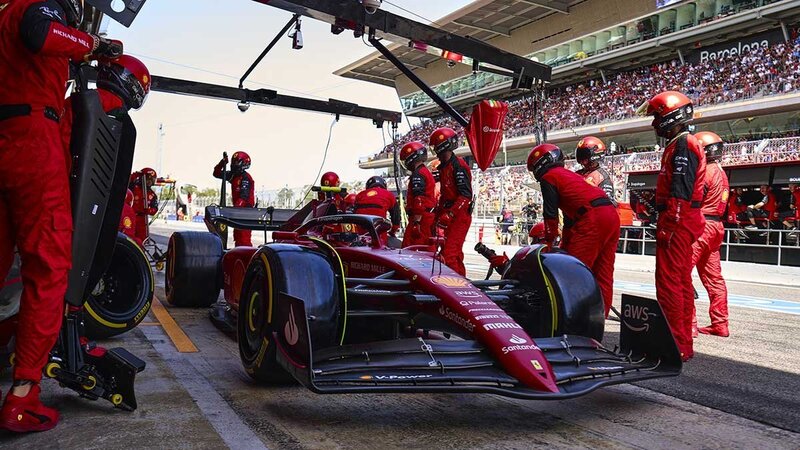
When it comes to Formula 1, especially at the end of the season, the collective imagination turns to big numbers: the drivers' millions, the star sponsors, the teams' pharaonic investments. Yet, as the 2025 World Championship prepares for its final act in Abu Dhabi, there's another figure—far from the spotlight but close to the action—who keeps the whole show going: the F1 mechanic.
A profession that fascinates, intrigues, and that many consider a dream: traveling the world, working alongside the best drivers, and getting your hands on cars that represent the pinnacle of automotive technology. But how much does a Formula 1 mechanic really earn? What sacrifices does his role entail? And how far is it from the economic reality of a "common" mechanic?
Amidst myths to be debunked, extraordinary work schedules, and often overestimated salaries, the truth is this: an F1 mechanic is a hyper-specialized professional who thrives on intercontinental flights, lightning-fast pit stops, and overwhelming responsibilities. And the numbers, the real ones, tell a very different story than what often circulates online.
<sommaire|title=How much does an F1 mechanic earn>
Who is a Formula 1 mechanic and what does he do? Here's what he gets paid for
Behind every single-seater hurtling at over 330 km/h is a small army of technicians, and among these, the most concrete and operational role is that of the mechanic. Many imagine this figure as a "pit stop" specialist, ready to change four tires in less than two seconds. But the reality is much more complex.
First of all, not all F1 mechanics are engineers. Indeed, the path often begins in technical schools, professional courses in motor mechanics, or diplomas as a mechanical or mechatronics expert. From there, the climb up the ladder inevitably involves years of apprenticeship in "minor" categories like F2, F3, WEC, GT. Only after a lengthy selection process do some actually make it into the F1 pits.
Looking at the typical CV of a Formula 1 mechanic, the skills required are enormous:
- manual dexterity and micrometric precision;
- advanced knowledge of electronics, aerodynamics, and composite materials;
- rapid decision-making;
- ability to work under constant pressure;
- maximum problem-solving and teamwork skills;
- physical and mental endurance.
Before the race weekend, mechanics take care of the complete assembly of the car: chassis, power unit, suspension, brake-by-wire, electrical system, wings, floorpans, hydraulic systems. Every single component is checked, tested, disassembled, and reassembled dozens of times.
During track sessions, the mechanics modify the set-up working side by side with engineers and drivers: millimetric adjustments to suspension stiffness, aerodynamic changes, brake balance, ride height. Even a single degree of difference in the incidence of a wing can change the entire behavior of the car.
Then there are the pit stops, the most visible act of their work. Here, everyone has a surgical role:
- pneumatic guns;
- tire removal and positioning;
- front supports;
- car stabilization;
- real-time monitoring of technical parameters.
<quote>A perfect pit stop is a proven team effort, practiced hundreds of times and timed, that takes between 1.8 and 2.5 seconds. And it can decide a race.</quote>
After each session, the car is completely disassembled for checks, replacements, safety checks. They work late into the night, often after 12–14-hour days.
Being an F1 mechanic means living between constant flights, jet lag, a grueling schedule, and enormous responsibility: if something goes wrong, even a simple nut can cost you a position up or down. Or even worse.
F1 mechanics today: how many are there in a team (and how are they classified)
Each Formula 1 team is a truly global company with hundreds of employees. But how many work directly on the car?
On average, each team brings between 25 and 35 mechanics to the GPs, divided into specific departments:
- track mechanics, responsible for the car during the weekend;
- workshop mechanics, who work in the factory between GPs;
- power unit specialists;
- suspension and hydraulics experts;
- tire technicians;
- aerodynamic mechanics;
- main pit crew;
- chief mechanic, the person responsible for maximum coordination.
The contractual framework varies from team to team, but almost all are full-time, highly specialized contracts, with mandatory travel availability and non-negotiable schedules. Former Red Bull mechanic Calum Nicholas, in an interview reported by Fanpage, explained the reality clearly.
<quote>The average working week is 70 hours. Most travel in economy class. No one gets paid more for being part of the pit crew.</quote>
Mechanics follow the team around the world, for 24 GPs per season (as in 2024 and 2025): this means more than 20 intercontinental trips, dozens of nights in hotels, very little free time, and a pace that to call intense is an understatement.
Even within the main teams, there's a precise hierarchy: climbing the ladder takes years, consistent performance, and total dedication. And not everyone, even those who work in F1, gets to work on the car over the weekend.
How much does an F1 mechanic earn? Average salaries
Talking about salaries in Formula 1 always means walking a fine line between myth and reality. Mechanics, despite being figures far from the spotlight, are often the object of curiosity precisely because of the contrast between their relatively low visibility and the enormous responsibility that falls on their shoulders. The available figures paint a much less "stellar" picture than the general public would imagine, but still higher than traditional automotive industry averages.
- A Formula 1 mechanic with standard experience generally earns between 40,000 and 70,000 euros per year. These salaries are highly dependent on seniority and role.
- Those working in top teams and have accumulated specific expertise on complex systems such as gearboxes, power units, or suspensions can earn exceed the 100,000-120,000 euro threshold.
- Salaries peak near 150,000 euros for chief mechanics.
These figures are also confirmed by the aforementioned former Red Bull coach Calum Nicholas, who recalled that his average annual salary was around £60,000 (just under €70,000), while his first contract was around £42,000. This is valuable testimony, coming from one of the most successful teams of the last 15 years.
Added to all this are bonuses and benefits: some teams offer performance-related bonuses or fully cover travel, subsistence, and per diem expenses. However, it's important to remember that these benefits are offset by a much higher workload than in a traditional job.
Original article published on Money.it Italy. Original title: Quanto guadagna un meccanico di Formula 1?