

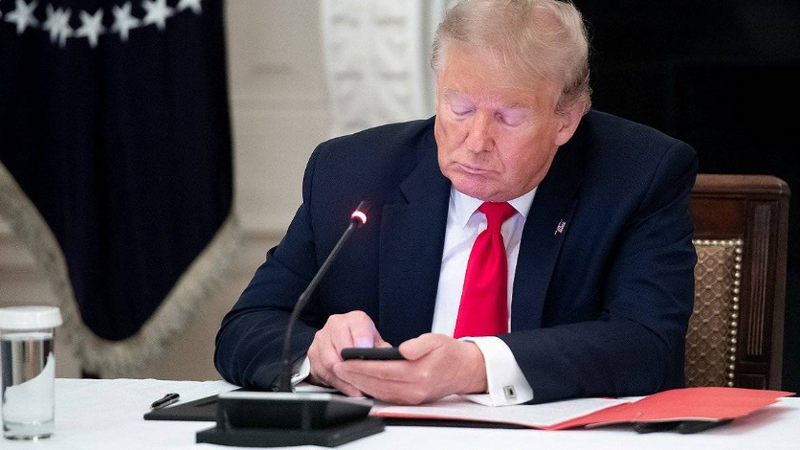
U.S. President Donald Trump has increased the across-the-board tariff on U.S. imports from 10% to 15%, the highest level allowed under a separate statutory authority, less than 24 hours after the Supreme Court of the United States struck down his previous tariff framework.
The Court ruled that the administration had exceeded its authority under the International Emergency Economic Powers Act (IEEPA), the law Trump had relied upon to justify sweeping tariff measures. The decision, authored by Chief Justice John Roberts and supported by both conservative and liberal justices, significantly limits the executive branch’s ability to use emergency powers to impose broad trade restrictions.
In response, the White House pivoted immediately to Section 122 of the Trade Act — a rarely discussed and never-before-used provision that allows the president to impose tariffs of up to 15% for up to 150 days without prior congressional approval.
The increase took effect immediately.
Section 122 and the 150-Day Countdown: Political and Legal Uncertainty
While Section 122 provides short-term authority, it comes with a critical constraint: any tariff imposed under this provision must receive congressional approval after 150 days to remain in effect.
This creates a clear political deadline.
Trade policy analysts note that even with a Republican-controlled Congress, extending the tariffs is far from guaranteed. Recent polling shows growing public concern over affordability and the cost of living, with many voters blaming tariffs for contributing to higher consumer prices.
With midterm elections approaching, lawmakers may be reluctant to endorse a measure that could intensify inflationary pressure.
There is also legal uncertainty. Because Section 122 has never been invoked before, its use could trigger fresh court challenges. For businesses and financial markets, this legal ambiguity adds another layer of risk.
Not all imports will be treated equally. The administration has confirmed exemptions for certain strategic products, including critical minerals, metals and energy goods. Additionally, countries that negotiated bilateral trade agreements with the United States will continue to face their previously agreed tariff rates — even if those exceed 15%. This creates uneven exposure across global trading partners.
Read more: Beyond Wall Street: Trump sends bonds tumbling as investors flee
Inflation, Corporate Margins and Market Volatility
From a macroeconomic perspective, the move from 10% to 15% represents a 50% increase in the tariff rate. While the headline change appears incremental, its cumulative impact on trade flows could be significant.
Inflationary Pressure
Tariffs function as an indirect tax on imports. A higher tariff rate can:
- Raise costs for imported intermediate goods
- Compress corporate margins
- Translate into higher retail prices
For the Federal Reserve, this development complicates the disinflation narrative. If import costs rise meaningfully, inflation expectations could stabilize at a higher level, potentially delaying rate cuts or altering monetary policy guidance.
Market strategists warn that tariff-driven inflation differs from demand-driven inflation: it erodes purchasing power without necessarily stimulating growth.
Corporate Strategy and Supply Chains
Multinational companies with global supply chains now face renewed uncertainty. Key adjustments may include:
- Repricing goods and renegotiating supplier contracts
- Accelerating reshoring or nearshoring strategies
- Delaying capital expenditures until policy clarity improves
Industries most exposed include automotive manufacturing, consumer electronics, retail and industrial machinery.
According to several trade economists, regulatory instability can weigh more heavily on investment decisions than the tariff rate itself. Businesses can adapt to costs; unpredictability is harder to hedge.
Financial Markets and Sector Exposure
Equity markets may react through:
- Increased volatility in export-heavy sectors
- Pressure on multinational earnings
- Rotations toward domestically insulated industries
If trading partners respond with retaliatory measures, global growth forecasts could face downward revisions.
Emerging markets that rely heavily on U.S. exports could see currency pressure, while commodity-exporting nations may benefit from product exemptions in critical materials and energy.
Read more: The Wall Street paradox. We’re at all-time highs, but many investors are turning cautious
Scenario A – Congress Extends the Tariffs
If lawmakers approve an extension beyond 150 days, the 15% rate could become a structural feature of U.S. trade policy.
Implications would likely include:
- Persistent import-driven inflation
- Strategic supply chain realignment
- Heightened geopolitical trade tensions
Certain domestic producers could benefit from reduced foreign competition, while import-dependent sectors would face margin compression.
Scenario B – Congress Blocks Extension or Courts Intervene
If Congress refuses to extend the measure, or if new legal challenges succeed:
- The tariffs would expire after 150 days
- A new policy vacuum could emerge
- Market volatility could intensify
President Trump has already signaled that his administration is exploring alternative legal pathways to impose product- or country-specific tariffs under national security or unfair trade practice statutes. This suggests that even if Section 122 lapses, trade tensions may persist under different frameworks.
This is not merely a tariff adjustment — it is a structural policy uncertainty event.
Key variables to monitor include:
- Congressional positioning ahead of the 150-day deadline
- Inflation data over the next two quarters
- Federal Reserve communication
- Corporate earnings guidance from globally exposed firms
For institutional investors and corporate decision-makers, the primary risk is not just the 15% rate itself, but the volatility surrounding U.S. trade governance.
In global markets, uncertainty often carries a higher cost than taxation.