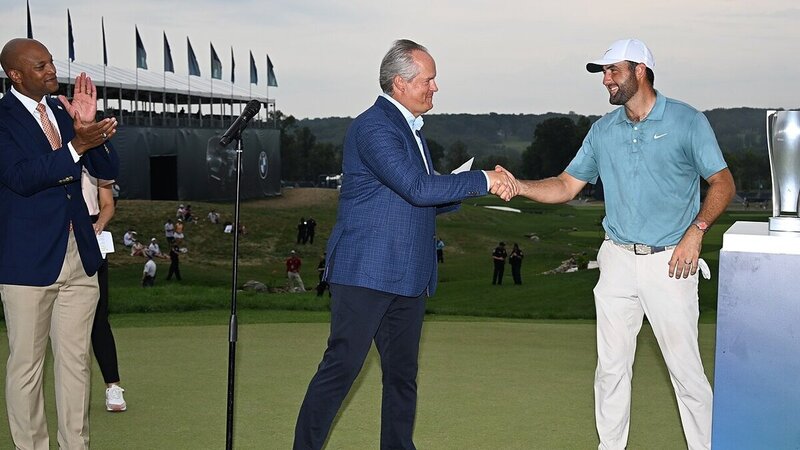
Scottie Scheffler’s fortune sits at roughly $110 million heading into the 2026 U.S. Open, with some trackers pushing the estimate as high as $125 million. That range reflects how quickly a dominant golfer’s balance sheet moves: just a year ago, his earnings profile was tens of millions smaller.
The timing is everything. Scheffler tees off at Shinnecock Hills on June 18 as the heavy favorite to win the only major he has never claimed. If he closes it out, he completes the career Grand Slam, joining the six-man club of Gene Sarazen, Ben Hogan, Gary Player, Jack Nicklaus, Tiger Woods, and Rory McIlroy, on his 30th birthday no less. That kind of milestone does not just rewrite the record books. It resets an athlete’s commercial value.
Where Does Scottie Scheffler’s Money Actually Come From?
Scheffler’s wealth runs on two engines: prize money and endorsements.
On the course, he has been the most reliable earner in the sport. He topped the PGA Tour’s official money list for a fourth straight season in 2025, banking roughly $26.58 million in tournament prize money that year alone. That consistency placed him on Forbes’ 2026 list of the world’s highest-paid athletes, where his total 12-month haul was reported at about $84.6 million.
Off the course is where the picture gets even bigger. Forbes estimates Scheffler earns close to $30 million a year from endorsements. His sponsor roster reads like a luxury portfolio: Nike, Rolex, NetJets, TaylorMade, Veritex Community Bank, and Golf Forever. Unlike many of his peers, he has stayed entirely on the PGA Tour rather than chasing a guaranteed LIV Golf payday, which means his on-course money is earned shot by shot rather than fronted as an appearance fee.
How Scheffler Built His Fortune
Scheffler turned professional in 2018, but the wealth came in a remarkably short burst. His breakthrough arrived in 2022 with his first Masters title and his first ascent to world No. 1, a ranking he has now held for more than 175 weeks across his career.
From there the trophies and the checks compounded. A second Masters in 2024, the PGA Championship in 2025, and an Open Championship win pushed his career on-course earnings to roughly $134 million, making him only the third golfer in history to cross the $100 million mark in tour winnings, behind Tiger Woods and italicMasters/italic champion Rory McIlroy.
What stands out is how concentrated that money is. Most of Scheffler’s career earnings have come in a four-year window, a velocity that few athletes in any sport, individual or team, can match. For comparison, even a generational individual earner like MotoGP legend Valentino Rossi built his fortune across two decades. Scheffler did it in roughly four years.
What’s Next for Scheffler’s Net Worth in 2026?
A U.S. Open win this week would do two things at once. It would bank another eight-figure first-place check, the 2026 purse is among the richest in golf, and it would hand him the career Grand Slam, an achievement that historically commands a premium in endorsement renewals and new deals.
There is also a structural tailwind. Top golfers have never been paid more. Sportico’s 2026 analysis found that Jon Rahm, McIlroy, and Scheffler each cleared $80 million in annual earnings, a ceiling that simply did not exist a decade ago. As long as Scheffler keeps winning and keeps his sponsor list intact, his net worth has a clear path past $125 million.
Still, golf wealth is volatile. Prize money depends on finishing positions, and even the world No. 1 has had a quieter 2026 by his own standards, with just one win on the season entering the U.S. Open. His endorsement income provides a floor, but the headline figures move with results. That is the same dynamic that separates a steady performer’s balance sheet from the guaranteed mega-contracts handed out in team sports, where a star like Shai Gilgeous-Alexander locks in $285 million regardless of how the season goes.
For now, $110 million is the working number, and it is one good Sunday away from looking conservative. Where do you think Scheffler’s net worth lands by the end of 2026?