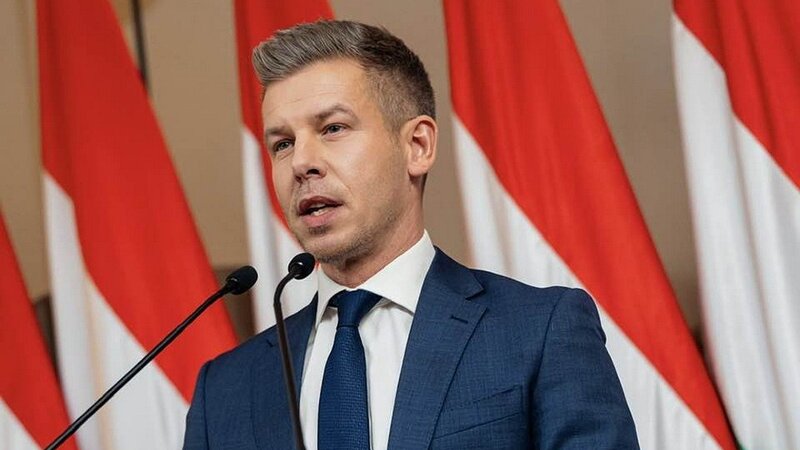
One of the most enduring and seemingly unshakable strongholds of the European far right has fallen. After a full 16 years of rule, Viktor Orbán lost the Hungarian elections to Péter Magyar, Orbán's former right-hand man during more than 20 years of activism in the Fidesz party, which as of today no longer governs the country.
Politician, MEP, and lawyer, Magyar has managed to pull off a historic feat in every sense of the word in just a couple of years: breaking free from Orbán's control, reviving a centrist party that had fallen into oblivion, establishing himself as a credible opposition figure and then as a popular leader, ultimately winning a record-breaking election with a landslide. So landslide that the future prime minister will even be able to amend the Constitution.
This is a significant blow for the right in general, given that Hungary has for years been held up as a model by many other European countries following the same trend. And while the EU rejoices at Hungary's newfound moderation—the Orbán era has not left a particularly good impression in Brussels—reactions from around the world have been very different. Giorgia Meloni also officially bid farewell to Orbán, renewing her support for him and congratulating him on his new prime minister.
But who really is Péter Magyar and why could he mark the beginning of a new era for Hungary? From domestic politics to more pro-European positions, here's what could really change starting today with the farewell to Viktor Orbán's "kingdom."
<sommaire|title=Péter Magyar: Biography, Career, and Program>
Biography and Career of Péter Magyar, the Man Who Upended Hungarian Politics
Péter Magyar is not an outsider in the traditional sense of the term: his political career began within the system he has now helped to "demolish." For over two decades, he was a trusted man of Orbánism, orbiting around Fidesz and consolidating a network of institutional and political relationships that would later prove decisive. A lawyer by training, MEP, and respected technical figure, Magyar has experienced the mechanisms of Hungarian power from the inside, but in recent years has increasingly broken with the model of so-called "illiberal democracy."
The turning point came in March two years ago, when he definitively broke with Orbán and decided to build a new political platform around the Tisza Party, until then marginal. In just over a year, he managed to transform it into a credible opposition force, tapping into growing discontent, especially among young people and in medium-sized cities. His campaign was characterized by a strongly anti-establishment narrative, but without radical overtones: pragmatic reformism and restoration of the rule of law became his rallying cry.
The numbers reveal the extent of the political earthquake better than any analysis:
<quote>Magyar won 53.6% of the vote, against Orbán's 37.7%, winning 138 out of 199 seats and thus a two-thirds supermajority.</quote>
This is a result unseen in decades and completely overturns the country's institutional balance. Turnout was also crucial: almost 80%, a record figure even higher than the first free elections since 1989. A plebiscite that certifies a victory not only political but also social. Is this truly the beginning of a new era?
The platform with which Péter Magyar won the elections
Magyar's success is essentially the result of a platform crafted with extreme precision to address some of the deep fractures in Hungarian society. The first pillar was undoubtedly the restoration of the rule of law, with a clear promise: to dismantle the system of political control over the judiciary, media, and public institutions built over the years by Orbán. It is no coincidence that among the first proposals is a new Constitution to be submitted to a popular referendum, a symbol of a democratic refoundation.
Another central point is the fight against corruption, a topic that exploded during the election campaign thanks in part to a series of investigations and testimonies that fueled public debate. Magyar built much of his consensus precisely on this ground, promising administrative transparency and a review of the mechanisms for allocating public funds.
On the economic and international front, the Tisza leader will, however, mark a clear break: rapprochement with the European Union and NATO, with the stated goal of unblocking European funds frozen in recent years. "Hungarians have chosen Europe," he declared on the night of his victory, effectively summarizing his political line, which aims to reintegrate Budapest into the heart of Western institutions.
No less relevant was the energy and geopolitical issue. In a context marked by tensions with Russia and accusations of foreign interference, Magyar promised a foreign policy more aligned with European standards, while maintaining a certain strategic autonomy. Finally, it must be said, a central role was played by Young Hungarians, the heart of the electoral mobilization that has reached unprecedented levels in recent years, marking a significant portion of the victory barometer.
What will Péter Magyar actually do as Hungarian Prime Minister in the near future
With such a large parliamentary supermajority, Péter Magyar now finds himself in a position of rare strength in contemporary European politics. His first moves will be decisive and, according to indications that emerged in the hours following the vote, will focus on three main areas.
The first concerns institutional reform: Magyar has already announced his intention to intervene in the Constitution, the judiciary, and oversight bodies, with the aim of reducing the influence Fidesz has built up over the years. He has also not ruled out calling for the resignation of key figures in the state apparatus.
On the international level, the new prime minister has outlined a clear roadmap: first trip to Warsaw, then to Brussels to negotiate the release of European funds. This is both a symbolic and strategic choice, signaling Hungary's desire to realign itself with the EU. Relations with Ukraine and Volodymyr Zelensky could also enter a new, more cooperative phase than in the past. And Russia, not surprisingly, is unhappy with this new trend.
Finally, domestically, Hungary will have to manage the sky-high expectations generated by its victory. The promise to "liberate Hungary" must quickly translate into concrete measures, from the fight against corruption to economic recovery. The real challenge now is no longer winning, but managing change without losing the extraordinary and, in some ways, unique consensus gained at the polls.
Original article published on Money.it Italy. Original title: Chi è Magyar, programma e cosa cambia con la sua vittoria in Ungheria.