Ever since electric mobility became the central theme in the debate over the future of the auto industry, solid-state batteries have been touted as the sector’s real breakthrough.
Compared with lithium-ion batteries, they promise much higher energy density, meaning more energy for the same weight, and greater safety, because they replace the flammable liquid electrolyte with a solid one. They are, however, more expensive and complex to manufacture, which is why industry insiders expect large-scale adoption only from the next decade onward.
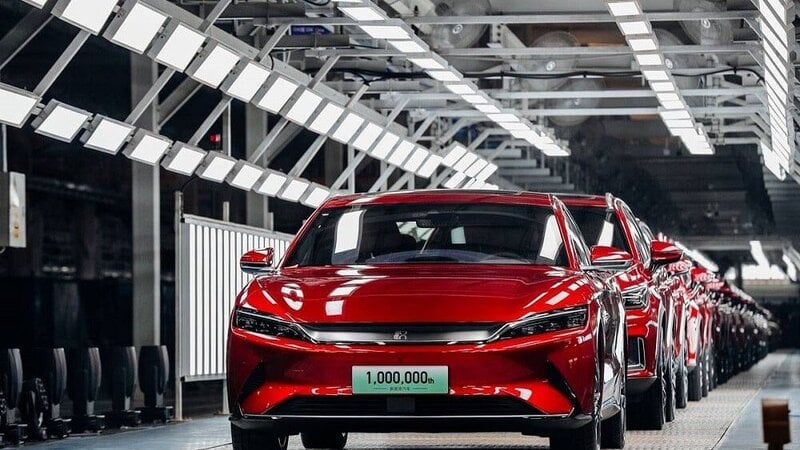
Those forecasts, though, did not account for BYD’s plans. The Chinese giant, one of the world’s leading electric-vehicle makers, announced through executive vice president Stella Li that its first vehicle with a solid-state battery will arrive as early as 2027.
An announcement with many open questions
The announcement, made in mid-September in an interview with the Spanish website Carwow, caused a stir, but little is clear so far. BYD has not revealed which model will carry the new battery, nor its capacity, range, power or charging times.
There is also no precise timeline for mass production. According to information circulated so far, the 2027 vehicle will be a demonstration model, designed to test the technology in real-world conditions rather than to serve the mass market: reports point to a few thousand high-end units, while large-scale production is not expected before 2030.
BYD’s battery track record
BYD has a major advantage over its direct competitors: it was founded in 1995 as a maker of rechargeable batteries and only later moved into cars. That path has allowed it to control much of the supply chain, from raw materials to the assembly of batteries into vehicles.
That structure gave rise to the Blade battery, based on LFP (lithium iron phosphate) technology and known above all for its high safety and for how efficiently it uses space inside the battery pack.
The new solid-state cells, which use a sulfide-based electrolyte, aim much higher. BYD is targeting a cell density of 400 Wh/kg (watt-hours per kilogram), more than double that of the Blade batteries currently in mass production. Early tests are encouraging: according to measurements by CATARC (China Automotive Technology and Research Center), a prototype equipped with solid-state batteries reached 1,218 km (about 757 miles) of range on the CLTC cycle (China Light-Duty Vehicle Test Cycle), a record in China for this technology.
The challenge of large-scale production
The real contest for BYD will be played out on the factory floor. A 2 GWh pilot line has been operating since February in Pingshan, in its home city of Shenzhen. Construction of a 20 GWh plant in the Bishan district of Chongqing is expected to begin in the third quarter of 2026, while the first demonstration batches of batteries are expected in 2027, coinciding with the vehicle’s road debut.
That schedule shows that at BYD, research, production and commercial strategy are moving forward in step.
Pending official confirmation, the most widely held view is that the new cells will debut on the group’s most expensive models, with the luxury brand Yangwang the leading candidate to bring them to the road.
Editor’s note
This article was originally published in Italian on money.it by Andrea Fabbri on September 29, 2026 as «BYD, è ufficiale. Nel 2027 lancerà la sua prima auto elettrica con batteria a stato solido». It has been translated and adapted for an international audience by the Money.it International desk.