Two days before the measures were due to bite, Donald Trump stopped everything. On Friday, October 16, the US president signed an executive order suspending, in the «national interest», the sanctions and tariffs set out in the Lindsey O. Graham Sanctioning Russia and Iran Act of 2026. The law is named after Senator Lindsey Graham, who died in July, and had cleared Congress with wide majorities: 86 to 11 in the Senate, 262 to 159 in the House. Trump signed it into law on September 18.
The waiver covers every operative section dealing with Moscow, including tariffs of up to 500% on all Russian goods and tariffs of up to 100% on the five largest buyers of Russian crude and gas, China and India foremost among them. Sanctions already imposed under earlier executive orders remain in force. The measure has no fixed expiry date, and it is the second move toward Moscow in two weeks, after the agreement that allows Russia to sell diesel on international markets.
Oil prices react, but only barely
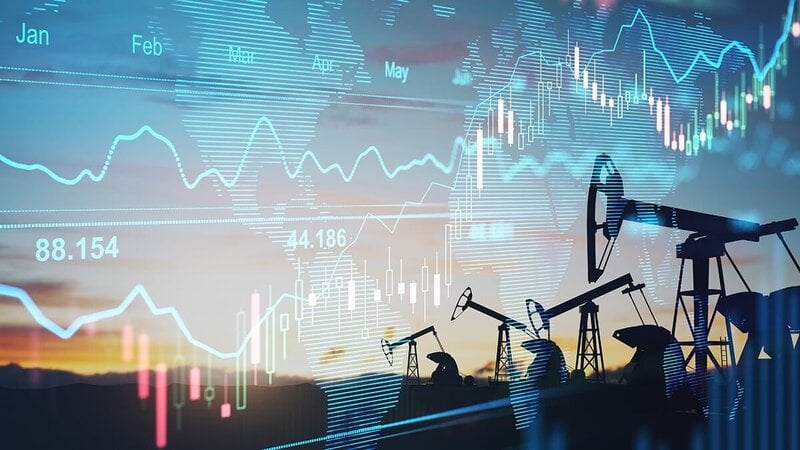
There was an effect on the barrel, but a contained one. Brent closed Friday at $109.86, a five-month high. At 8:11 a.m. Italian time on Monday it was down 1.83% at $107.8, while WTI (West Texas Intermediate, the US benchmark) slipped below $100, to $99.91. In the afternoon the European benchmark recovered part of the lost ground: at around 3:40 p.m. it was quoted at $108.63, down 1.12% from Friday’s close.
That decline has to be measured against the wider picture, because even after it Brent is still up more than 6% over a month and roughly 75% over twelve months.
Why the waiver matters less than it looks
The White House decision removes the most immediate risk to flows, namely secondary sanctions on buyers of Russian oil. But it puts no new supply into circulation. The Russian barrels heading to Asia will keep heading there, exactly as before.
Then there is the question of how durable the measure is. Secretary of State Marco Rubio said Trump will take up to 60 days to weigh sanctions and tariffs. In Congress the decision drew criticism across party lines: several Republicans called it reckless and a gift to Vladimir Putin. Volodymyr Zelensky judged it «wrong» and expects further sanctions to be eased. For anyone buying and storing crude, an authorization that can be revisited is worth far less than a structural increase in supply.
Hormuz is still setting the price
At this stage, the level of the barrel is being decided in the Gulf. Since late February, Iran has controlled the Strait of Hormuz, through which roughly a fifth of the world’s oil passed before the war. The United States responded with a naval counter-blockade on Iranian exports.
Over the weekend, incidents multiplied. On Saturday the Pasdaran, Iran’s Revolutionary Guards, said two tankers carrying around two million barrels each had caught fire after striking mines. The report was not independently confirmed. On Monday, Tehran announced a third episode: a tanker ablaze after hitting a mine south of the Strait. On Sunday, October 11, six ships had already been attacked in a single day, the highest number since the conflict began.
As long as the physical risk stays at this level, any relief on price is limited and easily reversed. It takes only one more vessel hit, or a fresh jump in insurance premiums.
What changes at the pump
For Italian drivers, for now, nothing. According to the price observatory run by Mimit (Italy’s Ministry of Enterprise and Made in Italy), on October 19 the average self-service price on the ordinary road network was €2.029 a liter for gasoline, or about $8.30 a gallon, and €2.257 for diesel, unchanged from the day before. On the motorway network, those figures rise to €2.048 and €2.297.
Diesel costs almost 23 cents more than gasoline. The gap reflects the scarcity of distillates on international markets rather than the price of crude alone. On top of that, diesel is carrying the end of the excise-duty discount.
Editor’s note
This article was originally published in Italian on money.it by Ufficio Studi Money.it (Money.it Research Desk) on October 19, 2026 as «Petrolio, Trump congela le sanzioni sulla Russia ma il Brent resta sopra 108 dollari. Perché il calo è così limitato?». It has been translated and adapted for an international audience by the Money.it International desk.