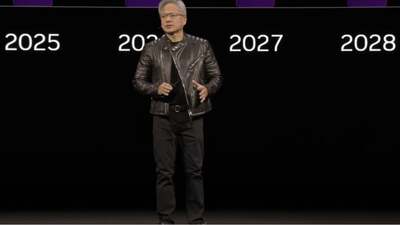
Nvidia reported revenue of $115.844 billion for its fiscal third quarter, more than double a year earlier, and raised its growth forecast for the next fiscal year. The results, published on the evening of November 17, were the first since founder Jensen Huang resigned as chief executive on November 12.
The numbers would normally be the whole story. Instead, Wall Street is focused on who replaces Huang after a departure that pushed the stock to within a few dollars of its 12-month low.
Fiscal third-quarter 2027 numbers
In the quarter ended October 25, 2026, revenue rose 103% from $57 billion a year earlier and 20% from the previous quarter. The LSEG consensus called for $109.1 billion, so Nvidia beat it by about 6.2%.
The gap on earnings was wider. Adjusted earnings per share came in at $2.68 against the $2.48 analysts expected. The GAAP figure was $2.70.
Reported net income climbed to $65.287 billion, up 105% from $31.91 billion. Gross margin was 74.8% on a GAAP basis and 74.9% adjusted, a touch below the 75% posted over the summer. Free cash flow reached $43.777 billion, more than twice the $21.341 billion of the previous quarter.
Data centers and Vera Rubin drive growth
Data centers accounted for $107.6 billion of the total, up 21% on the quarter and 110% on the year. The driver is Vera Rubin NVL72, which Nvidia calls the fastest platform it has ever brought into production. It is already running at CoreWeave, Google Cloud, Microsoft Azure, Oracle Cloud Infrastructure and Nebius.
The company disclosed one telling detail on the conference call. Revenue from neoclouds, sovereign AI and industrial customers nearly tripled, up about 195%, far outpacing the roughly 71% growth from the large hyperscalers.
The remaining $8.2 billion came from Edge Computing, which bundles PCs, gaming, automotive, robotics and telecommunications. That segment grew 14% on the quarter and 42% on the year. Alongside the results, Nvidia announced an agreement to acquire Hugging Face. The deal has yet to close.
Guidance above expectations
Nvidia guided to revenue of $130 billion in the fiscal fourth quarter, give or take 3%, against market expectations of roughly $125 billion. The figure assumes no revenue at all from data center compute chips sold in China. The current quarter also has one extra week, which inflates the comparison.
On the call, interim chief executive Colette Kress raised the revenue growth expected for fiscal 2028 to roughly 75% from a previous 70%, while noting that the new target starts from a higher base. Considerably higher: add the $293.7 billion booked in the first nine months to the midpoint of guidance and the current fiscal year closes at about $423.7 billion. A 75% increase would take Nvidia beyond $740 billion.
Margins slipping, financial commitments and China
The margins are the flip side. Nvidia expects a gross margin of between 71% and 72% in the fourth quarter, 2.9 to 3.9 points below the 74.9% just reported, with adjusted operating expenses rising to about $10.7 billion from $8.8 billion in the third quarter. The release does not explain the drop, which comes as supply chain costs face heavy pressure.
Financial commitments are what the market is watching most closely. Kress cited $390 billion in purchase commitments, a figure Wells Fargo calculates rose by $111 billion in a single quarter and which relates mainly to multi-year memory contracts. On top of that sit more than $100 billion of commitments on data centers and cloud and $118 billion of guarantees.
Kress told investors that every new investment, commitment or guarantee will be assessed rigorously and that capital allocation will stay disciplined. The promise carries weight for a company that has become, in recent months, something of a financial backstop for part of the artificial intelligence ecosystem.
In China, the current quarter’s estimates exclude the data center market entirely. On November 17 the board created a committee for national security and export controls, to which the teams handling trade compliance will report.
The leadership question after Huang’s resignation
The board announced on November 12 that Huang was stepping down with immediate effect as chief executive and leaving his board seat, following press reports about extramarital relationships. One reportedly involves Alice Huang, a former executive at Singapore data center company Megaspeed, whom several sources have identified as a possible Chinese intelligence asset. The board had opened an independent investigation four days before the resignation. Megaspeed, which is under inquiry by the US Justice and Commerce Departments, denies all wrongdoing, and none of the allegations has so far been substantiated.
Huang admitted to “serious mistakes” in his private life and said he would be willing to return if the board considered it useful to shareholders. The answer was blunt. Harvey Jones, named on November 12 as the first chairman in the company’s history, opened the conference call by saying the board “does not intend” to reinstate him and that the search for a new chief executive will look both inside and outside the company.
Both roles stay with Kress for now. The company’s chief financial officer for thirteen years, she assured investors of continuity, with the product roadmap on schedule and commercial momentum that, in her words, remains intact.
How the stock reacted
Nvidia closed the November 17 Nasdaq session at $155.46, down 0.44% and not far from its 52-week low of $148.80. The stock shed 12.75% in the week of Huang’s resignation alone. Since the start of November it has fallen close to 24%, and it sits more than 36% below the all-time intraday high of $243.67 reached on October 6. Market capitalization has dropped below $4 trillion.
After the results, the stock rose nearly 5% in after-hours trading to around $163, still well short of the levels before the leadership change was announced. The same day, the Muddy Waters fund disclosed a short position.
What analysts see ahead for the stock
Brokers had begun adjusting course even before the results. Bernstein downgraded the stock to Market Perform and halved its price target from $400 to $200. Mizuho went from $315 to $250, and Craig-Hallum cut to Hold with a $180 target.
The revisions continued after the quarterly report, including from those who remain positive. Morgan Stanley reaffirmed Overweight but moved from $267 to $260. Wells Fargo cut from $300 to $250, citing the weight of supplier commitments. Piper Sandler came down to $230 from $300 on uncertainty over the succession.
The average view is still optimistic. On the eve of the results, the average price target among the 53 analysts covering the stock was $258.09, roughly 66% above the November 17 close. After the slide of recent weeks the shares trade at less than 18 times expected earnings, a modest multiple for a company growing at triple digits.
Until the board names Huang’s successor, though, the stock will probably keep moving on news from the top rather than on the numbers, however good they are.
| DISCLAIMER The information and views contained in this article should not be used as the sole or principal basis for making investment decisions. The reader retains full freedom in his or her own investment choices and full responsibility for making them, since he or she alone knows his or her risk tolerance and time horizon. The information contained in the article is provided for informational purposes only and its publication does not constitute and is not to be considered an offer or solicitation to the public to invest. |
Editor’s note
This article was originally published in Italian on money.it by Flavia Provenzani on November 18, 2026 as «Nvidia, ricavi a 115,8 miliardi e stime alzate. Quali prospettive per il titolo dopo l’addio di Huang?». It has been translated and adapted for an international audience by the Money.it International desk.