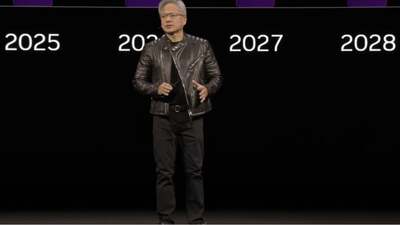
Jensen Huang resigned from Nvidia on Thursday, November 12, 2026, and the shock has spread well beyond the chipmaker’s own shares. CoreWeave fell nearly 12% in the same session. Palantir is down roughly 18% over the past month.
What markets have yet to price is how far the damage travels among the companies that built part of their financial model on Nvidia.
When the face of a technological revolution leaves the company supplying its engine, investors reread every tie to that company as a weak point. For anyone who bought into AI expecting a long-term trend, the question for the next few weeks is simple: how much does each holding actually depend on Nvidia?
Why a founder’s exit weighs more than an ordinary change at the top
Huang’s departure is a textbook case of key-man risk. Strategic vision and relationships sat with one person, and no org chart fills that void.
Huang personally stitched together partnerships and direct investments across the AI supply chain. That network is how the risk escapes Nvidia and reaches other companies.
The firms closest to the departing founder’s ecosystem usually pay first, with multiples compressed on day one. The sorting comes later, when the market starts examining how much of each company’s growth rests on that privileged relationship.
CoreWeave: a record backlog is not enough
The clearest case is CoreWeave, the Nasdaq-listed AI cloud provider. Revenue grew 168% year over year in the third quarter of 2026, to $3.66 billion, and the order backlog reached $132.5 billion. At another moment those numbers would have set off euphoria. Instead the stock lost nearly 12% on the day Huang quit.
Nvidia sells GPUs to CoreWeave, is one of its main shareholders and has contractually committed to buying up unused computing capacity.
CoreWeave expects capital spending of $37 billion to $39 billion in 2026, carries a heavy debt load and is not forecast to turn a net profit before the first half of 2028. If Nvidia’s support were to look lukewarm, even only in the market’s eyes, financing that growth would get harder than the quarter’s results suggest.
Palantir: results are racing, but the multiple is falling
Palantir has lost roughly 18% over the past month, even after nearly doubling quarterly revenue to $2.31 billion and raising full-year guidance to $8.53 billion. The market is paying less for every dollar of growth. When uncertainty rises, institutional investors cut valuations on growth stocks first, sound fundamentals included.
Then there is Washington. The Democrats’ win in the midterm elections flipped Congress, and the $1.5 trillion defense budget proposed by the Trump administration now risks being scaled back.
That spending underpins much of Palantir’s growth outlook in the public sector. A cut could force analysts to revise estimates that prices may not yet have discounted.
Hedging signals on the Nasdaq
The pressure is not confined to individual stocks. Short interest in the QQQ ETF, which tracks the Nasdaq 100 and is heavily weighted toward growth stocks, has climbed to its highest level since 2023, according to JPMorgan data. A growing number of institutional investors are either hedging or betting outright on a sector decline.
What to watch in the coming weeks
Huang’s exit could prove to be one of those junctures where the market stops looking only at growth and starts asking what that growth rests on. For investors trying to protect capital, abandoning the AI theme is not necessarily the answer.
Two indicators are worth tracking over the next few weeks: institutional investor flows, and credit spreads on the debt of the most exposed companies. They may say more than any fundamental analysis about which stocks the market really considers independent of Nvidia.
Editor’s note
This article was originally published in Italian on money.it by Tommaso Scarpellini on November 14, 2026 as «Nvidia dopo Jensen Huang. Quali titoli AI potrebbero pagare il prezzo più alto nei prossimi mesi?». It has been translated and adapted for an international audience by the Money.it International desk.