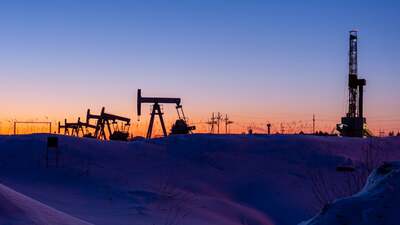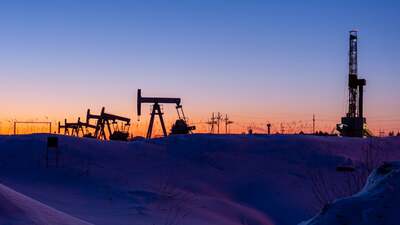
Brent crude traded at around $96.80-$97.00 a barrel in early afternoon trading on Friday, November 13, 2026, up roughly 1% and on course for a third straight session of gains. The North Sea benchmark touched a high of $97.12 after opening below the flatline. Driving the move: Houthi claims of a strike on Saudi oil infrastructure and Donald Trump’s hard line on Iran.
The recovery began from Tuesday’s low on November 10, 2026, the weakest settlement since August at $91.49. Wednesday brought $92.76, then Thursday a 3.3% jump to $95.82.
The Houthis take aim at the Saudi pipeline
The risk premium flared up again after claims by Yemen’s Houthis. On Thursday their military spokesman, Yahya Saree, said the group had struck a pumping station on the East-West pipeline, an oil facility at Yanbu on the Red Sea, and a Saudi Aramco building in Riyadh.
None of it has been confirmed. Riyadh has not commented and no damage has been reported. The Saudi-led coalition said only that it had intercepted and destroyed two drones, one over the Riyadh region and one over the Eastern Province.
The same day in New York, the UN Security Council unanimously renewed sanctions on Yemen for another year, condemning cross-border attacks on Saudi Arabia.
Why the East-West line has become critical
With traffic through the Strait of Hormuz still heavily disrupted by the war, Riyadh has rerouted roughly 4 million barrels a day onto the East-West pipeline, which crosses the Arabian Peninsula to the terminals at Yanbu. That is about 4% of global supply, and it is the valve that has allowed the world’s largest exporter to keep selling without going through the strait.
A real hit on that line would take out one of the few remaining ways out of the Gulf. That is why even an unverified claim moves prices.
On Hormuz, the picture remains murky. Iran’s military says four tankers were hit by explosions after ignoring warnings; the Revolutionary Guards speak of two supertankers. Reuters has been unable to verify either account. UKMTO, the British maritime security agency, later reported a tanker struck by a projectile in the Gulf, with casualties on board.
Trump: “We don’t need a deal with Iran”
On Truth Social, Trump wrote that we don’t need a deal with Iran, those days are long gone, adding that the United States now controls their Strait. The naval blockade and sanctions remain in place.
The message lends itself to two readings. Some infer that the end of the conflict is not near; others see Washington betting on economic pressure rather than a fresh military escalation.
For Sugandha Sachdeva of SS WealthStreet, geopolitical risks remain elevated and any new supply disruption could quickly reignite upward pressure on prices.
What is capping the rally
The rebound is not enough to salvage the week. Brent is still on track for a second consecutive weekly decline, after the previous week’s 16% collapse, when the market began deflating the war risk premium.
The main drag is US inventories. In the week to November 6, 2026, commercial crude stocks rose by 4.7 million barrels to 414.4 million, according to the Energy Information Administration, helped by a jump in imports and weaker fuel demand.
Gulf supply is recovering too. OPEC production rose again in October, driven in part by Saudi Arabia, though it remains below February levels, before the war began.
Not everyone is betting the risk premium will disappear. Goldman Sachs raised its December forecast for Brent earlier this month, precisely because of supply risks.
The technical levels to watch
Brent is holding above its 100- and 200-session moving averages but below the 20- and 50-session lines, both of which sit above $104. With the RSI at 41, the short-term picture remains fragile.
On the upside, the first obstacle is $99.72, the 38.2% Fibonacci retracement, a whisker away from the $100 mark that was already drawing attention earlier this month. Above that sits $102.01.
If prices pull back, the level to defend is $94.07, where the 200-session moving average meets the 50% retracement. Below that, $91.46 and $90.01 remain in play, the zone of Tuesday’s lows.
| DISCLAIMER The information and considerations contained in this article should not be used as the sole or primary basis for making investment decisions. Readers retain full freedom in their own investment choices and full responsibility for making them, since only they know their own risk tolerance and time horizon. The information in this article is provided for informational purposes only, and its publication does not constitute and should not be considered an offer or solicitation of public savings. |
Editor’s note
This article was originally published in Italian on money.it by Ufficio Studi Money.it on November 13, 2026 as «Petrolio, perché il Brent sale oggi: i droni Houthi sull’oleodotto saudita e la linea dura di Trump». It has been translated and adapted for an international audience by the Money.it International desk.