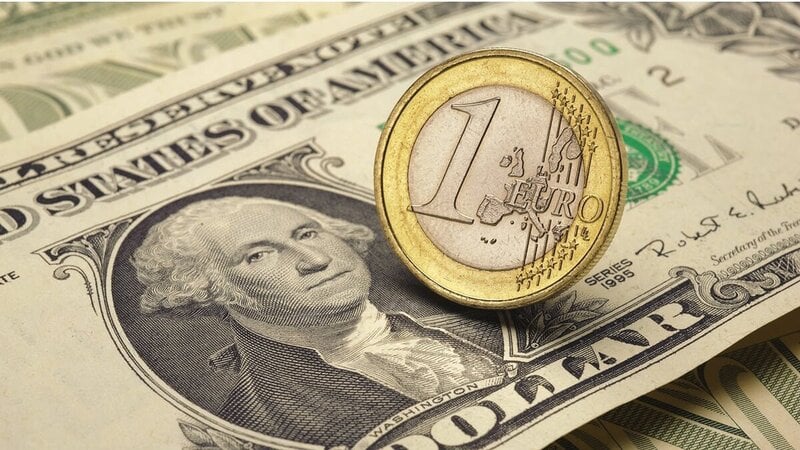
Anyone waiting for the euro’s comeback will have to be patient a while longer, perhaps for many months. Deutsche Bank now sees the single currency at 1.15 dollars at the end of 2027, against 1.0967 on Friday, November 20, 2026, and it set the tone for the 2027 forecasts by raising its estimates on the US currency and using a word rarely found in strategists’ reports, “exceptional.” The outlooks published in recent weeks by the big investment banks agree on at least one point. The greenback still has breath left, even if almost no one believes it can run forever.
At 10:27 a.m. Italian time on November 20, the euro was worth 1.0967 dollars, its lowest level in 52 weeks and down 5.22% from a year earlier. The single currency started the year above 1.20 and has shed roughly 9% in less than ten months. That is the starting point for every forecast below.
The “AI dollar,” according to Deutsche Bank
In a note released on Wednesday, November 18, 2026, Deutsche Bank strategists, among them Tim Baker and George Saravelos, start from artificial intelligence. The investment boom in the sector has pushed US real rates higher and drawn a mountain of capital into the United States, headed for the stock market. The “AI dollar,” for the German bank, is therefore “alive and well.”
The new estimates assume a dollar that is “strong for a long time,” a scenario the analysts themselves call highly unusual, since exchange rates normally revert toward their historical average.
Frankfurt expects the dollar to gain more ground in the first half of 2027, then lose some momentum in the second half without really giving way. The target is a euro at 1.15 dollars by the end of 2027 and a dollar/yen rate of 145. Deutsche Bank concedes that the greenback is expensive, having traded more than 20% above its average for four years, but says a real fall will have to wait until the end of next year.
Raising the dollar estimates does not mean forecasting further strengthening from here. Deutsche Bank revised them against its own earlier forecasts, and with the euro below 1.10, reaching 1.15 would mean a gain of about 4.9% for the single currency in little more than a year. Twelve months ago the same bank saw the euro at 1.25 by the end of 2026, driven by a European recovery with Germany leading the way. The exchange rate now sits more than 15 cents lower.
Among the risks, the strategists put US twin deficits first, the budget deficit and the current account deficit. Politics also weighs, after the Democrats won both the House and the Senate in the November 3 midterm elections. A hostile Congress could slow Donald Trump’s domestic agenda and push him, according to the bank, toward “foreign policy adventurism,” while a return to tariffs would end up weighing on the dollar.
Goldman Sachs and Morgan Stanley on different paths
The two Wall Street giants presented their 2027 outlooks a few days apart. Starting from similar data, they arrived at nearly opposite conclusions.
The Goldman Sachs currency team, led by Kamakshya Trivedi and Michael Cahill, expects a few more months of a strong dollar, above all against the euro, before the turn. It sees the single currency at 1.08 in three months and at 1.15 in twelve, roughly at the end of 2027. In the short term the dollar stays supported by a strong US economy, by inflation that is struggling to come down and by an uncertain political climate. Over the course of the year those supports should fade, with inflation slowing, AI investment less impetuous and the US rate advantage ever thinner. An easing of tensions over European sovereign debt would help the euro too.
Morgan Stanley is far less optimistic on the single currency. Its global outlook for 2027 forecasts a moderately higher dollar, with the DXY index at 105 in the fourth quarter, and a euro sliding to 1.08 as the French presidential election approaches and the risk premium rises. The change of stance began in late September, when the team led by David Adams admitted it had been wrong to bet on a weaker dollar in the second half of 2026.
ING, Bank of America and the rest of the market
ING sits roughly halfway between the two. In its November 12 outlook, Chris Turner and Francesco Pesole see the rate boxed between 1.10 and 1.15 for four or five months and then recovering gradually: 1.13 both at the end of 2026 and at the end of March 2027, 1.16 in June, 1.17 in September and 1.18 in December 2027. The Dutch bank expects the Fed to stay restrictive at least through the first quarter, with a 25-basis-point hike in December, and to ease only toward the end of 2027, once US inflation has turned the corner. From the ECB it expects one last adjustment, to 2.75%, also in December.
Several banks are more optimistic on the euro. Bank of America sees it at 1.20 at the end of 2027, MUFG at 1.18 in the third quarter and UBS at 1.20 as early as June. In October the Swiss analysts judged the pessimism on Europe overdone and bets on the dollar too crowded, to the point that they could deflate quickly. Westpac goes as far as 1.21 for December 2027 and Commerzbank stops at 1.18. Nordea does not rule out that the euro tests 1.08 again in the first half of next year before any recovery.
The Reuters poll conducted between October 30 and November 3 among 66 forecasters points to a median of 1.13 at three months, 1.14 at six months and 1.16 at one year. The euro was still around 1.12 at the time, before its latest slide, and 17 of the 30 strategists who answered an additional question thought a dollar stronger than their three-month estimates was more likely than a weaker one.
What could move the exchange rate in 2027
Much will depend on the central banks. Its September tightening brought the Fed’s rates to between 3.75% and 4%, while the ECB raised the deposit rate twice over the course of 2026, to 2.50%. Both meet in December, the Fed on the 8th and 9th and the ECB on the 17th. Frankfurt also faces the choice of Christine Lagarde’s successor, expected by February.
Energy matters too. Since the war in Iran broke out at the end of February, oil has weighed on the euro more than almost any other factor, because Europe imports most of the energy it consumes and every rise in crude widens the bill. ING puts a fresh flare-up in energy prices among the main risks for the single currency.
Then there is France, with S&P due to update the country’s rating on November 27 and the presidential election scheduled for the spring of 2027. This is where Morgan Stanley and Goldman Sachs diverge, the former seeing the risk premium rise and the latter expecting an easing of tensions over European debt.
Artificial intelligence can also work against the dollar. On October 30, Saravelos himself warned that if a correction in AI-linked stocks were to start in the United States, the dollar could stop acting as a safe haven. Foreign investors hold more than 20 trillion dollars of US equities, largely without currency hedging, and to protect themselves they would have to sell dollars. The November 20 session, when European stock markets fell precisely because of concerns over AI investment, shows how live the issue is.
A wide range and the lesson of 2026
Estimates for the end of 2027 run from Morgan Stanley’s 1.08 to Westpac’s 1.21, with most clustered between 1.15 and 1.20. Almost everyone expects a still-strong dollar in the first part of the year and a recovering euro later on. Opinions split on when the turn comes and how far it goes.
Exchange-rate forecasts age quickly. At the end of 2025 Deutsche Bank saw the euro at 1.25 by the end of 2026, and it is now below 1.10. In July 2025 Morgan Stanley was aiming for 1.27 by the end of 2027 and today points to 1.08. In between came the war in Iran, a new cycle of rate hikes in the United States and the return of political risk in Europe. Anyone holding dollar instruments without currency hedging has seen euro-denominated returns inflated this year by the greenback’s strength. If the exchange rate turns in the second half of 2027, that tailwind becomes a drag.
| DISCLAIMER The information and considerations contained in this article should not be used as the sole or primary basis for making investment decisions. The reader retains full freedom in their own investment choices and full responsibility for making them, since only the reader knows their own risk tolerance and time horizon. The information contained in the article is provided for informational purposes only, and its publication does not constitute and is not to be considered an offer or solicitation of public savings. |
Editor’s note
This article was originally published in Italian on money.it by Flavia Provenzani on November 22, 2026 as «Cambio euro dollaro, quali previsioni per il 2026? Le opinioni degli analisti, spiegate». It has been translated and adapted for an international audience by the Money.it International desk.