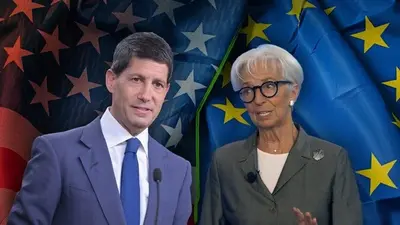
The foreign exchange market is barely moving, but it is doing so after a week that changed the tone around the dollar. The Dollar Index, which measures the greenback against a basket of currencies, closed last week lower, breaking a run of four consecutive gains, and currently stands at 101.83. The euro trades at $1.1225 (-0.1%), the dollar is worth about 158 yen, and sterling is holding above $1.33.
Warsh declines to pre-commit the Fed
The turning point was a single appearance. On Friday, October 16, in Bangkok, during the annual meetings of the International Monetary Fund (IMF) and the World Bank, Federal Reserve Chair Kevin Warsh avoided indicating what the central bank will do at its October 27-28 meeting. According to Reuters’ account, he recalled that the Fed raised rates in September and that on that occasion «we made clear that we would deliver price stability», but added that he does not «pre-commit» to meetings and does not believe in saying now what he will do later in the year.
On September 16 the Federal Open Market Committee (FOMC) lifted the policy rate to 3.75%-4.00% on a 12-0 vote, writing that «inflation remains elevated». After the mid-October price data, markets had begun betting on a second hike as soon as the end of the month, with the probability climbing toward 28%. After Warsh’s comments, according to FXStreet, that probability fell to roughly 16%; as of Monday, October 19, the CME’s FedWatch tool puts the odds of the Fed standing pat on October 28 at 84%, essentially unchanged from Friday. The bet has shifted further out: a December hike is priced at close to 90%.
The number matters more for direction than for level. A dollar that had been running on expectations of a more aggressive Fed lost part of that support the moment the chair declined to confirm it. This is not a change of strategy at the central bank, but an uncertainty the market translated into a smaller premium for the dollar.
The ECB a day later, and a euro held back by Paris
On the other side of the Atlantic the picture is a mirror image. The European Central Bank has held its deposit rate at 2.5% since September 10, according to data reported by FXStreet, and for the October 29 meeting the market expects a pause, with a hike in December. The Fed and the ECB will therefore decide twenty-four hours apart, and the euro/dollar rate will depend on the comparison between the two trajectories more than on either one taken alone.
Complicating the read for the euro is France. Weekend protests over the cost of living, which turned violent, weighed on the single currency at the Asian open. According to Kieran Williams, head of Asia FX at InTouch Capital Markets, quoted by Reuters, «the weekend unrest matters for the euro mainly through French government bonds, rather than directly». The same analyst expects positioning to stay light ahead of the two central banks and headline risk out of France to remain high.
Yen and yuan send two different signals
Against the yen, the dollar is steady around 158. Bank of Japan Governor Kazuo Ueda said core inflation is «quite close» to the 2% target, a signal that keeps the door open to further Japanese rate increases.
On the yuan, the offshore rate is at 6.6842 per dollar, ahead of China’s third-quarter GDP figure, which according to early indications grew 4.5% year over year against the 4.4% expected.
Why it matters
For an investor based outside the United States — and in the euro area above all — the exchange rate that counts is the one between the euro and the dollar. A weaker greenback reduces, in euro terms, the return on unhedged dollar assets, from US stocks to ETFs tracking US indexes; a stronger dollar does the opposite and makes European purchases denominated in US currency more expensive, starting with energy. For a US-based investor the mechanics run the other way: a softer dollar flatters overseas revenue and foreign holdings, and raises the cost of imports.
With the Fed and the ECB meeting so close together, the exchange rate over the coming days will hinge on the data and on comments from European central bankers: from the Saturday preceding the October 28 decision, Fed officials do not speak in public (the Fed’s self-imposed blackout period ahead of a policy meeting).
Editor’s note
This article was originally published in Italian on money.it by Ufficio Studi Money.it on October 19, 2026 as «Il dollaro interrompe quattro settimane di rialzi dopo Warsh. La partita di ottobre si gioca tra Fed e BCE a 24 ore di distanza». It has been translated and adapted for an international audience by the Money.it International desk.