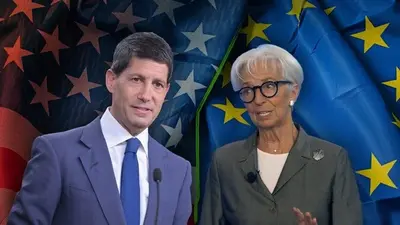

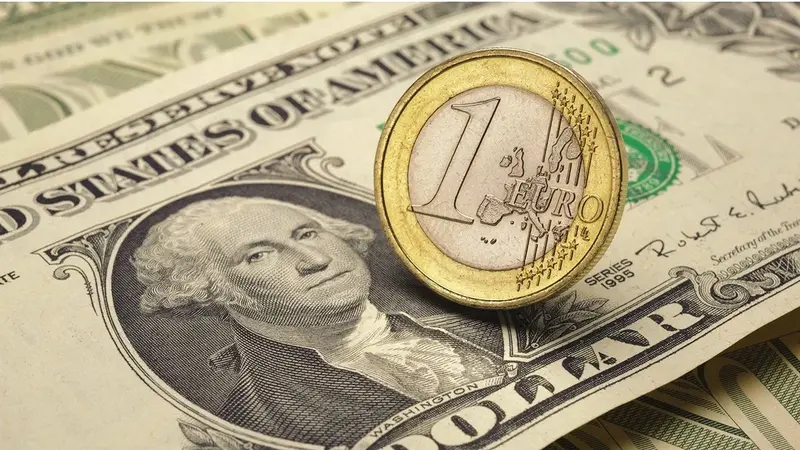
How much further can the euro slide against the dollar after the latest wave of selling pushed EUR/USD to its lowest level in more than a year?
The pair extended losses again today, trading below the $1.14 threshold at around $1.1350, as investors turned their focus to the ECB’s annual Sintra forum in Portugal.
Pressure on the single currency intensified after fresh macro data confirmed softer inflation readings across Germany, France and Italy in June, while Spain continued to report inflation near two-year highs.
The euro is now on track to close June down more than 2% against the dollar, bringing its total decline for Q2 2026 to roughly 1.3%.
Market sentiment remains decisively bearish on the common currency. Among the most notable calls, JPMorgan Global Research recently upgraded its U.S. dollar outlook while turning increasingly negative on the euro.
What, then, is driving the latest EUR/USD downside move, and how far could it go? Money.it gathered views from professionals who closely monitor the real-world impact of currency fluctuations on businesses, investment decisions and operating costs.
EUR/USD under pressure as rates differential widens
One of the clearest bearish arguments came from David Fesman, senior executive at Medmart, who follows supply-chain dynamics and the impact of FX movements on production and shipping costs.
According to Fesman, “the pair EUR/USD is currently signaling a fundamental rebalancing of the economy instead of a short-term change in the markets”.
Fesman observed that “global import pricing models are changing to prepare for a possible $1.1000 level in the currency pair in the coming 8 months, as it happens” adding that “heavy equipment with shipping containers that cost $4000 are now closer to the $4500 mark because of the greenback’s strengthening”.
The core issue remains the widening interest-rate gap between the euro area and the United States.
Markets increasingly expect a more restrictive monetary stance under Fed Chair Kevin Warsh, while the ECB appears constrained by slowing growth dynamics:
“Widening interest rate differentials are expected to keep the euro structurally weak over the next 12 months. European central banks are cutting borrowing costs close to 2.0 percent to stave off domestic sluggishness, while yields in America stay pegged at a much higher level. The difference of 250 basis points encourages wealth managers around the world to keep their assets in America rather than Europe. The gap in exchanges will be confirmed by domestic inflation rates and regulatory changes in shipping fees in the long run”.
That view broadly aligns with JPMorgan’s latest FX outlook. In mid-June, the Wall Street bank revised its dollar forecasts higher, citing the market’s repricing of U.S. rate expectations and the continued resilience of the American labor market.
JPMorgan also highlighted the prospect of a wider euro-U.S. rate differential, describing the Fed’s current stance as increasingly hawkish.
As a result, the bank now expects EUR/USD to trade in a 1.13-1.15 range over the next three quarters — a substantial downgrade from its previous $1.20 target.
Why some analysts believe the euro will remain weak through 2026
Another bearish assessment came from Yad Senapathy, founder and CEO of Project Management Training Institute (PMTI), who has spent more than two decades advising organizations including Amazon, General Dynamics and the U.S. Air Force.
Senapathy argued that his EUR/USD outlook is shaped by observing how exchange-rate volatility directly impacts corporate budgeting, staffing decisions and project execution.
“I am not surprised by the EUR/USD reaching its lowest point since August 2025 at 1.14 because the conditions leading up to this drop have existed for quite some time and the data shows that we are here for a good reason”.
In his view, the ECB’s June 2026 rate hike was primarily driven by concerns over inflation risks linked to Middle East tensions, but markets are already pricing in fewer future ECB hikes:
“The ECB made the decision to raise rates in June 2026 primarily because they are concerned about potential inflation due to the Middle East situation and I believe that the market has already priced in fewer ECB rate increases moving forward. This shift in expectations is what is currently pressuring the euro lower and not necessarily because of the rate increase itself”.
Germany, meanwhile, remains a major source of concern.
“I see Germany as being an area of much interest to me. According to the latest reports, German industrial output has declined by 2.8% on a year over year basis (through March 2026) and has experienced four consecutive months of negative growth”.
The result is that “market participants are not making aggressive bets on potential ECB responses, limiting the ability of euro-denominated capital to flow into Germany”.
His conclusion is straightforward: the euro is likely to remain weak throughout 2026 because the ECB is effectively trapped between inflation management and growth stabilization, limiting its ability to act decisively in either direction.
Bank of America cuts EUR/USD forecasts
Another major institution turning more cautious on the euro is Bank of America, whose research division recently lowered its EUR/USD projections while adopting a more constructive short-term stance on the U.S. dollar.
Like JPMorgan, BofA pointed to resilient U.S. macroeconomic data and a more hawkish Federal Reserve as key drivers supporting the greenback.
The bank now expects EUR/USD to end Q3 2026 at 1.12 before recovering modestly toward 1.15 by year-end — both figures below its previous forecasts.
According to BofA, FX markets are increasingly being shaped by two key themes: evolving U.S.-Iran geopolitical dynamics and expectations surrounding monetary policy under Fed Chair Kevin Warsh.
The bank expects additional Fed tightening risks to continue pressuring the euro throughout the summer.
At the same time, BofA believes the divergence between U.S. and euro-area GDP growth will likely peak in the coming months before the eurozone stabilizes later in the year, supported by German fiscal stimulus and lower energy prices. Only then could the euro’s decline begin to slow.
Sintra focus: ECB rhetoric remains cautious
For now, however, the euro remains under pressure not only because of softer inflation prints — which in several cases came in below expectations, easing fears of runaway price growth — but also because of the cautious tone emerging from the ECB’s Sintra forum.
Particular attention has been paid to comments from ECB hawk Joachim Nagel, long considered one of the strongest advocates of tighter monetary policy.
Speaking to CNBC, Nagel said that “we now have to wait; the situation remains highly opaque”.
Even one of the ECB’s most hawkish voices appears reluctant to fully commit to additional tightening in the near term.
That said, Nagel also warned that “the energy price shock is still present in the system,” suggesting the inflation battle may not yet be over.
Still, markets are increasingly beginning to price in the possibility that the ECB could pause after June’s rate hike — the first increase since September 2023.