

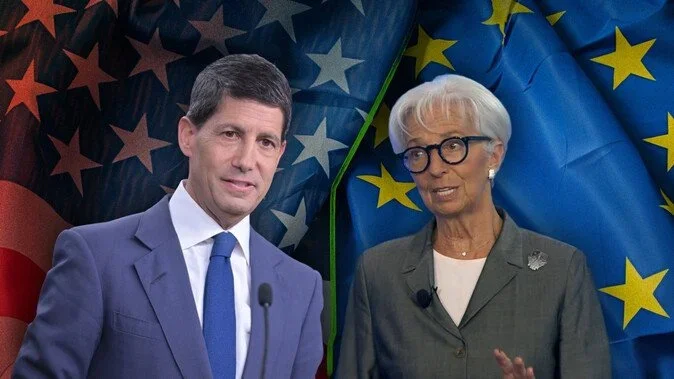
The euro-dollar exchange rate is one of the most closely watched financial assets right now, with the upcoming monetary policy meetings of the European Central Bank and the Federal Reserve in focus.
Several experts interviewed by Money.it shared their EUR/USD forecasts, providing their targets for the exchange rate through the end of the year.
With the ECB monetary policy meeting just days away, on Thursday, September 10, 2026, EUR/USD is currently trading slightly above 1.1621.
EUR/USD: Euro-Dollar Moves Ahead of Fed and ECB Rate Decisions
One important point to make at the outset is that, beyond expectations for the path of interest rates in the euro area and the U.S., EUR/USD performance in recent weeks has also been influenced by the battle against the bond vigilantes launched by the U.S. Treasury Secretary Scott Bessent.
On August 20, 2026, Bessent opened the door to the possibility that the U.S. Treasury’s buyback program for Treasurys could exceed the previously announced $4 billion cap.
The series of announcements from Washington immediately weighed on the U.S. dollar, sending EUR/USD higher during the August 21 session to an intraday high of $1.1711, its highest level since May 14, or roughly three months.
The dollar subsequently recovered after comments from Federal Reserve Chair Kevin Warsh at the Jackson Hole symposium prompted markets to price in a greater probability of another U.S. rate hike at the September 15-16 meeting, supporting the greenback.
The rebound was not enough, however, to prevent the dollar from posting a negative monthly performance in August.
The Bloomberg Dollar Spot Index fell 0.9%, marking its second consecutive monthly decline after a 1.3% drop in July.
EUR/USD Forecast: Money.it Interviews Monex USA’s Juan Perez
So where does EUR/USD go from here?
In the near term, the exchange rate will undoubtedly be driven by monetary policy decisions from the Federal Reserve and the ECB.
The key issue is that both central banks now appear to be heading toward further rate hikes.
As a result, EUR/USD may not experience particularly large swings and could instead trade within a relatively narrow range.
One of the key views comes from Juan G. Perez, Senior Director of Trading at Monex USA, a foreign exchange strategist and market commentator who works closely with corporate clients on currency markets and FX risk.
He was also ranked Bloomberg’s #1 Overall G10 FX Forecaster for Q2 2026.
In an interview with Money.it, Perez highlighted the importance of central-bank communication, noting that, “when it comes to the Fed, there is a ton more volatility to their decision, the voting, as well as the press conference remarks”, in a situation where Fed Chair Kevin Warsh is facing “significantly more pressure than his Eurozone counterpart Christine Lagarde”.
While Lagarde “has established herself as a beacon of confidence, the former is under immense scrutiny”, he added, explaining that “Wall Street, as well as economic analysts, have not been satisfied with the lack of clarity as well as details about guidance when it comes to his style of communication”.
Warsh Uncertainty Could Keep the Euro More Resilient Against the Dollar
Perez stated that “although the Jackson Hole Symposium was a good opportunity he took advantage of to establish more sternly that interest-rate hikes will indeed be considered as the ’dominant tool’ to combat stubborn advancement of prices, some doubts remain of the Fed’s ability to rein in inflation”.
As a result, “we believe that the Euro has a chance to be steadier, while it may only have limited gains from the ECB’s already priced-in increment of borrowing costs”, since the “odds of a 25-basis-point increase are basically guaranteed currently at 99.0%”.
Having said that, “the tone in which both head officials address questions from the media will be crucial”.
EUR/USD: Warsh’s Tone Matters, but Watch the Russia-Ukraine War
As for Warsh, “it will be very important if he signals ’hawkishness’, something that could be achieved if a hike by December is considered very likely”, Perez said.
At the same time, “with armed conflict and historically high yields on global treasury bonds distracting traders and being the main focus for investors, the effects on FX moves could play out to be as mild as they were in August”.
So Perez is “primarily watching for breakthroughs in the FX intervention and war fronts, with potential for Ukraine and Russia to get to a negotiation table for possible peace”.
A peace deal would clearly be positive for the euro.
The evolution of the energy crisis will also be an important factor in determining the euro’s trajectory, according to Perez.
Investors should therefore monitor both GDP growth and inflation data. This is particularly true at a time when, “while Q2 averaged 1.0% growth, we feel any progress above that figure will translate into a major gain for euro value,” and “the idea that inflation may keep going could also, more gradually, keep the ’shared currency’ buoyant”.
EUR/USD Forecast: Perez Sees $1.17 by Year-End and $1.18 in Early 2027
What is Monex USA’s EUR/USD target?
Perez pointed out that Monex USA was ranked as the most accurate currency forecaster in Bloomberg’s FX rankings:
“We have been fortunate enough to be one of the most accurate forecasters for EUR/USD according to Bloomberg FX Rankings, thus we are sticking to our guns and calling for 1.1700 to be the average by end of Q4. Jumping ahead a bit, we believe 2027 could start with a spark and hit 1.18000”.
That would represent further upside for EUR/USD, which Perez partly attributes to “the diplomatic efforts that may arrive to put an end to war and its negative consequences”.
He added that “the more integrated both America and Europe remain, the better off Euro will hold its merited value”.
The Senior Director of Trading at Monex USA does not rule out, however, that “a deterioration of the economic situation as well as worsening that prolonging hostilities"could easily drag the euro down from its current levels.
Investors should also pay attention to the risks facing the U.S. dollar.
According to Perez, the greenback “may suffer from a loss of faith in its dominance and how the U.S. can influence others to align with economic and security interests”.
Schroders Sees EUR/USD Falling to $1.10 by End-2026
George Brown, senior economist at Schroders, offers a diametrically different view, at least when it comes to his EUR/USD target.
Brown is more bullish on the U.S. dollar than the euro, pointing to the diverging monetary policy paths of the two central banks.
“We expect the ECB to finish its hiking cycle by the end of the year, while the Federal Reserve will likely be just beginning to raise rates. That should widen rate differentials in favour of the dollar and lead to a weaker euro".
As a result, his forecast points to EUR/USD falling to $1.10 by the end of 2026.
ECB and Fed Both Hiking Rates? The Spread That Could Signal the Next EUR/USD Move
Money.it also spoke with Gregor Emmian, Head of Digital Marketing at Trade Rise, who follows the currency markets closely. In his view “the setup going into September shows exactly what drives EUR/USD: the gap between the Fed and ECB interest rates”.
Emmian added that "the rule is simple: capital follows yield”, noticing that “that gap now sits near 150 basis points, and it has pinned EUR/USD close to 1.16”.
However, “what most people overlook is the fact that with regard to the two major central banking institutions involved in the EUR/USD trade, they are both currently operating under a ’hawkish’ monetary policy stance”.
That is why, according to him “the underlying theme driving the EUR/USD price action will continue to be driven by whoever surprises the other with respect to how aggressive their monetary policy stance becomes”.
The 2-Year Treasury-Bund Spread Could Signal the Next EUR/USD Trend
Despite the many variables capable of influencing EUR/USD, Gregor Emmian offered investors looking for a clearer early signal on the medium-term direction of the exchange rate a key indicator to watch:
“The cleanest early signal is the two-year yield gap between US Treasuries and German Bunds. That front-end spread tends to move before the spot rate does”.
Investors should therefore pay close attention to signals coming from the 2-year U.S. Treasury-Bund yield spread, which could provide an early indication of the next major move in EUR/USD.


