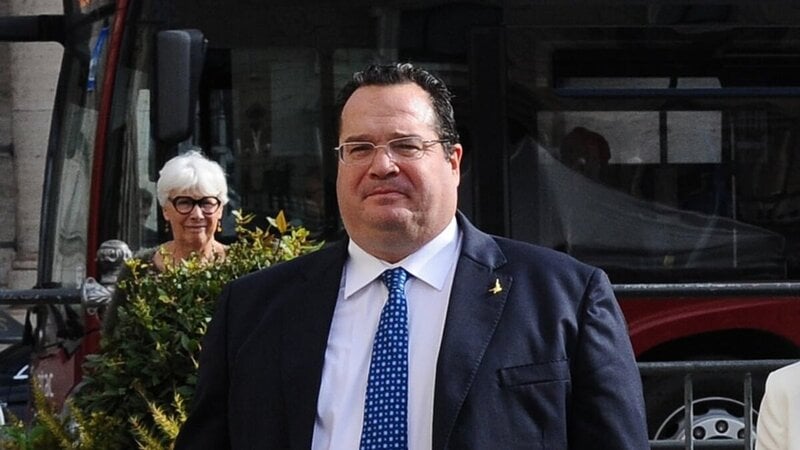
What will actually be in Italy’s next legge di Bilancio (the annual budget law, which parliament has to approve by December 31) is still unknown, but the latest remarks by labor undersecretary Claudio Durigon, made at the «City Talks» event under way in Naples, give a clearer sense of where the government is heading.
Durigon described two tracks the government intends to follow, both shaped by the strains running through the Italian labor market.
The usual argument is that making tomorrow’s pensions sustainable requires fixing the labor market first, by pushing employment and wages higher. Durigon argues the reverse case also holds. Given how hard it has become to bring in new professional skills to lift productivity and, above all, competitiveness, the pension system needs to move too. How? By letting workers who are already close to retirement — presumably the same ones with the widest gaps in new skills — leave earlier.
Hence the government’s first big pension objective for the coming budget, one that has already won the blessing of Matteo Salvini: allowing every worker to retire at 64. «A three-year discount for anyone who wants it is a way to get rid of the Fornero law, which for me remains a priority», said the leader of the League (Lega), who clearly has no intention of dropping the slogan that served him so well in past elections, however thin the results so far. The Fornero law is the 2011 reform, named after then labor minister Elsa Fornero, that sharply raised Italy’s retirement ages during the sovereign debt crisis; the standard state pension age is now 67.
That prospect comes paired with a second lever: cutting taxes for retirees, with the aim of bringing down the overall tax burden, following what other countries have already done.
Retirement at 64: «We’re working on it»
This is not new: it has been discussed for weeks, but there is still no certainty that retirement at 64 — plus the one extra month triggered by the life-expectancy adjustment — will actually be extended to everyone.
The goal is clear: to grant workers who started their careers before 1996 the same right to the pensione anticipata contributiva (early retirement under the contributions-based formula), which can be claimed at 64 with at least 20 years of contributions and a monthly payment worth at least three times the Assegno sociale, Italy’s means-tested basic old-age allowance.
«We’re working on it», Durigon said, without committing further, while making clear that this is the government’s current orientation. The measure is also meant to encourage generational turnover, letting companies walk surplus staff into retirement and bring in the new skills they need.
It has to be said, though, that this outcome is anything but a given, since earlier flexibility schemes such as Quota 100 (which allowed retirement at 62 with 38 years of contributions) were launched with the same goal, only to produce limited effects on generational turnover.
Partly because it remains to be seen who would actually want to retire three years early on a check recalculated entirely under the contributions-based system — a «penalty» that, as measures like Quota 103 have already shown, can be a disincentive to retiring at all.
The risk is that early exit is taken up mainly by public-sector employees, where turnover is not so immediate, as already happened with Quota 100, and by workers in less physically demanding jobs.
Lower taxes for retirees
Durigon then turned to a second ambitious objective, this one fiscal: without going into the details of the proposal, the undersecretary pointed to the target of lowering the taxation of pensions.
The average tax burden today is 20%, while Durigon is aiming to bring it down to 12-13%, citing France as the example.
For now, the only proposals on the table concern a reduction in taxes on the slice of income between €50,000 and €60,000 (roughly $54,000 to $64,800), by raising the ceiling of the second bracket. The rate applied to that band would go from 43% to 33%, a cut of 10 percentage points — though it does not appear to come with measures aimed specifically at retirees, comparable to the tax relief already in place for employment income.
So for the moment there is only a stated objective, while the tools the government intends to use to get there, and the resources it will be willing to put behind lower taxes on pensions, have yet to be spelled out.
Editor’s note
This article was originally published in Italian on money.it by Simone Micocci on October 24, 2026 as «Pensioni, meno tasse e anni di lavoro. Il piano del governo per la prossima legge di Bilancio». It has been translated and adapted for an international audience by the Money.it International desk.