Europe today is facing one of the most delicate tests of its recent history. While Italy keeps pushing to obtain greater “flexibility” on its public finances – an elegant term to indicate fresh borrowing capacity – the risk does not concern only the next budget law or pre-election tensions. The real danger is structural and strikes at the very heart of the single currency.
Mario Seminerio, in his article from May 5, 2026 on Phastidio.net (the blog where the Italian commentator regularly publishes his macroeconomic analysis), describes with merciless lucidity a continent trapped in the Zeitgeist of deficits: governments that cannot (or will not) cut public spending for fear of being swept away by populist backlash, and that at the same time fear taxing capital heavily for fear of triggering an exodus abroad. The result is debt destined to rise, fueled by still-elevated interest rates.
«Governments neither want nor can close the deficit because they fear being swept away by populism if they cut spending, or triggering massive capital flight if they tax the wealthy. The combined effect of this situation is, precisely, the swelling of public debt».
Germany, France, Italy: a continent on diverging tracks
The picture is not uniform. Germany is eroding decades of fiscal rigor to finance rearmament and prop up a welfare state that is creaking, while its automotive sector is being progressively cannibalized by Chinese competition. France, meanwhile, keeps obtaining repeated extensions from Brussels on its adjustment targets, thanks to the (so far) patient stance of markets. But how long can that patience last, with debt-servicing costs eating into budget lines for healthcare, education, and pensions?
Seminerio does not spare criticism of even the most discussed proposals in Italy, such as taxing windfall profits or imposing a “corralito” on capital (a reference to Argentina’s 2001 freeze on bank deposits, sometimes evoked in European debate as a worst-case capital-control scenario):
«I can even feel some human sympathy for Giancarlo Giorgetti» (Italy’s finance minister) «scaling a glass wall at the Eurogroup to demand the creation of a ’pocket of flexibility’ [...] a EU-wide tax on excess profits (assuming, but not granting, that anyone can define them) would simply shift the points of capital outflow: from national borders to the Union’s. The flight would happen anyway».
The real issue: euro sustainability
The central point of Seminerio’s analysis, however, lies elsewhere, and deserves to be stressed. If eurozone countries keep running structural deficits to keep alive a welfare state no longer supported by adequate growth, how long will the European construction hold up?
«If EU countries keep running deficits to prop up a welfare state that does not float because growth is scarce, how long will the European construction hold? And what will be the pressure point that turns into the breaking point? It’s not hard to imagine: it’s the euro».
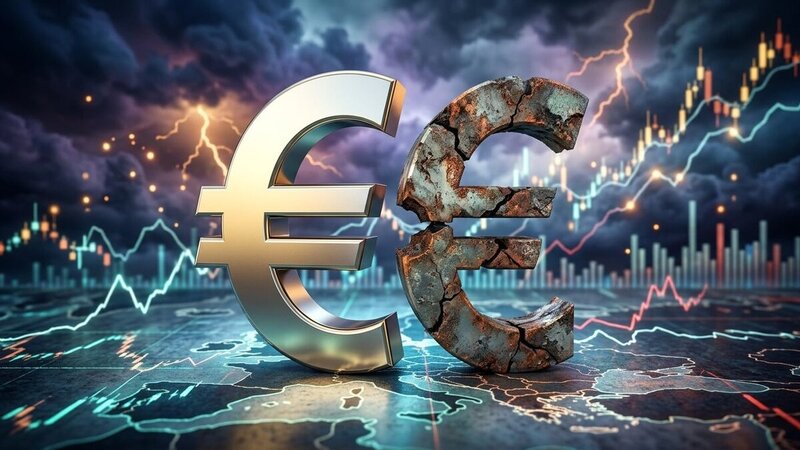
The analyst evokes a scenario already discussed years ago, but today more concrete: a de facto fragmentation of the single currency, with a strong “German euro” and a weaker “Italo-Greek euro” (or Franco-Italian one). Technically separating them would be a nightmare, but the divergence in real values between economies that are too different could become unsustainable.
«We risk going back to the dark times when people hypothesized a fragmentation of the euro’s value, between countries with no deficit or debt and those in serious trouble. Back then the saying was: there will be a German euro and an Italo-Greek euro, and they cannot have the same value. Try separating them».
The “Schrödinger euro” and the dollar narrative
This risk arrives just as narratives proliferate of an euro destined to replace (or at least challenge) the dollar as the world’s reserve currency. Seminerio is blunt:
«Already last year I had to smile reading politicians and entrepreneurs strutting about the ’strong euro’ only to then cry over the dollar’s weakness, which hurts our exports. I don’t see Schrödinger’s euro doing very well. All the more so given that, at this rate, European exports will end up the way of the dodo».
The contradiction is the heart of the matter: a single currency cannot be both a candidate to dethrone the dollar as global reserve and, at the same time, a drag on export competitiveness. Either it is the strong currency of a disciplined economic bloc, or it is the soft currency of a continent unable to grow. The longer Europe avoids the choice, the closer the breaking point gets.
Editor’s note
This article was originally published in Italian on money.it by Redazione Money Premium on May 09, 2026 as «I segnali inquietanti sul futuro dell’euro. Mario Seminerio lancia l’allarme rosso». It has been translated and adapted for an international audience by the Money.it International desk.