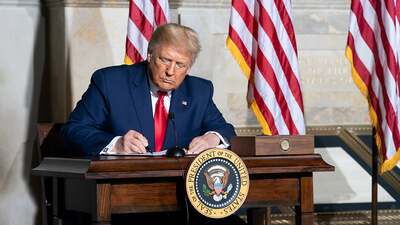
Tariffs were supposed to narrow the U.S. trade imbalance, but August data released on October 6 by the Census Bureau and the Bureau of Economic Analysis point the other way. The goods and services trade deficit widened 13.7% in a month to $105.6 billion, above the $102 billion expected in the Reuters consensus. It is the highest reading since March 2025, when American businesses rushed to buy from abroad ahead of the tariffs taking effect. For comparison, in November 2024, the month of Donald Trump’s reelection, the deficit stood at $79.8 billion.
Imports at record highs
The deterioration came entirely from the buying side. Total imports rose 4.3% to a record $420.8 billion; goods imports alone climbed 5.3% to $342.2 billion. Exports grew far less, up 1.4% to $315.2 billion.
U.S. trade balance, August 2026 (billions of dollars)
| Item | Value | Monthly change |
|---|---|---|
| Goods and services deficit | 105.6 | +13.7% |
| Total imports | 420.8 | +4.3% |
| Goods imports | 342.2 | +5.3% |
| Total exports | 315.2 | +1.4% |
| Goods-only deficit | 136.6 | +10.3% |
Three forces sit behind the figure. The first is inventory rebuilding, after companies cut stockpiles for five consecutive quarters. The second is energy: purchases of industrial supplies and materials rose $9.1 billion, with crude oil up $3.3 billion and nonmonetary gold up $3.1 billion (the latter is excluded from the GDP calculation). The third, and the most structural, is artificial intelligence. Capital goods imports hit a record $146.4 billion, driven by semiconductors and industrial machinery. Computer accessories, although down in August, are worth $158.5 billion over the first eight months of the year, against $89.5 billion in the same period of 2025.
Geographically, Washington posted record goods deficits with Mexico, Vietnam and Malaysia, and the deficit with Canada rose by $4.1 billion, probably because businesses front-loaded orders ahead of new tariffs in the trade war between the two countries.
Why the tariffs are not working as promised
The point is that the United States does not currently have the production capacity to meet its own demand, which grew in the second quarter at the fastest pace in more than three and a half years, supported by consumption and by investment in AI-related equipment. When demand runs hot and domestic supply cannot keep pace, imports rise even as they become more expensive.
That is the thesis of Christopher Rupkey, chief economist at FWDBONDS, who argues that the administration’s trade policies «have largely been a failure». Rupkey maintains that American labor costs remain too high to produce goods at competitive prices and that, even if manufacturers wanted to, new factories could not be built fast enough to replace the foreign goods consumers depend on.
The impact on GDP
Foreign trade has subtracted from GDP growth for three consecutive quarters and, according to economists’ estimates, could take away as much as 2.5 percentage points in the third quarter. Goldman Sachs has cut its annualized growth forecast for July-September to 3.1%, from 3.4% previously. In the second quarter, the economy grew 2.2%.
Imported inflation raises the pressure on the Fed
The deficit is also a sign of excess demand, with direct implications for prices. Part of the increase in the value of imports already reflects higher prices, and tariffs, which are paid by American importers, tend to pass down the supply chain to consumers. Carl Weinberg, chief economist at High Frequency Economics, urges the Federal Reserve not to underestimate the picture: beneath the energy price shock, he notes, there is a demand-driven inflationary push, of which energy is only the surface layer.
Last month the Fed raised its benchmark rate by 25 basis points to a range of 3.75%-4%, its first hike in three years, and signaled further tightening. The August data reinforce expectations of another increase before year-end.
What it means for the dollar
A growing trade deficit has to be financed by capital inflows from abroad. As long as international investors keep buying American assets, drawn by the AI investment cycle and rising interest rates, the dollar stays supported and the deficit is sustainable.
But dependence on foreign capital is increasing: if appetite for U.S. assets were to cool, rebalancing would come through a weaker currency, which would make imports even more expensive and feed imported inflation further. It is the paradox of a trade policy designed to reduce the imbalance that, so far at least, coexists with its worsening.
The outlook remains uncertain. Veronica Clark, an economist at Citigroup, expects trade with Canada to remain volatile for several months, amid sharp swings in energy goods and the entry into force of new tariffs.
Editor’s note
This article was originally published in Italian on money.it by Ufficio Studi Money.it on October 07, 2026 as «I dazi USA sono un flop? Deficit commerciale sale a $105,6 miliardi, cosa rischiano crescita, prezzi e dollaro». It has been translated and adapted for an international audience by the Money.it International desk.