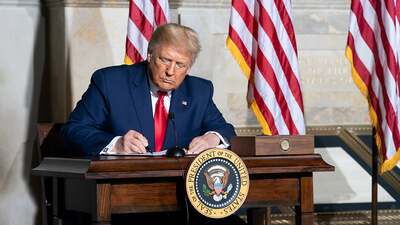
Chinese President Xi Jinping arrived in Washington today for a multi-day summit with Donald Trump, an encounter markets have been watching all week as the biggest potential market mover on the calendar. Just hours before the meeting, US Treasury Secretary Scott Bessent announced that the trade truce between the two powers, set to expire November 10, would be extended two months, to January 10, 2027.
From Busan to Washington
The truce dates back to the agreement Trump and Xi signed on October 30, 2025, in Busan, South Korea, on the sidelines of the APEC summit: a one-year package of reciprocal commitments under which Beijing agreed to suspend, for twelve months, global export controls on rare earths (lithium, germanium, antimony, graphite), to roll back tariffs on American agricultural products, and to buy large volumes of US soybeans, while Washington halved fentanyl-related tariffs from 20% to 10% and extended several tariff exclusions.
A number of those commitments were scheduled to lapse right around November 10, 2026. The two-month extension Bessent announced today is meant to buy time before the entire package has to be renegotiated.
AI, Taiwan and the Iran question
Beyond the trade file, the summit agenda includes at least three other open issues. The first is artificial intelligence: Trump is looking to assert US technological and economic superiority in the sector, though he has softened some of his harsher deregulation rhetoric in recent days to help the negotiations along. The second is Taiwan, where Beijing continues to press against a roughly $14 billion US arms sale to the island - a matter Xi himself has already called potentially explosive if “mishandled.” The last is Iran: the crisis between Washington and Tehran, with its knock-on effects on fuel prices, remains an indirect point of friction between the two delegations.
Markets: cautious, but with the extension already priced in
Ahead of the meeting, Wall Street traded essentially flat and cautious - the Nasdaq 100 and Dow Jones were down around 0.2% in Wednesday afternoon trading on September 23, while the S&P 500 was little changed - while oil extended its recent decline: Brent moved in the $100-a-barrel range (down 0.77%) and WTI traded around $90 (down 0.74%). That’s consistent with a market that had already largely priced in an extension of the truce as its base case, rather than a breakdown.
Some more cautious voices remain, though. Scott Kennedy, an expert on US-China relations at the Washington-based Center for Strategic and International Studies (CSIS), predicted ahead of the summit that it would be “relatively underwhelming, with a limited number of concrete outcomes,” noting that neither Washington nor Beijing appears ready for a structural reset of the trade relationship. Trump himself, asked about what the meeting would cover, offered only general remarks: “We’ll talk about a lot of things, it will be a great meeting,” he said.
The extension of the truce reduces, for now, the risk of a fresh global tariff shock that would hit Italian and European exports to China and the United States across the board, along with stocks most exposed to the semiconductor and rare-earth supply chains. But it is only a two-month extension, not a structural agreement, and reciprocal tariffs remain above their pre-2025 levels.
Taiwan and the race in artificial intelligence remain the two fronts where a sudden deterioration could put the truce back in question before the new January 10 deadline - just as the United States heads into its November midterm election campaign.
Editor’s note
This article was originally published in Italian on money.it by Ufficio Studi Money.it on September 24, 2026 as «Trump e Xi a Washington. La tregua sui dazi si allunga di due mesi, fino al 10 gennaio 2027». It has been translated and adapted for an international audience by the Money.it International desk.