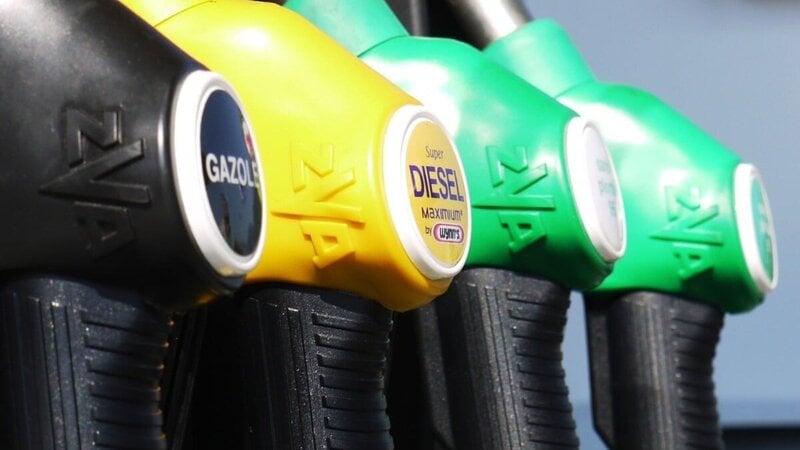
For a generation of Italian drivers, diesel was shorthand for saving money: cheaper per liter and more miles to the tank, a combination that drove a sales boom and no small amount of trouble in cities where particulate matter is among the most insidious pollutants and the hardest to curb. Diesel engines in optimal conditions can keep those emissions well in check, thanks to the catalytic converter and AdBlue (the urea solution sold in the United States as diesel exhaust fluid, or DEF). What fewer drivers know is that the converter only works above a certain temperature, so in the first minutes after a cold start — minutes that stretch out at low revs and in cold weather — the pollution is anything but theoretical. And that is before maintenance: everyone has been stuck in traffic behind a car that puffs black smoke at every acceleration.
Either way, and perhaps fortunately, diesel’s run is over for now. Today it costs more than gasoline almost everywhere in Italy, and not by a little.
According to self-service average prices collected by the fuel price monitor at Italy’s Ministry of Enterprise and aggregated by municipality, diesel is above gasoline in 5,101 of the 5,118 municipalities that have at least one station reporting updated prices. The average gap is 23 euro cents a liter: on a 50-liter fill-up, that is nearly €12 (about $13, or roughly 94 cents a gallon on a 13-gallon tank).
What gasoline and diesel cost right now
In mid-October 2026 the national average was €2.034 a liter for self-service gasoline and €2.256 for diesel. At roughly $1.08 to the euro, that works out to about $8.32 and $9.22 a gallon.
The municipal figures, updated to October 23, 2026, are in line: half of all municipalities pay between €1.996 and €2.066 for gasoline and between €2.236 and €2.299 for diesel.
The reason for the flip is one we have explained more than once. Part of it is fiscal: the realignment of Italy’s accise (fuel excise duties) that, starting in 2026, raised the levy on diesel and cut the one on gasoline.
Part of it is industrial. Europe produces less diesel than it consumes, and the cost of refining it — the so-called crack spread — has stayed high even as crude prices fell. On top of that, in recent months geopolitical tensions in various parts of the world have seen refineries singled out as strategic targets. That is an enormous problem for everyone, because the world’s refineries are not in surplus relative to demand for refined products, and building new ones is not a short-term operation: rebuilding refining capacity will take years, and there is no guarantee that more plants will not be hit in the meantime.
The regions where a full tank costs most
Back to Italy and its pump prices, where the regional divide is sharp. The most expensive region is Campania (the region around Naples), with a municipal average of €2.088 for gasoline and €2.320 for diesel. Next come Basilicata (€2.085 and €2.317), Calabria (€2.064 and €2.303) and Sicily (€2.057 and €2.294). At the bottom of the table, meaning where drivers spend least, are Lazio (diesel at €2.249), Umbria and Veneto (€2.250), then Liguria and Lombardy.
Between the average station in Campania and the average station in Lazio there are about 7 cents a liter on diesel. Not much? For someone driving 20,000 kilometers a year (about 12,400 miles) in a car that burns 6 liters per 100 kilometers — roughly 39 miles per gallon — that is about €85 a year, close to $92.
The priciest and cheapest provincial capitals
Among provincial capitals, the most expensive diesel is in Matera, at €2.306 a liter, followed by Salerno and Potenza (€2.288), Trieste (€2.287), then Vibo Valentia, Reggio Calabria and Catanzaro. For gasoline the top spots go to Caserta and Matera (€2.056), then Catanzaro and Reggio Calabria.
The capital where drivers save most is Viterbo: €1.939 for gasoline and €2.151 for diesel, more than 15 cents below Matera. Next come Carbonia, Macerata, Fermo and Ancona for diesel, and Belluno and Cuneo for gasoline.
The extremes are found outside the provincial capitals. The smaller islands pay the price of logistics: on Lipari, off Sicily, diesel tops €2.52 a liter, and on Ischia, in the Bay of Naples, €2.40. At the other end is Livigno, where gasoline costs €1.546 and diesel €1.646 — not thanks to generous station owners, but because the Alpine town sits in a duty-free enclave where excise taxes do not apply.
Unbranded pumps and apps: where the savings really are
Out of roughly 23,800 stations on the register, the pompe bianche — unbranded stations that do not carry the logo of one of the major oil companies — number 3,601, or 15% of the total. They are often the simplest route to saving a few cents, as are the apps that compare prices in real time using the Ministry’s own data.
It is worth remembering, though, that in 2,555 municipalities, home to roughly 3 million people, there is no station at all. There the problem is not picking the cheapest pump but having one within reach. That is no small matter, and the run-up in prices has only made it worse.
The end of diesel: prices are getting there before Brussels
Italy has spent years debating a ban on internal combustion engines and traffic restrictions on Euro 5 vehicles (the European emissions standard covering cars registered roughly between 2011 and 2015). But in Italy it is the price at the pump, far more than the rules, that is already pushing diesel out of the market. Anyone replacing a car today who drives relatively few kilometers has fewer and fewer reasons to choose diesel, well before European rules — already pointed in that direction — come into force.
As the opening of this article suggests, that is not necessarily a bad thing: for urban driving in particular, diesel is a poor solution that price alone was wrongly pushing many drivers toward.
What happens to fuel prices next?
Prices sustained at these levels will sooner or later force the state to intervene again on excise duties, driven both by public pressure and by the fact that falling consumption means lower tax receipts anyway — while also damaging the wider economy through all the business that the kilometers not driven never generate.
Excise duties aside, the global refining bottleneck described above means the upward pressure on fuel prices, and on diesel especially, is set to persist, and may well get worse. We will see. The outlook, in any case, is not encouraging.
Editor’s note
This article was originally published in Italian on money.it by Dimitri Stagnitto on October 24, 2026 as «Il diesel costa più della benzina in 5.101 comuni su 5.118. Dove si paga di più il pieno, città per città». It has been translated and adapted for an international audience by the Money.it International desk.