

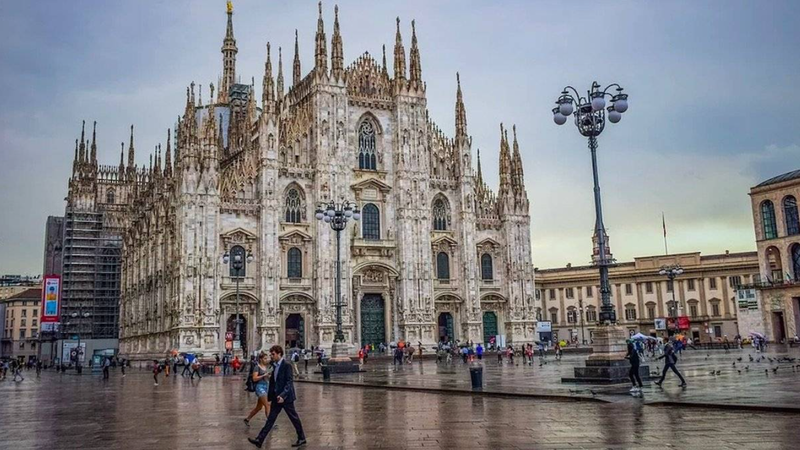
Milan is no longer just Italy’s financial capital. It is rapidly becoming one of Europe’s most strategic real estate markets — and the numbers are hard to ignore.
Italy’s residential property market generates tens of billions of euros in annual transaction volume, and Milan consistently accounts for the largest share among Italian cities. With average prices per square foot far above any other domestic market and a disproportionate concentration of high-end deals, the city functions as the country’s real estate engine. Estimates from market operators suggest Milan’s residential transactions alone move roughly €8 billion annually, a figure that has expanded significantly since 2020.
The Winter Olympics have amplified global visibility, but the rally predates the Games. Tax incentives introduced in 2017 attracted high-net-worth individuals. Post-Brexit corporate shifts strengthened Milan’s role in finance and professional services. Infrastructure upgrades, urban regeneration and foreign capital flows have compounded the effect.
“The Olympics accelerated capital flows that were already in motion,” says a European real estate strategist at a global advisory firm. “The real story is Milan’s repositioning within the European hierarchy of cities.”
This distinction matters. Event-driven spikes fade. Structural repricing can last a decade.
Prime Is Expensive. Opportunity Is Selective
Brera, Quadrilatero della Moda and Porta Nuova now operate at valuation levels once considered unthinkable for Milan. Record transactions have reset psychological price ceilings. Ultra-prime penthouses and architecturally distinctive assets command scarcity premiums comparable to top-tier districts in Paris or Madrid.
However, yields in these trophy locations are compressed. For investors seeking income generation, entry costs may limit immediate returns.
That does not mean opportunity has vanished — it has simply migrated.
Historically, the most compelling gains occur in districts bordering prime areas, where infrastructure improvements and perception shifts are not yet fully priced in.
Scalo Romana, reshaped by Olympic development and future student housing conversion, is a textbook example of an urban regeneration corridor transitioning from speculative phase to structural integration. Early movers have already benefited, but pricing inefficiencies may still exist at the micro-location level.
“Urban redevelopment tends to unfold in waves,” explains an Italian asset manager focused on residential strategies. “The first wave is speculative. The second is institutional. Between those two phases, selective opportunities emerge.”
For disciplined investors, that window is critical.
Read more: Investors bet on property for long-term despite bumpy ride since pandemic
Scarcity as a Defensive Strategy
Another defining feature of Milan’s current cycle is the premium on truly scarce assets — especially panoramic penthouses with expansive terraces and unobstructed views.
In dense European cities, skyline visibility and outdoor space are finite resources. Post-pandemic demand has amplified this structural scarcity. Buyers increasingly prioritize light, privacy and open-air living space over sheer square footage.
From a capital-protection standpoint, assets tied to scarcity rather than fashion tend to demonstrate stronger downside resilience. A generic luxury apartment may track market volatility. A unique top-floor residence with irreplaceable characteristics often trades within a narrower valuation band, even during corrections.
Still, caution is warranted. The label “penthouse” has become marketing shorthand. Investors should differentiate between:
- Architecturally integrated, view-protected units
- Rooftop conversions surrounded by future development risk
- Properties with genuine panoramic exposure versus partial or obstructed sightlines
In late-cycle environments, quality dispersion widens.
The Greater Milan Hedge
While central Milan absorbs international headlines, surrounding provinces such as Monza and Brianza offer a different strategic profile.
Entry prices remain significantly lower than in the historic core. Larger properties, green space and family-oriented housing stock attract domestic buyers and relocating executives alike. Connectivity improvements continue to narrow the perceived distance from the city center.
In many global markets, secondary luxury zones outperform when core affordability thresholds are breached. As prime prices rise, demand spills outward, compressing valuation gaps.
For investors balancing appreciation with risk mitigation, Greater Milan may provide:
- Lower capital exposure per asset
- Stronger rental yield potential
- Diversification within the same metropolitan growth story
As one Milan-based economist notes, “when a primary city strengthens structurally, its periphery becomes the pressure valve. That is where relative value can emerge.”
Read more: Largest Real Estate Companies in the World
Risks, Rates and the Bigger Picture
No market expands indefinitely without friction. Key variables to monitor include:
- European Central Bank interest rate policy
- Italy’s fiscal trajectory and regulatory stability
- Potential oversupply in newly developed luxury towers
- Global wealth mobility trends
Yet Milan’s transformation appears less speculative and more structural. Corporate relocations, technology investment, academic expansion and lifestyle migration are multi-year drivers unlikely to reverse abruptly.
Milan’s real estate market can serve three complementary roles:
- Core store of value in historic prime districts
- Growth exposure in regeneration corridors
- Relative value diversification in Greater Milan
The Olympic flame may extinguish, but infrastructure, global branding and capital repositioning endure.
€8 billion in annual transaction volume is not a temporary headline figure. It reflects liquidity, depth and institutional interest.
The real question is not whether Milan has already risen.
It is whether the market is completing a cycle — or redefining its long-term valuation ceiling within Europe’s evolving urban hierarchy.


