

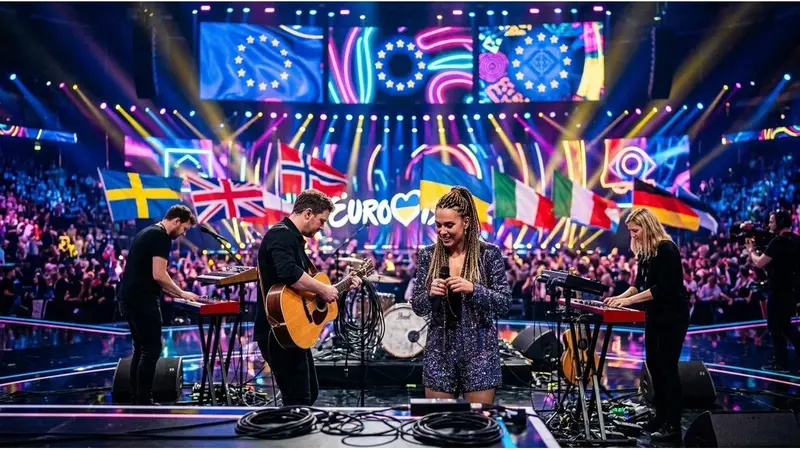
With the first semifinal broadcast from Vienna last night, the Eurovision Song Contest officially kicked off. In recent years, the event has become a global sensation, with a highly distinctive, consolidated formula that, in some ways, represents a fascinating unicum. It’s also an important showcase for artists who, in many cases, are completely unknown outside of their home country. Call Maneskin for confirmation.
But how much does an event like this cost? Between the pre-shows, semifinals, and finals, for several editions, Eurovision has been a commitment that requires significant effort, starting in the previous fall. And all of this is reflected in a million-dollar budget, with significant funds disbursed by the ESC and local organizations and administrations, in this case, Austria.
Here, then, are the estimated total costs of Eurovision 2026 and how much the singers and performers will earn.
Eurovision 2026 from Vienna: Estimated Costs
According to estimates prepared by ECO Austria on behalf of the Federal Ministry of Economic Affairs, Energy, and Tourism, the Eurovision Song Contest 2026 in Vienna is expected to cost approximately €36 million in total, including the €5 million contribution guaranteed by the EBU. This is a huge sum, but still less than the record-breaking Basel 2025 edition, which topped €64 million. The bulk of the cost will be borne directly by the city of Vienna, which last September set a maximum investment cap of €22.6 million.
The most expensive part concerns the management of the Wiener Stadthalle, security, and the logistical organization of an event that will last almost two weeks. A veritable “Eurovision city” will revolve around the arena: the Eurovision Village at Rathausplatz, the public giant screen in front of the town hall, the Euroclub inside the Rathaus, and all the collateral events designed for fans, delegations, and the international press.
Forecasts call for 88,000 visitors, including tourists, journalists, and official delegations, with average stays exceeding a week. Vienna also boasts a gigantic accommodation system: 433 hotels and over 82,000 beds in total. It’s no coincidence that Mayor Michael Ludwig has called Eurovision “a strategic investment,” rather than simply a cost to the public purse.
Is Eurovision 2026 the most expensive ever? Analysis of past editions
No, because Eurovision 2026 won’t even come close to breaking the all-time record. With an estimated €36 million, Vienna is in the upper echelon of modern editions, but far from some extreme cases of the past. The most expensive edition ever organized remains Baku 2012, which exceeded €600 million, including infrastructure, urban redevelopment, and the new construction of the Crystal Hall. Looking at the show’s production costs alone, the recent record belongs to the aforementioned Basel 2025, which came in at approximately €64 million.
Behind it are Moscow 2009 with €42 million and Copenhagen 2014 with approximately €41 million, a figure that rose after design errors in the redevelopment of the B&W Hallerne. To find a direct comparison with the current Austria, we need to go back to Vienna 2015, when the ESC cost approximately €21.7 million: almost €15 million less than the current edition.
In recent years, however, Eurovision has increasingly become a global mega-event. Liverpool 2023 drew nearly €28 million, Turin 2022 around €22 million, and Malmö 2024 remained between €10 and €12 million, although security concerns related to geopolitical tensions have increased several spending items. Vienna 2026, in short, will be expensive, but without uncontrolled excesses: ORF’s stated goal has been clear from the beginning: to be “spectacular but thrifty.”
How Much Does the Eurovision Song Contest Make
If the costs are enormous, Eurovision’s revenues and economic benefits are no less significant. According to the economic study presented by the Austrian government, the 2026 edition is expected to generate an overall economic impact of approximately €57 million, €52 million of which will remain directly in Austria. The estimate includes tourism, overnight stays, transportation, local consumption, and event-related services.
Added to this is a massive global advertising return: the international visibility of Vienna and Austria is estimated at around €730 million in media exposure. These figures explain why more and more European cities continue to compete to host the event.
The Eurovision economic model is supported by several sources: contributions from participating broadcasters, international sponsorships, ticket sales, television advertising, and commercial partnerships. The so-called Big Five countries—Italy, France, Germany, the United Kingdom, and Spain—are the largest contributors to the EBU system and account for a huge share of the television audience.
And this is where the biggest problem for the 2026 edition emerges. The boycott of some countries due to Israel’s presence risks impacting both ratings and overall revenue. Spain alone attracted nearly 5.9 million spectators in 2025, while the Netherlands, Ireland, and Slovenia add millions more in lost audiences. Overall, the festival could lose nearly 10 million spectators compared to last year, or about 6% of the global audience recorded in 2025, equal to 166 million people.
This loss is not merely symbolic. Fewer viewers mean less advertising value, less commercial clout, and a more fragile economic balance for a format that has become increasingly ambitious and expensive to produce in recent years.
And how much do the singers earn? The expected fees
The answer, paradoxically, is very simple: the singers earn nothing directly from the Eurovision Song Contest. Neither Sal Da Vinci nor the other competing artists receive fees, appearance fees, or financial prizes from the EBU or the Austrian ORF. The same goes for the eventual winner, who will only take home the famous crystal microphone.
Eurovision, in fact, has always operated according to a completely different logic: the true value is global visibility. And recent history demonstrates this very well. After their 2021 victory, Måneskin have multiplied their audience ratings, international tours, and live fees, transforming the festival into a global platform.
However, this doesn’t mean that participation is free. On the contrary. Each national broadcaster must cover significant costs for registration, logistics, hotels, delegations, rehearsals, sets, and technical staff. For the Big Five countries, the investment often exceeds 100,000 euros for the participation fee alone.
The presenters also don’t earn outsized sums compared to major international shows. The Eurovision philosophy remains that of a major collective television event, where most of the profits come later. And in some cases, it can change an artist’s career forever.
Original article published on Money.it Italy. Original title: Quanto costa e quanto incassa l’Eurovision 2026?