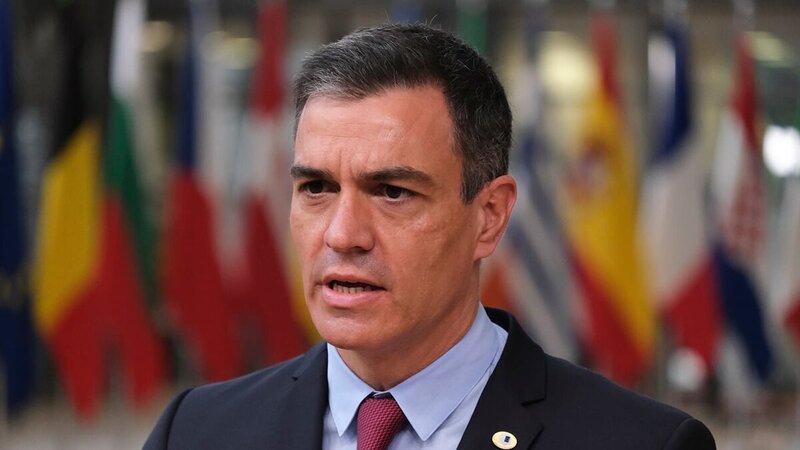
There is one name that has forced its way back to the center of European political debate in recent days: Pedro Sánchez. The head of Spain’s government has become the great continental antagonist of Italy’s prime minister, Giorgia Meloni — the socialist who never pays a courtesy call when passing through Rome, and who, after the Ceuta migration crisis and Italy’s decision to suspend the Schengen open-border rules, hit back blow for blow by imposing border checks on travelers arriving from the Italian peninsula. It is a clash that is at once personal and strategic, with two leaders both facing the polls in the coming months and each determined to build support precisely by opposing the other.
But Sánchez is more than Meloni’s rival. He is, all things considered, one of the few dissenting voices left in the West: the last openly left-wing figure still leading a major European country, willing to hold his ground against Donald Trump over NATO military spending, to raise Spain’s minimum wage by 60%, and to regularize hundreds of thousands of immigrants while the rest of the continent drifts right. It is a profile as prominent as it is contested — one that has also landed him at the center of judicial scandals brushing up against his party and his family. But how much, exactly, does the man who stares down half the West earn? Let’s find out, between salary, assets, and declared wealth.
Who is Pedro Sánchez, and how he became Spain’s prime minister
Born in Madrid in February 1972, Pedro Sánchez Pérez-Castejón is an economist by training before he is a politician. Before reaching the Palace of Moncloa (the Spanish prime minister’s official residence), he had piled up more than twenty years of public office: Madrid city councillor from 2004 to 2009, a member of the Congress of Deputies across three separate stints, and, in the background, an international résumé that includes a spell in the cabinet of the UN High Representative in Bosnia and Herzegovina and consulting work for the European Parliament.
The turning point came in 2014, when he won the leadership of the PSOE, Spain’s Socialist Workers’ Party. After a stormy interlude — he was forced to resign by the party’s leadership in 2016, only to reclaim the top job in 2017 with a stunning comeback among the rank and file — Sánchez became prime minister in June 2018 through a no-confidence motion against the conservative Mariano Rajoy, a first in Spain’s democratic history. He has since won or held on through three electoral rounds, assembling fragile and patchwork majorities: first the coalition with Unidas Podemos, then, from November 2023, a governing coalition with Sumar supported from the outside by Catalan and Basque pro-independence parties.
That very ability to stay balanced atop precarious alliances has made him a one-of-a-kind figure. On the international stage, Sánchez has carved out the role of the contrarian: at the NATO summit he refused to fall in line with the target of 5% of GDP on military spending demanded by Trump, drawing first the tycoon’s fury («Spain is a lost cause») and then an abrupt reversal. With Meloni, by contrast, the freeze is total: as prime minister she has never made an official visit to Madrid, and Sánchez has passed through Rome’s Palazzo Chigi just once, in 2023.
How much does Pedro Sánchez earn? What we know about his salary and assets
Let’s start with the salary — what the prime minister is paid for the job itself. According to Spain’s official Transparency Portal, in 2025 Sánchez collected €95,944 gross (about $103,600), spread over twelve monthly payments. It is a figure that has climbed steadily over the years: from €47,097 in 2018 (a partial year) to €83,080 in 2019, then €84,845 across 2020 and 2021, €87,814 in 2022, €90,449 in 2023, and €93,145 (about $100,600) in 2024. In just under seven years, the increase came to nearly €13,000 (roughly $14,000).
The comparison with Giorgia Meloni is trickier than it looks. The Italian prime minister would be entitled to about €80,000 (some $86,400) a year as head of government, but she waived that allowance, drawing only her salary as a member of parliament. Her total declared income tells a different story, however: in her latest filing, for 2024, Meloni reported €180,031 (about $194,400), nearly double Sánchez’s institutional salary — a sum inflated in earlier years above all by the royalties from her books (in 2023 it had approached €460,000, or roughly $496,800).
Curiously, the Spaniard also tops up his income with writing: in his asset declarations he reported around €42,000 (about $45,400) in royalties for his three books, plus up to €12,845 (some $13,900) a year from property rentals. On the wealth front, Sánchez is openly a long way from big money: he owns two homes and two parking spaces in Madrid, a private pension plan built up over years (around €105,000, or about $113,400), an investment fund worth roughly €81,000 (some $87,500), and cash in his checking accounts on the order of a few tens of thousands of euros — all weighed down by a mortgage that is still being paid off. He lives at Moncloa, the prime minister’s official residence, with utilities and expenses covered by the state.
All told, international estimates put his net worth at around $300,000 (about €258,000) — light-years away from the millions held by many of his peers.
Editor’s note
This article was originally published in Italian on money.it by Emanuele Di Baldo on August 10, 2026 as «Quanto guadagna Pedro Sanchez, il primo ministro spagnolo antagonista di Giorgia Meloni». It has been translated and adapted for an international audience by the Money.it International desk.