

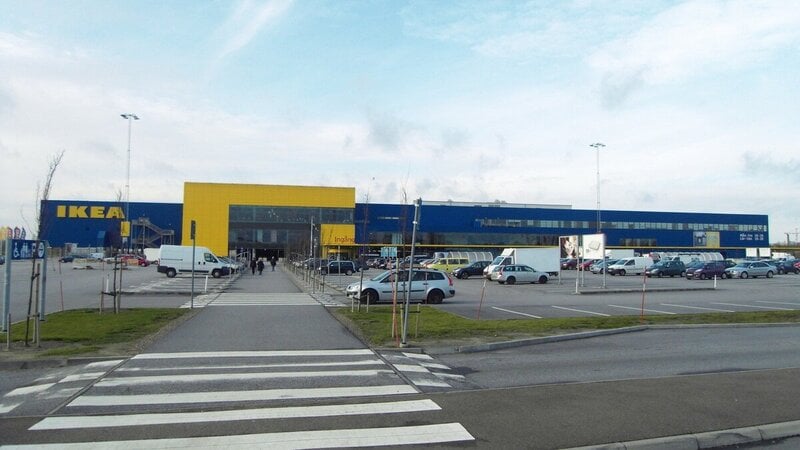
Here’s What You Need to Know. IKEA announced this month that it will close its 32,000 sq m megastore in Borlänge, central Sweden — the first time the Swedish furniture giant has shut a store in its home country in more than 40 years. The current store stays open through 2027, when it will reopen as a much smaller 5,000 sq m location inside the Kupolen shopping center, built on the company’s new “Lada” small-format playbook. The decision touches roughly 230 employees, and it is not just a Swedish story: the same shrink-the-box strategy is already live in San Marcos, Texas and Arcadia, California, with at least 10 new US store openings planned for 2026. Below: where the closure is, why it matters, and what it tells you about the next chapter of brick-and-mortar in America.
Where Is IKEA Closing — and Why Now?
The store in question is the Borlänge megastore in Dalarna County, central Sweden — opened in 2013 after years of local negotiations, and one of 20 IKEA stores in Sweden. According to Michael Parker, acting CEO of IKEA Sweden, more than 20% of IKEA’s Swedish sales now come from online channels, and many in-store customers begin their journey digitally before ever walking through a door.
The new location will move into Kupolen, an existing shopping center in town, and is scheduled to open in the first half of 2027. It will carry a curated assortment rather than the full 9,500-product catalog of a traditional “blue box” store. The company has not yet said how many of the 230 employees will keep their jobs after the move — a typical small-format IKEA needs far fewer staff than a full megastore.
For an American reader, the symbolic weight matters more than the square meters. This is the first closure of an IKEA store on Swedish soil in over 40 years. When the company starts trimming its own backyard, it is no longer testing — it is committing.
What Does This Mean for IKEA’s 50+ US Stores?
IKEA has more than 50 large-format stores in the United States, plus 29 Plan and Order Points and 57 pickup points, according to the company’s FY25 summary. The blue boxes in places like Brooklyn, Burbank and Round Rock are not on a closure list. But the formula for new growth is unmistakably the small box.
In 2026 alone, IKEA is opening at least 10 new US locations — including Chicago, Tulsa, Fort Collins, Los Angeles, Huntsville (AL), Phoenix, Houston-Webster, Chantilly (VA), and two additional Dallas-area stores in University Park and Rockwall. A typical IKEA megastore in the US is 300,000 to 350,000 square feet; the new small-format stores are closer to 50,000 square feet, carry a fraction of the SKUs, and lean on the IKEA app, click-and-collect, and a Best Buy partnership for in-store visibility in markets where a full store does not pencil out.
In other words: the Borlänge announcement is not a one-off Swedish quirk. It is the same decision Inter IKEA is making in six US metros this year, and the natural extension of an American consumer spending wave that keeps shifting online.
How Big Was This Megastore Compared to a Typical IKEA?
The Borlänge store ran at 32,000 square meters — roughly 344,000 square feet, near the upper end of IKEA’s traditional global footprint. The replacement format, at 5,000 square meters (about 54,000 square feet), is essentially the same size as the small-format stores IKEA is opening in Texas and California. The compression is dramatic:
- Old format: 32,000 sq m, 9,500 products, destination-shopping experience
- New format: 5,000 sq m, 3,000 products, curated for planning + pickup
- Footprint reduction: roughly 84% smaller
- Staffing: not disclosed, but small-format IKEAs typically run with a quarter of the headcount
That is the move in a single number: IKEA is trading 34 acres of warehouse-style retail for the size of a Target neighborhood store, and trusting the e-commerce flywheel to make up the difference.
Is Brick-and-Mortar Retail Finally Cracking — Even at IKEA?
The pattern is bigger than IKEA. Roughly 7,900 US store closures are expected in 2026, according to Coresight Research and CNBC tallies — on top of the 1,200+ closures already announced as of early May. Walgreens is shutting 1,200 underperforming stores over three years. Macy’s is on its way to 150 closures by year-end. Kroger has roughly 60 stores on its 18-month cut list. UBS analysts now forecast more than 40,000 US brick-and-mortar closures over the next five years.
But IKEA’s story is not a retreat — it is a format swap. US brick-and-mortar sales still totaled roughly $5.93 trillion in 2024, around 81.6% of all retail dollars. Physical stores are not vanishing; they are getting smaller, denser, and tightly synced to online inventory. That is precisely what is happening in global supply chains and US trade flows, where fewer, leaner nodes are replacing yesterday’s just-in-case megasites.
What the Borlänge call really announces is that IKEA — the company that invented destination-furniture retail with the blue box, the meatballs and the Friday-night family outing — has officially decided the megastore is the wrong unit of growth for the next decade.
The Bottom Line
For American shoppers, the lesson is concrete. The next IKEA you see open near you is likely going to look more like a showroom plus pickup counter than a warehouse maze. If you bank on the $2 hot dog, the cinnamon rolls and the kid-friendly playroom, those experiences live in the existing 50+ blue boxes — and those stores are not closing in the US. But for the next ten openings, set your expectations for something closer in size to a Best Buy or a CVS, not an aircraft hangar. The Borlänge closure is the clearest signal yet that IKEA itself believes the bricks-and-mortar of the 2030s will be smaller, smarter, and bolted to a phone.
This article is adapted from the Italian original published by Money.it: Ikea chiude uno dei suoi grandi magazzini per la prima volta in 40 anni. The English version corrects and expands several factual points — including the year the Borlänge store opened (2013, not “40 years ago”), the size of the old vs. new footprint, the number of employees affected, the exact role of Michael Parker, and the year of the actual move (2027) — and adds the US angle.
Sources: SVT Nyheter, “Ikea lägger ner varuhus i Borlänge — flyttar till Kupolen,” May 5, 2026. NordiskPost, “Ikea closes a store in Sweden for the first time in more than 40 years,” May 6, 2026. Daily Northern, “Ikea to close Borlänge store, first shutdown in Sweden in 40 years,” May 2026. Bloomberg, “IKEA Turns to Small-Town Shoppers to Power Its Next Growth Phase,” October 16, 2025. Retail Dive and The Hill on IKEA’s 2026 US small-format expansion. IKEA U.S. Newsroom, FY25 Annual Summary, February 2026. Coresight Research and CNBC, 2026 US store closure forecasts. Capital One Shopping Research, US brick-and-mortar retail sales 2024.