

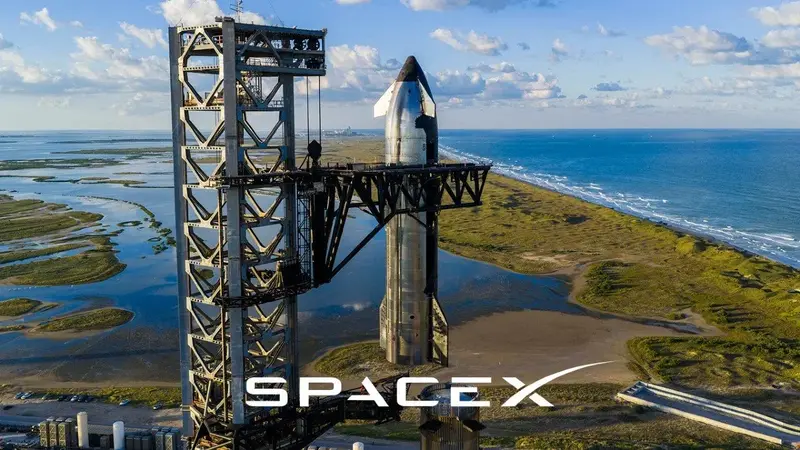
SpaceX shares ended Wednesday’s Wall Street session at $148.30, down 0.78%, marking a second consecutive close below the $150 level at which the stock joined the Nasdaq-100 on July 7.
The retreat follows a sharp rally that drove the shares to an all-time high of $201.80 on June 16. Even after the correction, however, the stock remains comfortably above its $135 IPO price, set when SpaceX debuted on the Nasdaq on June 12.
The cooling in investor enthusiasm is becoming increasingly evident.
That shift lends credibility to analysts who warned even before the IPO that the market had assigned an aggressive valuation to the aerospace company from day one.
Is the speculative excess that some feared finally beginning to unwind?
Today, the shares are up more than 1.5%, although they have declined by approximately 7% over the past five trading sessions.
The Real Cost of AI Is Higher Than Investors Think
Several experts interviewed by Money.it have consistently challenged the narrative surrounding SpaceX’s explosive post-IPO rally, arguing there was little justification for treating the company as a proxy for AI investor sentiment.
Among them is Bryan Byrer, founder of Millennial Financial Planning, who points out that roughly one-third of SpaceX’s revenue comes from U.S. federal government contracts: “The true cost of AI is likely more meaningful than investors realize. Also, about one-third of SpaceX’s revenue depends on the government. Any changes to current arrangements could materially hurt SpaceX”.
That dependence on Washington and, more specifically, on the Trump administration’s policy priorities—means any shift in federal spending or procurement could materially affect the company’s outlook.
Byrer also cautioned that “the real cost of AI is probably higher than investors realize,” suggesting the market may be underestimating the capital intensity required to support SpaceX’s artificial intelligence ambitions.
For that reason, he said he has no intention of buying SpaceX shares - for himself or for his clients - until investors have access to earnings calls and a more comprehensive set of financial disclosures.
He also dismissed the idea that SpaceX’s IPO represents a referendum on the AI sector.
If investors are looking for listings that genuinely reflect market appetite for artificial intelligence, Byrer argues, OpenAI and Anthropic are far more representative candidates:
“Given that xAI is the weakest of the three major AI IPOs, I don’t view it as a reflection of the market’s belief in AI. I believe that OpenAI or Anthropic will be more representative of that”.
As for xAI, Elon Musk’s AI company whose integration helped fuel the narrative that SpaceX is an AI stock, Byrer was blunt.
“xAI is currently an albatross that weighs on the rest of the company, and is currently on pace to lose $10 billion in 2026”.
The First Real Test Has Yet to Come
Caution is also the prevailing view for Jay Hurst, U.S. entrepreneur, finance expert and mortgage industry veteran, best known as co-founder of Hurst Lending & Insurance and as Co-founder & Managing Partner of Ribbon Home.
Speaking with Money.it, Hurst said he had already decided before the IPO that he would wait before taking a position in the stock.
“When a listing is this size, the first day’s price is determined by the demand for allocation and the momentum in the media, not the value of the business on the first morning. I have seen this happen so many times that I’m no longer surprised. My normal thought process is 90 days. By then the excitement is over, lockup expiration pressure becomes apparent and the first post-listing disclosures provide you with something tangible to work with”.
Shouldn’t the prospectus already provide investors with enough information? Hurst reminded that “the prospectus is a document that contains information that the company wants you to know. The first quarterly filing is the true indicator of what is going on”.
Was the IPO Priced for Perfection?
Francisco Matilla Serrano, an independent finance and technology consultant, agrees that SpaceX has evolved beyond being simply an aerospace company, describing it instead as “a space-enabled infrastructure platform”.
Even so, he believes the IPO valuation overshot reality.
In his view, a fair valuation would have been between $1.2 trillion and $1.4 trillion, well below the $1.77 trillion implied by the IPO pricing.
To justify anything above that range, Serrano argues, SpaceX would have needed to provide investors with far greater financial transparency:
“A more reasonable range, in my view, would be closer to $1.2-$1.4 trillion unless the company provides very strong financial disclosure around Starlink margins, launch economics, free cash flow, and the future economics of its AI infrastructure plans”.
Before the IPO, Serrano warned that multiple compression represented the market’s biggest blind spot.
SpaceX, he said, can remain one of the world’s most strategically important technology companies while still generating disappointing shareholder returns:
“The biggest risk investors may be underestimating is valuation compression. SpaceX can remain one of the most important companies in the world and still disappoint public-market buyers if the IPO price already assumes flawless execution across launch, satellite broadband, AI infrastructure, defense contracts, and future space commercialization”
.
That appears increasingly relevant after the stock’s post-IPO surge.
Serrano said he deliberately chose to stay on the sidelines until additional financial disclosures become available. According to him, investors should wait for greater visibility into operating margins, capital expenditures, segment profitability, leverage, insider selling activity and post-listing corporate governance:
“I would personally wait for additional financial disclosures before buying immediately after listing. For a company of this scale, the first trading sessions may be dominated by hype, allocation dynamics, retail demand, and index speculation. I would rather evaluate the business after seeing more detail on margins, capex intensity, segment profitability, debt, insider selling, and post-IPO governance”.
Then, the consultant thinks that SpaceX “is not primarily an AI company ”.
At the same time, “it may become a moment of truth for the broader AI infrastructure narrative. If investors are willing to pay an extreme premium for SpaceX partly because of its future AI infrastructure potential, that tells us the market is still rewarding long-duration technology optionality very aggressively”.
Scarcity Premium Was Likely to Fade
One expert whose valuation framework is proving remarkably prescient is Arthur Azizov, founder and CEO of B2BROKER Group and B2BINPAY.
In the weeks following the IPO—when SpaceX’s market capitalization briefly approached $2.1 trillion, Azizov argued that investors were paying not for the company’s $18.7 billion of 2025 revenue, but for future optionality: “This means that investors don’t pay for “SpaceX” as a brand, but for Starlink’s further growth, launch dominance, AI, orbital compute”.
His base-case fair value estimate for the next 12 to 24 months was $115 to $145 per share.
Even at those levels, Azizov acknowledged, the valuation would remain demanding but would better reflect execution risks, heavy capital spending requirements and the gradual disappearance of the stock’s scarcity premium as additional shares enter the market.
“My 12-24 month fair value estimate for the stock would likely be around $115-145 as a base case. Even then, this implies a very large valuation, yet it gives some discount for execution risk, capex intensity, and future dilution of scarcity as the float expands”.
The stock has already moved close to the upper end of that valuation range:
A Return to $200 Isn’t Impossible—But Several Conditions Must Be Met
Azizov has not ruled out a bullish scenario in which SpaceX eventually trades between $180 and $200 per share and sustains those levels: “In a bullish scenario, if Starlink motenization grows, AI infrastructure losses diminish and get into a more controllable form, the stock could clear the $180-$200 range and lock above it”, the expert told Money.it.
But several key milestones would first need to materialize:
- Faster monetization of Starlink.
- Meaningful improvement in AI infrastructure economics.
- Successful execution of major operational objectives.
The biggest risk, however, lies elsewhere. According to Azizov, investors continue to underestimate share supply, since over the coming months, a substantially larger portion of shares could become eligible for trading as the public float expands, fundamentally changing the supply-demand balance that supported the stock’s early surge:
“The key risk investors may be currently underestimating, in my view, is supply. The first-day performance was driven by its scarcity, with only about 4% of shares trading freely. Even so, for the next six months or so, a much larger part of the company can become tradable, which will naturally change the price dynamic. Also, it’s worth paying attention to governance and AI capex risks".