

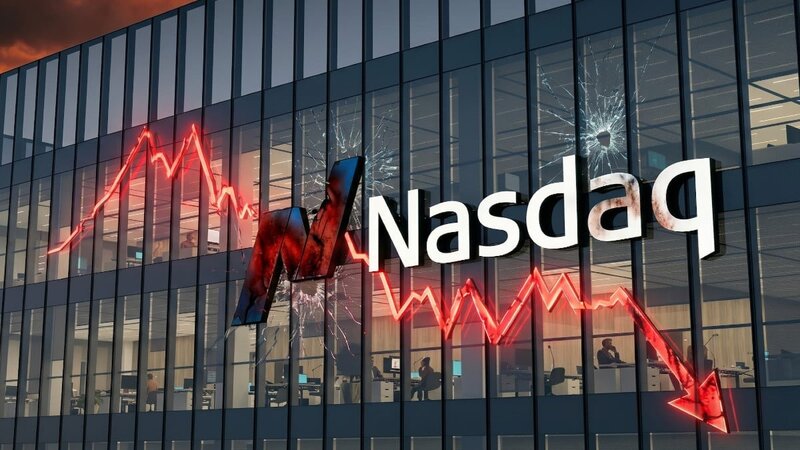
US stocks were set to open lower Friday. The selling that started overnight in Asia is now washing onto Wall Street.
Nasdaq-100 futures dropped 1.2% in early trading, and S&P 500 futures fell 0.5%. Dow Jones Industrial Average futures held up better, shedding 67 points, or about 0.1%, as money rotated out of expensive technology names and into more defensive corners of the market.
The trigger is the same one that has rattled investors all week: the soaring cost of building artificial intelligence infrastructure. Traders are reassessing whether the hundreds of billions of dollars being poured into data centers can ever earn an acceptable return, and valuations that looked untouchable a month ago are suddenly being questioned.
Asia leads the rout
The overnight session in Asia set the tone, and it was brutal.
South Korea took the hardest hit. The benchmark Kospi closed down 5.81% at 8,411.21, after an intraday slide of 8% triggered a circuit breaker that briefly halted trading. The smaller-cap Kosdaq lost 4.10%. Chipmakers led the damage, with Samsung Electronics down more than 7% and SK Hynix off about 9% as memory-chip names bore the brunt of the AI repricing.
Japan was not spared. The Nikkei 225 fell 4.15% to 69,360.88, weighed down by SoftBank Group, which plunged more than 12% — a single-stock move that says a great deal about how concentrated the AI bet has become. The broader Topix slipped 1.32%.
Mainland China’s CSI 300 dropped 3% to 4,869.64, and Hong Kong’s Hang Seng eased 1.76%. Australia’s S&P/ASX 200 was the lone bright spot, edging up 0.18% to 8,764.20, helped by its heavier weighting in banks and miners rather than chips.
For investors who have spent two years riding a handful of mega-cap winners, the message is uncomfortable: when the AI trade turns, it turns everywhere at once. It is a reminder of why some strategists have pushed clients toward broader exposure, including S&P 500 ETFs that strip out the Magnificent 7 to dilute single-theme risk.
A hot inflation print lands at the worst time
As if the tech sell-off were not enough, the Commerce Department delivered an unwelcome surprise before the open.
The Bureau of Economic Analysis reported that the Personal Consumption Expenditures price index — the Fed’s preferred inflation gauge — rose 4.1% in May from a year earlier, the fastest annual pace since April 2023. On a monthly basis, headline PCE climbed 0.4%. Core PCE, which strips out food and energy, rose 3.4% year over year and 0.3% on the month, the hottest core reading since October 2023.
Service prices did most of the work, with costlier restaurant meals, hotel rooms, auto repairs and healthcare driving the gain. “Persistently high prices are a burden for the American people, but the recent past need not be prologue,” Federal Reserve Chair Kevin Warsh said after the Fed held its benchmark rate steady at its June 17 meeting and left the door open to a rate hike later this year. Nine of the FOMC’s 18 members now project at least one hike before year-end.
The combination is the tricky part. A sliding stock market would normally argue for easier policy, but an inflation print this hot ties the Fed’s hands. That tension is why the mega-cap AI leaders are taking the heaviest punishment: their valuations depend on lower rates that the inflation data make harder to deliver.
Bonds, oil and gold
The cross-asset picture offers some cushion. The 10-year Treasury yield has eased to around 4.41%, slipping below the 4.5% mark as easing Middle East tensions and progress in US–Iran talks pulled energy prices back to pre-conflict levels. Crude’s retreat is one reason economists suspect May’s PCE could mark a near-term peak for inflation, since June’s lower energy costs are not yet in the data.
Gold continues to act as the haven of choice, trading above $4,000 an ounce as a softer dollar and lower yields lend support. The US Dollar Index sat near 101.64.
What to Watch at the Open
- Chip and AI names: Nvidia, Broadcom and the semiconductor complex will set the tone. A stabilization here could calm the broader tape; another leg down likely drags the Nasdaq with it.
- The PCE reaction in rates: Watch the 2-year Treasury yield. If it jumps, the market is pricing a more hawkish Fed — bad for growth stocks.
- SoftBank’s US-listed peers and data-center plays: The 12% drop in Tokyo is a tell. See whether US AI-infrastructure names follow.
- Defensive rotation: The Dow’s relative resilience suggests money is moving toward value. If that holds, it is a risk-off open, not a panic.
- Fed commentary: Any speech walking back rate-cut hopes after the hot PCE print could deepen the sell-off into the close.
The bottom line: this is a repricing of the AI trade colliding with sticky inflation, not a single headline shock. Until valuations and the rate outlook find a floor, expect volatility to stay elevated.
[1]