

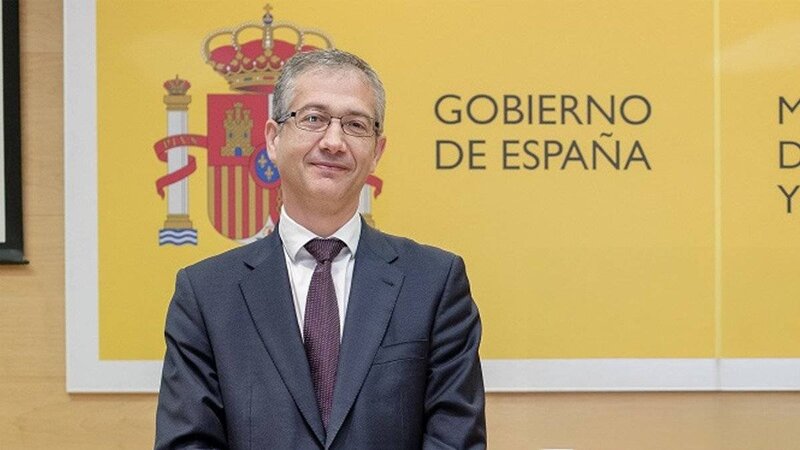
His name is Pablo Hernández de Cos, and it is increasingly appearing among the top candidates considered by economists to lead the European Central Bank when current president Christine Lagarde’s term concludes in November 2027.
The Financial Times has highlighted Hernández de Cos as a potential successor to the Eurotower, following a survey in which the City newspaper asked several economists which central banker they would most like to see take over after Lagarde.
De Cos received the highest level of consensus among the experts surveyed, alongside another banker considered a “super hawk,” the Dutch central banker Klaas Knot.
Other bankers regarded as suitable candidates for the ECB presidency include Bundesbank President Joachim Nagel, a member of the ECB Governing Council, and Isabel Schnabel, an ECB Executive Board member.
Nagel and Schnabel, both German, are known—like Knot—for their hawkish stance on interest rates and, according to their own statements, for being open to succeeding Lagarde.
Pablo Hernández de Cos, however, received the largest share of votes.
Among the 70 economists surveyed, 26% expressed a preference for him to succeed Christine Lagarde, while 24% opted for Dutch “hawk” Klaas Knot, who recently completed his second seven-year term as governor of De Nederlandsche Bank and who, a few months ago, also received praise from Christine Lagarde.
Pablo Hernández de Cos, the name is circulating amid criticism of Lagarde
But who exactly is Pablo Hernández de Cos?
What can we infer from the biography and career of the banker who, before joining the ECB Governing Council, served as governor of the Spanish central bank?
And is he truly, as Christian Kopf, head of fixed income at German asset management firm Union Investment, told the Financial Times, “the candidate with the most solid technical knowledge of monetary policy and the functioning of central banks”?
The question is increasingly relevant to investors and governments, particularly at a time when uncertainty over the trajectory of eurozone interest rates remains high—a topic that has generated continuous political debate in recent years.
The issue of Lagarde’s succession also arises at a time when the current ECB president has come under renewed scrutiny, not solely for her approach to the cost of money in the eurozone—which remained unchanged at the December 2025 interest rate meeting for the fourth consecutive time—but also for her annual salary of €726,000.
This amount is four times higher than that earned by Federal Reserve Chairman Jerome Powell and the highest salary of any European Union official.
Who is Pablo Hernández de Cos, former governor of the Banco de España: Education and Early Career
Returning to the "profile card" of Pablo Hernández de Cos, on July 1, 2025, he assumed the role of General Manager at the Bank for International Settlements (BIS), a key institution in the global financial architecture.
54 years old, Hernández de Cos was born in Madrid, Spain, on January 20, 1971.
After graduating in 1993 in Economics and Business Studies from the College of Financial Studies (CUNEF) of the Complutense University of Madrid, he earned a Law degree from UNED (National University of Distance Education) in 1994.
Ten years later, in 2004, he obtained a PhD in Economics from the Complutense University of Madrid, and in 2009 completed a Management Program at the IESE Business School.
His professional career began from 1997–2004, when he worked as an economist in the Directorate General for Economics, Statistics and Research of the Banco de España.
Between 1998 and 2004, Hernández de Cos served as a member of the ECB Working Group on Public Finances, thereby entering the ECB’s decision-making structures.
During the same period, he also contributed to the Working Group on Ageing and Sustainability, supporting the European Union’s Economic Policy Committee (ECOFIN).
In 2000, he was appointed as a national expert at the ECB Directorate General for Economic Affairs, while from 2000–2004 he also served as an associate lecturer in the Department of Economics at Carlos III University of Madrid.
Pablo Hernández de Cos’s extensive CV includes:
2004–2007: Advisor to the Executive Board of the ECB
2007–2015: Head of the Economic Policy Analysis Division at the Directorate-General for Economics, Statistics and Research (DG Economics, Statistics and Research) of the Bank of Spain
From ECOFIN to Governor of the Bank of Spain
Between 2008 and 2014, Pablo Hernández de Cos was a member of the Economic Policy Committee (ECOFIN) of the Council of the European Union.
From 2010 to 2015, he chaired the Working Group on Public Finances of the ECB Monetary Policy Committee. From 2011 to 2014, he also lectured at the Instituto de Empresa.
During 2013–2014, he was a member of the Committee of Experts for the Reform of the Spanish Tax System, and later served as Director General for Economics, Statistics and Research at the Bank of Spain.
2015 marked a turning point: Hernández de Cos became Deputy Governor of the ECB Governing Council, a member of the High Council of Statistics of Spain, a board member of the Centro de Estudios Monetarios y Financieros (CEMFI), and a member of the Board of Trustees and Executive Committee of FEDEA (Foundation for Applied Economic Studies).
Since 2016, he has been a board member of the International Center for Monetary and Banking Studies (ICMB), and since 2017, a member of the Economic and Financial Committee of the EU.
He was appointed Governor of the Banco de España in 2018, a position he held until June 2024.
During the same period, Hernández de Cos continued on the ECB Governing Council and chaired the Basel Committee on Banking Supervision from 2019 to 2024.
The banker has also held other key leadership roles at the international level, including membership in the Financial Stability Board and the BIS Group of Governors and Supervisors.
The question for European markets and governments, however, is not only Hernández de Cos’s resume, but his monetary policy vision.
First, the main concerns for eurozone citizens—facing mortgages and financing costs—are: what path would Hernández de Cos take on interest rates?
Other questions include: how would he balance inflation and GDP growth?
And finally, to what extent is there a risk—similar to the United States with the Fed—that the ECB could lose its independence and become subject to political influence?
On this last point, Christian Kopf of Union Investment is unequivocal. He says that if Hernández de Cos becomes ECB president, his technocratic career would send “a strong signal of a Europe that does not falter and of a euro that remains a strong currency.”
Pablo Hernández de Cos is also regarded as a dovish figure on interest rates, and his presidency would be favourable for households, who critics argue have seen the ECB under Lagarde prioritise inflation over overall growth.
In the past, de Cos has supported interest rate cuts to stimulate growth, though he also adopts a cautious, data-driven approach, balancing GDP growth and price stability.
He outlined his profile in a speech shortly after taking over the BIS in summer 2025, emphasizing the need for central banks not to become subservient to government economic plans:
“A clear mandate for price stability, independence, and accountability are the anchor, hull, and mast of monetary policy,” he said in Mexico, August 2025.
Hernández de Cos highlighted post-COVID inflationary challenges, praised decisive interest rate hikes, and pointed to structural issues such as geopolitical tensions, public debt, trade barriers, aging populations, AI, and climate change.
Under his leadership, the ECB would not rush to raise rates, unlike hawks such as Knot, Nagel, and Schnabel. While attentive to inflationary risks, he would adopt a gradual, data-driven approach prioritizing economic growth alongside price stability.
The difference between Hernández de Cos, close to Draghi, and Christine Lagarde
Politico notes that Hernández de Cos is a career economist and central banker, unlike Lagarde, and is considered close to former ECB president Mario Draghi. He helped restore Banco de España’s credibility during the financial crisis and is respected for his technical expertise and independence.
Spain has never held the ECB presidency, and competition with Germany may arise. Paradoxically, this could favour Hernández de Cos if other EU nations resist granting Berlin another high-level role. Another key position would likely go to a hawkish banker, ensuring vigilance over inflation while Hernández de Cos focuses on balanced growth.
Original article published on Money.it Italy 2026-01-08 16:01:17. Original title: Chi è Pablo Hernández de Cos e cosa succede se diventa il nuovo presidente della BCE