

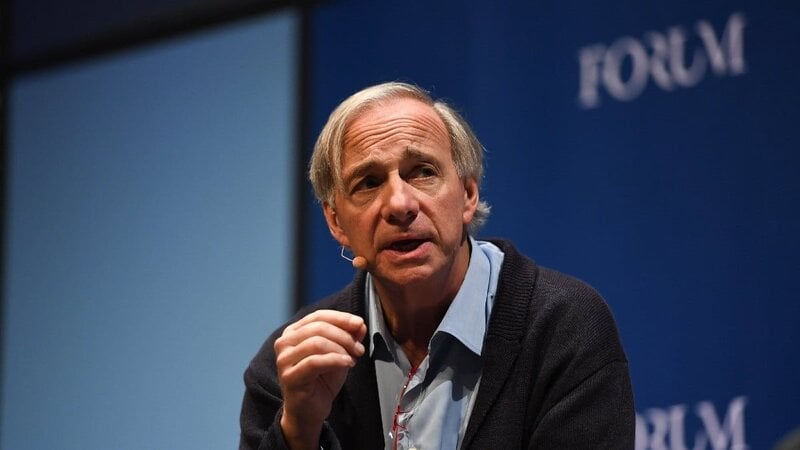
In today’s global financial landscape, marked by mounting geopolitical tensions and the possibility of a reordering of the world’s balance of power, billionaire investor Ray Dalio, founder of the hedge fund Bridgewater Associates, recently said in an interview that he holds 1 percent of his portfolio in Bitcoin.
The remark comes at a time when Bitcoin is trading at $63,520.86, down 0.85 percent on the day, while gold was quoted at $4,442.80, off 0.55 percent, and September 2026 crude oil slipped to $81.57, a 2.04 percent decline. Dalio continues to warn of a potential collapse of the international architecture built on trust in fiat currencies and sovereign institutions, pushing him to seek assets capable of preserving capital in scenarios of heightened uncertainty.
Bitcoin’s potential
Historically, Bitcoin has shown very low or even negative correlation with the main traditional asset classes, a trait that has made it a favored diversification tool among many hedge fund managers. When equity or bond markets move, the cryptocurrency can move in the opposite direction, offering a form of protection that does not depend on any central bank’s decisions.
Dalio stresses in particular that no sovereign government can dilute Bitcoin’s value through expansionary monetary policy: its total supply is rigidly capped by the algorithm at 21 million units, of which roughly 20 million are already in circulation. This programmed scarcity, combined with rising institutional adoption, creates a dynamic of growing demand against a fixed supply, potentially driving prices higher over the long run under the classic laws of supply and demand.
Gold’s role needs redefining
The comparison with gold nonetheless remains central to Dalio’s thinking. The precious metal boasts a significantly larger market and a centuries-long track record as a hedge against inflation and systemic risk. Bitcoin, often called «digital gold», is a relatively recent phenomenon and in recent years has begun to show a growing correlation with technology stocks, partly eroding its appeal as a pure diversifier.
Regulatory uncertainty also continues to weigh: while new rules under discussion could clarify the legal framework, many investors still remember the early days when several governments tried to hamper or ban the use of cryptocurrencies outright. Added to this are the technological risks Dalio himself flags, in particular the quantum threat: should advanced quantum computers manage to break the cryptography that protects the Bitcoin network, the entire system could prove vulnerable — a danger that does not apply to physical gold.
The 1 percent allocation Dalio has chosen looks like a pragmatic compromise: enough to capture the growth potential tied to scarcity and institutional adoption, yet contained enough not to expose the portfolio to excessive volatility or to risks that are still not fully quantifiable. For investors who have already lived through the extraordinary rise of stocks like Nvidia, whose performance from 2009 onward generated remarkable returns, Dalio’s signal is an invitation to carefully reassess Bitcoin’s weight within a long-term strategy.
This is not about replacing gold entirely, but about recognizing that in a world where the global order seems destined to change, even a small exposure to an asset beyond the control of central authorities can serve as an added element of resilience. The final decision will depend on individual risk tolerance, time horizon, and the ability to withstand the price swings that remain an inherent part of Bitcoin’s nature.
Editor’s note
This article was originally published in Italian on money.it by Redazione Money Premium on August 14, 2026 as «Ray Dalio investe in Bitcoin. Ecco perché sta modificando l’allocazione del suo portafoglio». It has been translated and adapted for an international audience by the Money.it International desk.