

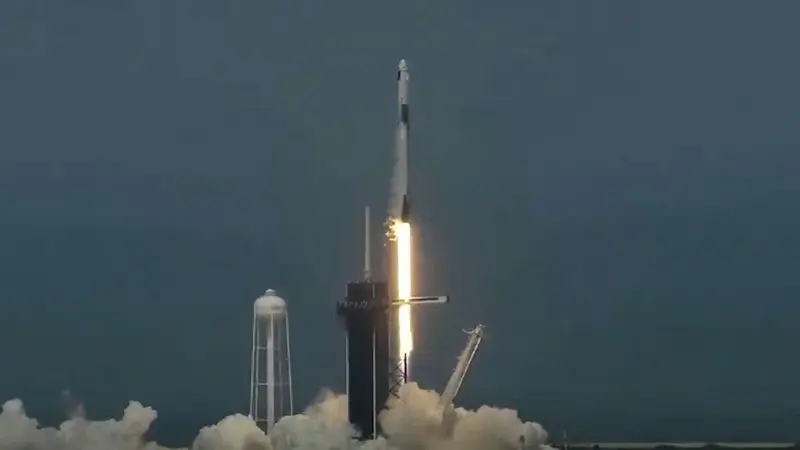
The moment has arrived. Today, Friday, June 12, 2026, marks the landmark Initial Public Offering (IPO) of SpaceX.
The American aerospace pioneer, founded by the world’s wealthiest individual, Tesla CEO and X owner Elon Musk, is officially making its debut on Wall Street with a listing on the Nasdaq.
SpaceX has been offering 555.6 million shares priced at $135 per share, implying a massive $1.77 trillion fully diluted valuation.
Musk’s strategic objective is to raise $75 billion in primary capital, a figure that cements SpaceX’s public debut as the largest IPO in corporate history.
Institutional investors, analysts, and market strategists are closely watching the opening cross and the stock’s initial trading performance.
The Largest IPO in History
The offering is widely viewed as a critical litmus test for the broader Artificial Intelligence (AI) sector.
The rationale behind this connection is that SpaceX is no longer seen solely as an aerospace manufacturer or satellite operator through its Starlink constellation.
In February of this year, the group acquired xAI—another Musk-founded venture—deepening its exposure to the AI ecosystem.
In addition, SpaceX is positioning itself as the only company capable of deploying data centers and advanced computing infrastructure directly in orbit—a thesis known as Orbital AI Compute—potentially creating an entirely new addressable market.
However, the central question dominating the debate on Wall Street remains unchanged: to what extent do SpaceX’s fundamentals justify a $1.77 trillion valuation?
Money.it spoke with market strategists to assess the company’s financial profile and examine the short- and long-term implications for AI equities.
Is the Pricing Disconnected from Fundamentals? Analyst Commentary
When evaluating what a realistic market capitalization for SpaceX might be, Igor Pejic—tech strategist, banker, and author of Tech Money—argued that traditional valuation frameworks have limited relevance:
“Traditional valuation methods don’t work for tech stocks. They work even less for frontier technologies like space. So it is impossible to put a ’reasonable’ price tag on such high growth companies”, Pejic noted.
Pejic highlighted that “at the proposed pricing, SpaceX would trade at 94 times its 2025 revenue (about $18.7
billion) while still posting a net loss of about $4.9 billion”, adding that “no traditional investor would even look at a company with such P/E ratios, but tech investors look for other indicators, namely those that foretell growth.
And those look outstanding for SpaceX”.
Pejic continued:
“Another critical indicator foreshadowing growth is the R&D/Sales ratio. SpaceX spent $3 billion on R&D in 2025, meaning the ratio was at 16%, an incredibly high number, especially since it is not a pure software company”.
This means that “the company is well positioned for explosive growth ” and that “in the long-run it has decent chances to deliver good returns even at its sky-high valuation”.
Investors should nevertheless remain mindful of the risks.
It is still high risk though. For investors that dare to take that high risk, the question is whether they can buy the stocks at a better price in the foreseeable future.
Given the extreme amount of hype swirling around SpaceX, the chances of downward price swings are high.
Expressing deeper skepticism regarding the offer price is Cody Schuiteboer, President and CEO of Best Interest Financial.
According to Schuiteboer, current pricing assumptions require near-perfect execution.
This valuation “would only be justified if you were to assume that Starlink’s subscribers would continue to grow, and that the aerospace and the AI Infrastructure verticals would achieve large, sustained revenue. I would place a reasonable estimated fair value of SpaceX, at between $800 billion and $1.1 trillion ”.
The governance issue, he argues, is being underestimated by investors.
“After the IPO, Elon Musk will still have effective control over the company and public shareholders will have almost no say over the board or control over the decisions of who the executives will be, over the deals and who will be shareholders. This is a risk that has always existed with tech and is the justification of the dual-class shares. The real problem for SpaceX is the concentration of everything to Elon Musk. The contracts with the government are dependent on Musk, the regulatory relationships and the speed of the development of Starship”.
Echoing this cautious view, Jeff Stollman—chief scientist at RMTM (Rocky Mountain Technical Marketing) and former consultant to the US Department of Defense—concluded that a justifiable fair value for the stock should be discounted by at least 50% relative to the current IPO pricing.
A “Moment of Truth” or a “Stress Test” for AI Multiples
?
When asked whether the debut represents a genuine moment of truth for the AI sector, and how AI equities could react to SpaceX’s valuation, Pejic argued that the immediate impact on publicly traded mega-cap names such as Nvidia, Alphabet (Google), and Amazon is likely to be limited.
“The SpaceX performance will, however, determine the mood for the Anthropic and OpenAI IPOs. In the long-term, strong post-IPO performance and visible progress on orbital compute would reinforce the broader AI infrastructure narrative and support multiples for companies like NVIDIA”.
Rather than describing the event as a moment of truth, Schuiteboer characterized the listing as a crucial liquidity stress test for the sector.
“If the IPO goes well and the stock holds its price for the first 60 days, it would suggest the market is hungry for AI-related stocks, and it would provide a boost to other companies in the space. If it doesn’t do as well, and the concerns of operating losses post-IPO and the price of Musk’s governance discount balance out, the AI infrastructure space could see a decline in overall interest”.
Schuiteboer summarized his outlook as follows:
“A more realistic way of looking at things is that SpaceX is a test to see if investors are OK with the valuations of the private markets as of the year 2025. If investors are OK with that, we will likely see a continued expansion of AI stocks. If not, we will see a major correction”.
Offering a more conservative perspective, Stollman argued that SpaceX’s IPO should not yet be viewed as the defining moment for AI equities:
“No.. We need ot wait to see how ChatGPT performs after both SpaceX and Anthropic hold their IPOs. Even if all goes wll for ChatGPT, the froth will not last”.
Market Liquidity Drain: Near-Term Capital Rotation and Risks for Nvidia and Microsoft
In the near term, the SpaceX IPO is expected to draw liquidity away from other mega-cap technology leaders, including Nvidia and Microsoft.
The historic offering will attract significant capital from both institutional and retail investors without materially expanding the overall pool of market liquidity, at least in the short run.
As a result, in a market already heavily concentrated in large technology companies, temporary selling pressure could emerge as capital rotates into the newly listed stock. Most analysts, however, expect any such effect to be short-lived.
Cody Schuiteboer, CEO of Best Interest Financial, shares this assessment. He noted that institutional reports suggest “institutional investors implementing the offering will likely have to liquidate 0.5–1.0% of the S&P 500 market capitalization”.
At the same time, “due to the public listing of SpaceX, structural demand for AI infrastructure does not dissipate”.
This implies that “Nvidia has no need to be concerned about the listing and the strength of SpaceX’s capital — SpaceX will more than likely become a large-scale Nvidia customer”.
Consequently, “any liquidity mechanics driven dip in Microsoft and Nvidia should be considered an investment opportunity, rather than concern for structural demand”.
SpaceX Trading Strategy: Trade the Open or Wait for the Rebalancing Catalyst?
From a portfolio-management perspective, the key question facing investors is whether to buy immediately after the IPO or wait for additional catalysts and disclosures.
Cody Schuiteboer, CEO of Best Interest Financial, advocates patience, noting that “the mechanics work in favor of the more patient investor”, while reminding investors that “SpaceX is entering the Nasdaq-100 after around 15 days of space on the exchange” and that “this triggers around $22 to $27 billion in ’forced’ mechanical buying from index funds that will track the Q’s”.
Since “institutional investors are focusing on the rebalancing event, which will happen in the first days of July”, Schuiteboer said:
“If you decide to buy on day one, you are competing with that rebalancing premium. If you hold out for the post-lock-up selling (insiders selling their shares) and the IPO enthusiasm dies down, you will more likely be buying the stock at a price that the publicly available financials (which are likely to be worse than the roadshow people are showing you) reflect”.
When asked whether he would buy SpaceX shares immediately after the IPO or wait for additional financial disclosures, Stollman noted that “SpaceX might be a good buy at its opening and rise for a short peroid. But I wouldn’t invest in it as a long-term hold for another year, because I expect it will be lower then”.
The ultimate verdict now rests with the market and how SpaceX shares continue to trade on the Nasdaq in the hours and days ahead.