

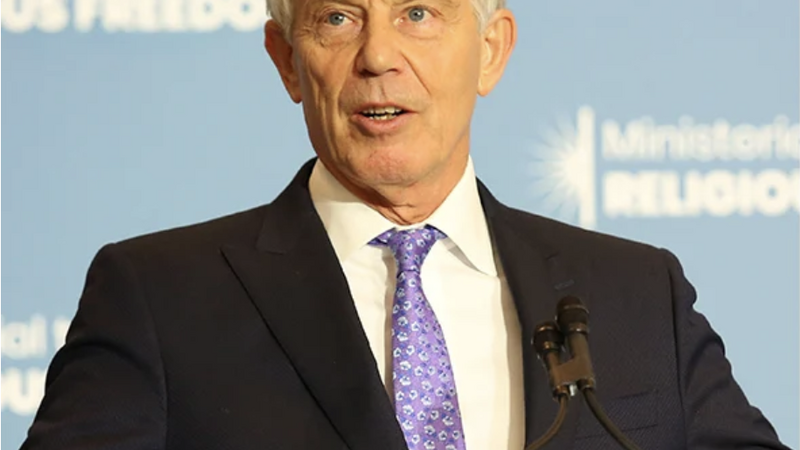
Former prime minister Tony Blair, who served as UK prime minister from 1997 to 2007, has never entirely abandoned the political sphere. He launched his scathing attack on the current trajectory of British and western politics in an essay published online by his Tony Blair Institute for Global Change. The institute counts on many well-known names as strategic counsellors, including Matteo Renzi and Sanna Marin.
Net-Zero
In his 5,700-word essay, Blair touches on multiple themes that he sees as deeply damaging to the current trajectory taken by large parts of the western world. He suggests, at number three of his ten-point plan, that:
‘We must prioritise cheaper energy and electrification over net zero and use what is left of our North Sea oil and gas resources. This is essential for our competitiveness and for taking advantage of AI.’
Blair’s criticism of the strong drive towards carbon neutrality and the fight against climate change came as a shock to large parts of the British political scene and set alarm bells ringing not only in the UK, but also across Europe. Meanwhile, the EU as well as the UK have aspirational targets to reach net-zero carbon emissions by 2050.
Trump’s US
Blair, in his essay, also hammers home the message that a good relationship with the US, no matter who happens to be in the White House, is essential for the whole of the western world.
In advocating for a radical centrism, capable of reinjecting mainstream politics with some innovation and energy, he praises the approaches of some of the more populist world leaders, saying that Donald Trump and Javier Milei’s approach to doing politics is not constrained by conventional thinking, and is simultaneously high in potential risk and in potential effectiveness.
Blair’s remarks reflect a growing difficulty in many countries across Europe about what approach to adopt with President Trump’s US. While distancing themselves entirely from Trump-era America risks weakening western unity at a time of heightened geopolitical instability, many are conscious that Europe must maintain good relations with the other side of the Atlantic for the post-Trump era.
Unwavering support for business
The first of the ten points in Blair’s plan is that of unwavering support for business, and the elimination of obstacles to business growth. He insists that business and entrepreneurs need to know government is on their side. Blair calls for making business feel respected and supported.
The essay leaves little room for doubt on Blair’s position on Keir Starmer’s government, which since its 2024 election win, has significantly increased tax contributions paid by businesses for each employee.
European businesses are increasingly facing the costs of geopolitical instability and regulatory pressures linked to economic modernisation and the green transition. This comes at a time when, in many of Europe’s most established economies, unemployment is rising. In France, Denmark, Germany and Belgium, in the year to January 2026, unemployment increased: in Denmark this increased from 6.6 per cent to 7.5 per cent. Blair’s message of support for business could be of relevance for those countries struggling with growth and job creation.
Lessons for the future
Without doubt, Blair’s openly hostile position towards the current UK government sent shockwaves through the corridors of power in London. However, the essay is not only a lesson for prime minister Keir Starmer. While some of its points are without doubt deeply destabilising for the political classes of the whole of the European continent, there are some insightful comments that the developed world’s leaders should consider, reflecting on the arguments put forward by one of Britain’s most influential modern political figures.
Whether this provocative essay represents a realistic blueprint for political renewal or simply a critique of the current western consensus seems to remain uncertain. What is clear, however, is that his intervention has reopened debates over energy, economic growth, and the future direction of western democracy at a time of mounting political instability across Europe and the United States, at a moment when political consensus around issues such as the green transition had appeared firmly established.