
On Friday, the American economy did exactly what it is supposed to do. It created jobs — 172,000 of them in May, roughly double what economists had penciled in. Unemployment held steady at 4.3%. Average hourly earnings rose 3.4% over the year, comfortably ahead of inflation. “Total nonfarm payroll employment increased by 172,000 in May,” the Bureau of Labor Statistics reported, “and the unemployment rate was unchanged at 4.3 percent.” A worker who read only that release would have closed the page reassured.
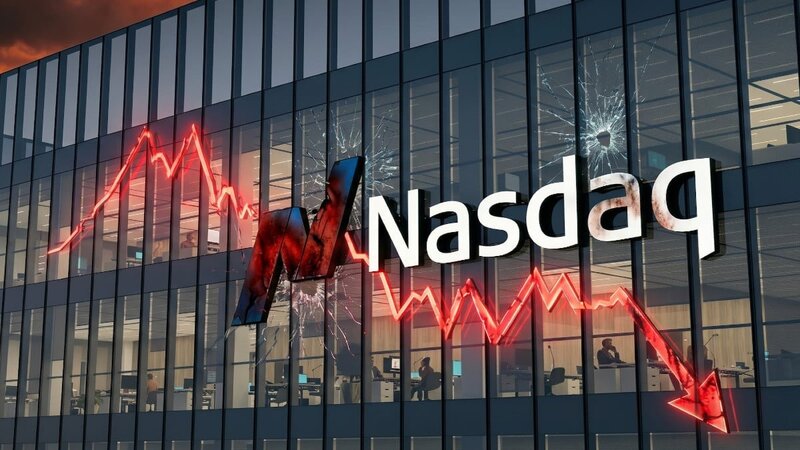
Wall Street read the same numbers and ran for the exits. The Nasdaq fell 4.18%, its worst single session in more than a year. The S&P 500 dropped 2.64%. More than a trillion dollars in market value evaporated between the opening bell and the close. The chip stocks led the rout — Nvidia alone shed over $300 billion — but do not let the semiconductors distract you. The market did not fall despite the strong jobs number. It fell because of it.
Read that sentence again, because it is the entire story, and almost no headline said it plainly. We have built a market that is now afraid of good news about the country it is supposed to represent.
Why prosperity became a sell signal
The mechanism is not mysterious, and that is what makes it disturbing. A hot labor market gives the Federal Reserve every reason to keep money expensive and no reason to cut. Treasury yields duly jumped, the ten-year pushing past 4.5%. And a market priced for cheap money cannot breathe without it. The most expensive stocks — the AI names carrying valuations that only make arithmetic sense if borrowing stays nearly free forever — fell hardest, precisely the way a leveraged bet collapses the moment the leverage is withdrawn.
Laid bare, the chain of logic runs like this: the economy is strong, so the Fed stays tight, so the rate cuts the market has been praying for keep receding, so the speculative premium deflates. A great week for the worker is a terrible week for the speculator. Good news for Main Street has become bad news for Wall Street — and the fact that we now state this as a banality, a thing every trader nods along to, is the symptom we should be examining, not the moves on the screen.
Keynes wrote the diagnosis in 1936
There is a line that has been quoted so often it has gone soft, but Friday gave it its teeth back. “When the capital development of a country becomes a by-product of the activities of a casino,” John Maynard Keynes wrote in The General Theory, “the job is likely to be ill-done.” He was warning that a financial market is meant to be a servant of the real economy — a mechanism for channeling savings into the factories, the homes, the inventions that make a nation richer. When the servant becomes the master, when the daily question stops being is the country prospering? and becomes what will the central bank do next?, the market has quietly inverted its own purpose.
That inversion is what we watched on Friday, in real time, with a stopwatch. The signal that should have mattered most — a healthy, hiring, wage-paying economy — was treated as a threat. The signal that actually moved prices was a guess about the next Fed meeting. The thermometer is no longer reading the patient’s temperature. It is reading the doctor’s mood, and it has decided it prefers the patient sick, because a sick patient gets the medicine of cheap money.
This is the deeper story behind every debate about whether AI is a financial bubble. The bubble question is, in a sense, downstream. The root condition is a market so financialized, so addicted to monetary stimulus, that it has come to root against the very prosperity it claims to track. We have spent fifteen years training an entire generation of investors to read a strong economy as a danger and a weak one as an opportunity. On Friday the training showed.
To be fair to the optimists
None of this, to be honest, is yet a catastrophe, and the bulls have a case worth hearing. Friday was a repricing, not a panic; the small-cap Russell 2000, full of ordinary domestic companies, actually rose. The hyperscalers are funding their AI buildout largely from profits rather than debt, which makes this nothing like 2008. A market that has run to records for two years was always going to wobble on a hot print. Perhaps this is simply the healthy exhale of an overstretched lung, and by next week the reflex to buy every dip will reassert itself, as it almost always has.
Perhaps. But notice that even the optimistic case concedes the premise. It does not argue that the market welcomed the good news. It argues only that the market’s fear of good news is survivable. That is a remarkable thing to have to take comfort in.
The confession in the crash
So here is the monito, and it is not really about stocks. A market is supposed to be the place where a society bets on itself — on its workers getting raises, its companies growing, its economy compounding. When that same market learns to sell on the news that the workers got their raises, it has confessed something about what it has become: not a measure of the country’s prosperity, but a leveraged wager on the central bank, indifferent or even hostile to the prosperity itself.
The crash will be forgotten in a month; markets always heal the bruise and keep the habit. What should stay with us is the confession underneath it. An economy whose financial markets have learned to fear their own people’s good fortune has misplaced the thing markets were invented to serve. Friday was not the disease. It was the X-ray.