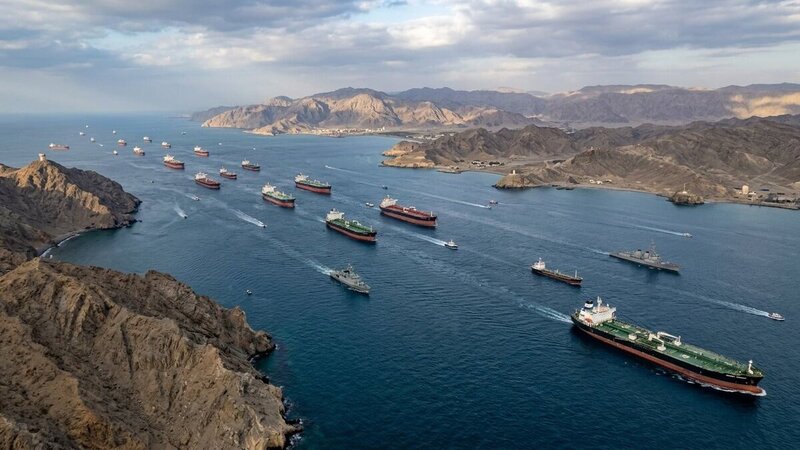
The Strait of Hormuz has been the single most sensitive chokepoint in global energy geopolitics for decades. Roughly one-fifth of the world’s oil passes through this narrow waterway every day, which means any instability in the area is an immediate threat to financial markets and to the energy supply of Western and Asian nations alike.
Whenever geopolitical tensions flare up, the specter of a closure of the strait resurfaces right on cue. Yet establishing who actually holds the legal power or authority to block this passage is far from intuitive. It involves a tangle of geopolitical balances, international treaties that not every superpower has ratified, and competing interpretations of the rules that govern maritime navigation.
The geography of the strait and the sovereignty of its waters
To understand the legal side of the Strait of Hormuz, you have to start with its geography. At its narrowest point, the distance between the Iranian coast and the Omani peninsula is just 21 nautical miles (about 39 kilometers). That detail is crucial in light of the rules laid down by modern international law, which grants every coastal state the right to claim a band of territorial sea extending up to 12 nautical miles from its coastline.
Because the total width of the strait is less than the combined territorial waters of the two countries (24 miles), there is no strip of international waters or high seas within the Strait of Hormuz where navigation is entirely free of state control. Any vessel crossing the strait must therefore pass through the territorial waters of either Iran or Oman. To keep order, dedicated shipping lanes have been established for commercial traffic, located mostly within Omani jurisdiction.
Two different legal regimes: innocent passage and transit passage
The United Nations Convention on the Law of the Sea (UNCLOS), signed at Montego Bay in 1982, sets out the rights and duties of coastal and seafaring states, and introduces a fundamental distinction between two different navigation regimes that apply within territorial waters.
The first is innocent passage, the standard rule that applies to a state’s ordinary territorial waters. It allows foreign ships to transit freely, provided the passage is swift, continuous, and does not threaten the peace or security of the coastal state. If a state believes a ship is violating these conditions, it has the right to temporarily suspend transit to protect its borders.
The second regime is transit passage, created specifically to prevent the blocking of major global trade flows. This rule applies exclusively to straits used for international navigation that connect parts of the high seas or exclusive economic zones. Transit passage guarantees all ships, including submarines and military vessels, a continuous and non-suspendable right of transit. A coastal state cannot obstruct the flow of maritime traffic, nor can it impose passage fees or tolls.
The positions of Iran, Oman, and the United States
The Strait of Hormuz is nonetheless a special case, because the Montego Bay Convention has never been ratified worldwide. Oman, which ratified the convention in 1989, maintains reservations tied to its national security, while historically striving to preserve a neutral diplomatic role and to facilitate international commerce.
Iran, by contrast, signed the treaty in 1982 but never formally ratified it in parliament. Tehran argues that the transit passage rules are binding only on states that have completed the ratification process. For that reason, Iran applies the innocent passage regime to the Strait of Hormuz. Under Tehran’s interpretation, this regime gives it the ability to inspect, divert, or seize vessels it deems hostile or dangerous to national stability.
Opposing the Iranian view are the United States, which, despite not having ratified UNCLOS, recognizes much of it as customary law. Washington maintains that the principle of transit passage is by now a well-established international custom, applicable to any strategic strait worldwide, regardless of which treaties a country has signed.
It is precisely from this legal discrepancy that the constant military and diplomatic friction in the area springs, with Western navies ready to escort merchant ships to guarantee what they consider a universal right to free navigation.
How a de facto blockade happens without formally breaking the law
In peacetime, a formal declaration by Iran or Oman closing the strait would carry no legal legitimacy and would be treated as an act of military aggression, inevitably followed by an international armed response. That is true on paper, but geopolitical reality shows that an effective blockade can be carried out even without a formal declaration of war.
Trade routes can in fact be interrupted through asymmetric warfare or bureaucratic pressure. The temporary seizure of tankers on the pretext of environmental violations, the use of drones, or the mere threat of laying naval mines are each enough to destabilize the entire area.
In these scenarios, the closure of the strait is not decreed by a law or a government, but by the laws of the insurance market. As soon as the perceived risk climbs past a certain threshold, insurance companies raise war-risk premiums to unsustainable levels, or refuse to cover ships bound for the strait altogether. Without insurance coverage, shipowners choose on their own not to risk their vessels and cargo, producing a real blockade of oil flows without a single cannon shot being fired at the merchant routes.
Editor’s note
This article was originally published in Italian on money.it by Emanuela Ceccarelli on July 17, 2026 as «Chi può bloccare lo Stretto di Hormuz? Le regole spiegate in modo semplice». It has been translated and adapted for an international audience by the Money.it International desk.