

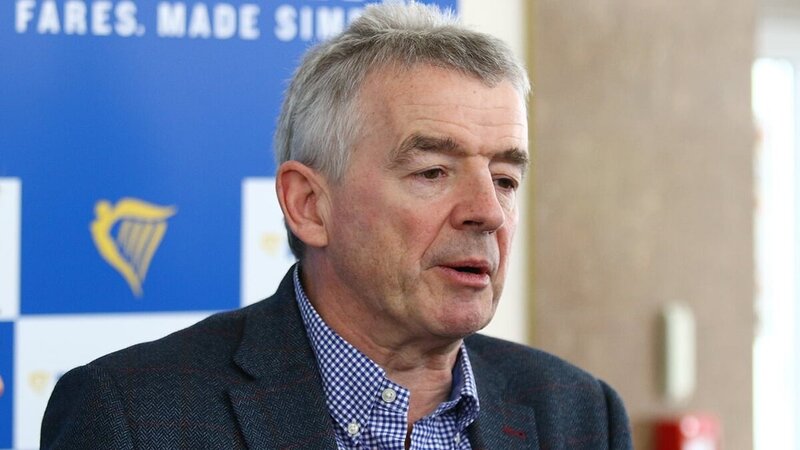
For thirty years he sold flights at impossible prices, treating his passengers like cargo to be stowed and his critics like background noise. Today, though, the background noise has grown deafening. Ryanair closed the first quarter of its 2027 financial year with a net profit of €538 million ($581 million), down 34% from the €820 million ($886 million) posted in the same period a year earlier, and the stock in Dublin fell more than 6%. The paradox is that there were more passengers, not fewer: 61.3 million between April and June, up 6%. It’s just that, to fill its planes in an environment marked by the war in the Middle East, average fares were cut by 6% while the cost of fuel kept climbing.
And then there is July 10. A shattered window on a Boeing 737 that had taken off from Thessaloniki, the cabin depressurized, a passenger pulled up to the shoulders out of the aircraft at an altitude of more than 5,000 meters (about 16,400 feet). On the sidelines of the earnings presentation, Michael O’Leary attributed the episode to a foreign object that had ended up in the engine during takeoff — a formulation that drew criticism. Who, then, is the man holding Europe’s largest airline in its most difficult quarter?
Who is Michael O’Leary, the CEO of Ryanair
He is not an airline man. He is a numbers man. Michael O’Leary is an accountant by training, who came up professionally in auditing before entering the orbit of Tony Ryan, Ryanair’s founder, whose personal financial adviser he became. From there, the climb: he has led the company since 1994, a tenure of more than thirty years with no equal among Europe’s major carriers.
His insight was at once obvious and revolutionary: to import the American no-frills model into Europe and push it beyond every limit considered acceptable. A single-type Boeing 737 fleet to slash maintenance and training costs, routes to secondary airports, a bare-bones ticket and everything else for a fee. The result is the carrier that redrew the geography of continental tourism.
Around that strategy, O’Leary built a persona: deliberately provocative statements, head-on clashes with unions, airport authorities and governments, an ostentatious refusal of any corporate diplomacy.
It is the same style seen again in recent days, when he flatly rejected any suggestion that the July 10 incident stemmed from the state of the fleet, noting that the aircraft involved is 18 years old and that its engine had undergone full maintenance and an overhaul within the past two years.
The difference, today, is that he is judged not only by passengers and the press but by the U.S. National Transportation Safety Board (NTSB), which is investigating what happened. A first draft of the report is expected within roughly 28 days.
How much does O’Leary earn as Ryanair’s CEO?
Here the persona falls away and the numbers remain.
O’Leary’s base salary has risen from €1.2 million to €1.8 million ($1.3 million to $1.9 million), a 50% increase, decided as part of the contract extension formalized in June 2026 and detailed in the group’s annual report.
The new agreement ties him to Ryanair until March 2032, four years beyond the previous expiry set for April 2028.
The contract, though, is stricter than the raise suggests. Fixed pay is frozen for the entire term, the annual bonus cannot exceed 50% of base salary, there are no pension benefits, and a 12-month non-compete clause has been added. In the most recent reported financial year, the total package came to €3.83 million ($4.1 million), including €600,000 ($648,000) in bonus and non-cash accounting charges tied to stock options.
The real incentive is of a different order of magnitude. O’Leary has been granted the option to buy more than 10 million Ryanair shares at €26.70, the level at which the stock traded before the war in Iran. Exercising it requires three conditions: staying in office until April 2032, a share price above €42 for 28 consecutive trading sessions, and an annual net profit above €4 billion ($4.3 billion). The potential payout is worth about €153 million ($165 million).
The gap to close is enormous: profit for the financial year ended in March came in at €2.26 billion ($2.44 billion), and the stock closed at €26.33. That is the real reason why, at Ryanair, the quarter just filed weighs more than the bare numbers suggest.
Editor’s note
This article was originally published in Italian on money.it by Emanuele Di Baldo on July 23, 2026 as «Chi è e quanto guadagna Michael O’Leary, CEO di Ryanair». It has been translated and adapted for an international audience by the Money.it International desk.