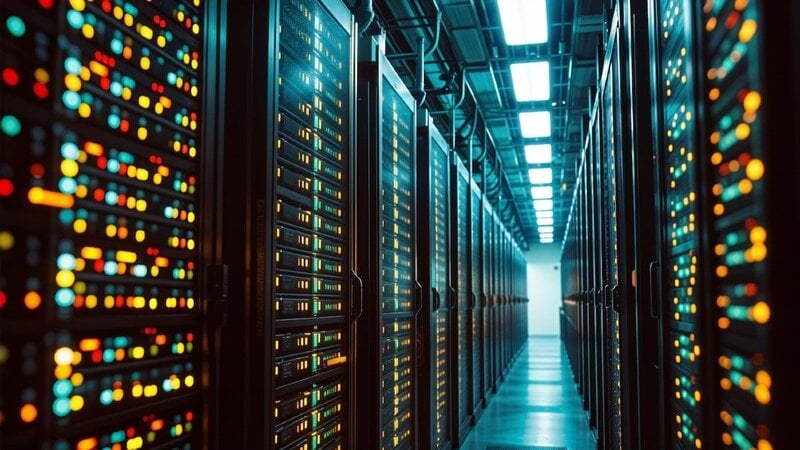
AI chatbots have become some of the most heavily used tools on the internet, for work and for leisure alike. You open one, click on the text box, type a prompt. What few people picture is what sits on the other end: a data center running servers that consume water to stay cool. According to the study “One Quarter of Global Data Centers are Located in Water Stressed Areas”, published in Environmental Science & Technology, that side of the ledger deserves far more attention than it currently gets.
Roughly one in four of these buildings stands in a region where demand for water exceeds supply for at least one month a year. Researchers examined 9,347 operating data centers; of those, 2,315 are located in drought-prone areas. Annual water use is estimated at between 313 billion and 764 billion liters (about 83 billion to 202 billion gallons), a figure that could more than double by 2030. Cause for concern? It is, once you consider that the upper end matches the volume a developed country such as the Netherlands withdraws each year for household and municipal use.
What the research found
The researchers began from a list of operational data centers supplied by the private firm Saoradh Enterprise Partners LLC, then calculated a monthly water deficit for each site — the months in which a region consumes more water than nature replenishes. To put hard numbers behind it, they ran two simulations.
The first used water conditions as estimated between 2001 and 2010; the second used projections for a world 3 degrees Celsius (5.4°F) warmer, a realistic outcome if emissions stay high. Water use at individual buildings could not be measured, given the absence of consistent data on cooling systems, but the sites where these data centers operate could be verified.
Although nearly four in ten data centers are in the United States, the regions most at risk are South Asia and the Middle East. In India, 73% of data centers face at least one month of water scarcity every year, and 33% face between nine and twelve. In the United Arab Emirates, 93% sit in areas with some form of shortage.
The other side of the shortage
Unlike electricity, water consumption is tied directly to the availability of rivers and aquifers. Data centers themselves are unlikely to run dry, not least because of the supply agreements they have secured. So who absorbs the shortfall? Farmers above all, forced to rethink the resources they can put toward irrigation. In a scenario that remains distant for now, it could extend to restrictions on household water use and a steady thinning of rivers.
The study concludes that the real trouble would begin in the absence of transparency around reported water-consumption data — the factor that will inevitably determine whether it is residents of neighboring areas who end up paying the price.
Editor’s note
This article was originally published in Italian on money.it by Pasquale Conte on October 23, 2026 as «Intelligenza artificiale, il rischio nascosto dei data center. Uno su quattro è in zone a rischio siccità». It has been translated and adapted for an international audience by the Money.it International desk.