
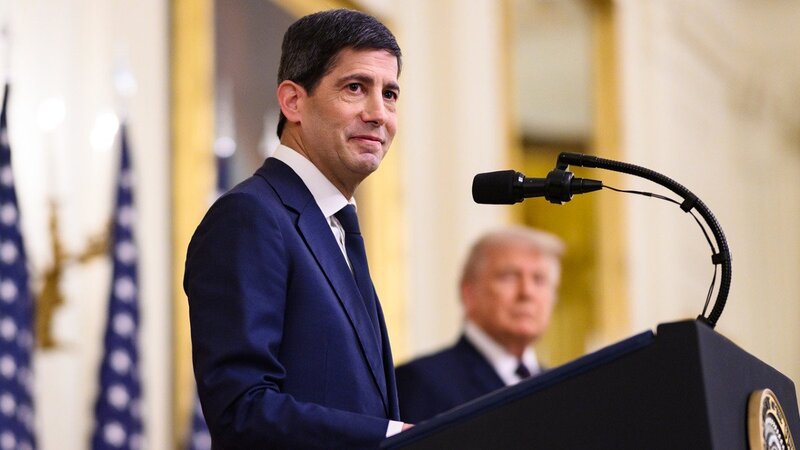
Under the leadership of newly appointed Fed Chair Kevin Warsh, the Federal Reserve is entering a distinctly different phase.
Speaking to Money.it, Matt Hasan, founder and CEO of aiRESULTS and a former senior executive at firms such as Deloitte and Citigroup, outlined what he describes as the early-stage transformation of the U.S. central bank under Warsh’s first period at the helm.
According to Hasan, the shift goes well beyond a more hawkish stance on interest rates. The real change is philosophical: the Fed’s overall operating framework appears to be evolving.
“The Fed appears less interested in reassuring markets and more focused on responding to incoming economic data. That’s a meaningful shift”.
In Hasan’s view, the Federal Reserve now appears less concerned with actively managing market expectations and more focused on reacting to incoming economic data in real time. That, he argues, is a meaningful shift in communication and policy behavior.
He broadly supports the initial steps taken by Warsh, including the removal of forward guidance and the creation of five dedicated task forces aimed at conducting a comprehensive review of monetary policy and related frameworks.
Hasan argues that forward guidance had gradually become a constraint, forcing the Fed to manage market expectations as much as, if not more than, underlying economic conditions. Removing it, in his view, restores flexibility:
“Forward guidance became a constraint that often forced the Fed to manage market expectations instead of economic realities. More flexibility is generally a good thing”.
No “revolution,” but a shift in Fed–market dynamics
Hasan does not describe Warsh’s approach as a revolution, emphasizing that the Fed’s mandate remains unchanged.
However, he does believe the relationship between the central bank and financial markets may evolve significantly:
“I wouldn’t call it a revolution. The mandate hasn’t changed. What may be changing is the Fed’s relationship with the markets, and that could matter more than any single rate decision”.
Rate outlook: no hikes expected before late 2026
On the policy outlook, Hasan expects the current stance to hold for an extended period.
When asked about the timing of the next rate hike, he suggested:
“Probably not before late 2026. The Fed will want more evidence on inflation, growth, and energy markets”.
That said, he does not rule out isolated moves: “If inflation remains sticky, a 25-basis-point hike by year end would not be surprising”.
Markets and Wall Street positioning
Following the Fed meeting on June 17 under Warsh’s leadership, Bank of America took a notably more hawkish stance on the outlook for rates.
Market pricing now reflects a roughly 30% probability of a 25-basis-point hike at the July 28–29 FOMC meeting, with expectations rising to around an 80% probability for a tightening move by the September 15–16 meeting.
Bank of America analysts are even more aggressive in their baseline scenario, projecting three rate hikes in 2026—totalling 75 basis points.
Those moves would be expected around the September, October, and December FOMC meetings.
If realized, that path would lift the federal funds rate into the 4.25%–4.50% range by the end of 2026.
This marks a sharp reversal from the bank’s previous view, which had assumed no rate changes throughout 2026.
The revision reflects a combination of a resilient labor market and persistently elevated inflation in the U.S.
Analysts also highlighted signals from the latest Fed dot plot, noting that 9 out of 18 FOMC members now anticipate at least one rate hike this year.
Bank of America economist Aditya Bhave also noted that Warsh’s press conference carried a hawkish tone, repeatedly emphasizing the need to restore price stability, even while suggesting that policy may not yet be highly restrictive.
Bhave described a potential hike as “on the table”, possibly as soon as the July meeting.
However, the bank’s base case still assumes action beginning in September, given the Fed’s tendency to wait for additional summer macroeconomic data before adjusting policy.
Inflation remains the key risk
Recent inflation data continues to complicate the outlook. The Fed’s preferred inflation gauge, core PCE, rose 3.4% in May, while headline PCE increased to 4.1%, up from 3.8% in April, both still well above the Fed’s 2% target.
Despite more hawkish calls from some Wall Street banks, not all economists expect further tightening in 2026.
Hasan himself remains in the camp of policy stability, while acknowledging that a late-cycle rate hike cannot be fully ruled out.