
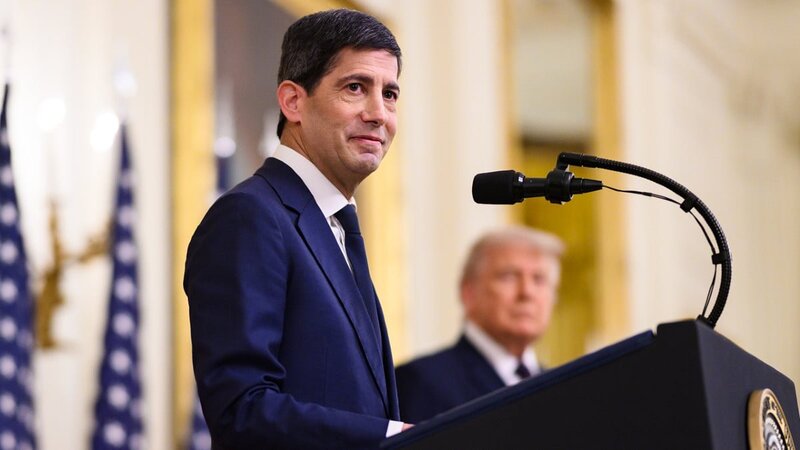
After the ECB, it is the turn of Kevin Warsh’s Federal Reserve to make the big announcement on US interest rates.
Will rates be left unchanged once again, or will they be raised, with Warsh having repeatedly stressed the need to bring US inflation back to the 2% target?
FOMC meeting, July 28-29: here we go
The market’s answer looks clear, even though, over the latest Wall Street sessions, the probability of a monetary tightening at this imminent July 28-29 meeting has risen.
According to the CME Group’s FedWatch tool, which is based on the prices of 30-day fed funds futures contracts, the probability of a rate hike has climbed to 34.3%, up from 12% two weeks ago.
The increase is explained by the winds of war in the Middle East, which have started blowing harder again after the flare-up of the conflict between the United States and Iran, with the end of the truce between the two sides.
Higher, in any case, remains the probability that fed funds rates will be held in the 3.5% to 3.75% range, for the fifth consecutive time.
The Fed’s July 29 decision on US rates
The rate decision is expected at 8:00 p.m. Italian time on Wednesday, July 29, 2026 (2:00 p.m. Eastern), at the close of the meeting of the FOMC (Federal Open Market Committee), which begins on Tuesday, July 28. At 8:30 p.m. Italian time, Federal Reserve Chair Kevin Warsh will open the press conference, taking questions from reporters after his debut at the June 17 meeting.
His most recent remarks, including those delivered in Sintra, sent more than one message to investors: the “tax” of inflation remains the challenge to beat for the US central bank, which nonetheless, under Warsh’s leadership, wants less and less “forward guidance.”
The end of forward guidance? Gregory Daco’s “significant paradox”
Several economists and market experts have discussed the end of forward guidance, among them Gregory Daco, chief economist at EY Parthenon and president of the NABE (National Association for Business Economics), one of the most cited economists in the world in the field of US macroeconomics and Federal Reserve monetary policy.
In his post Less Guidance, More Discretion: The Warsh Fed Takes Shape, Daco wrote that Kevin Warsh has “signaled a preference for less frequent use of press conferences, arguing that they are an important communication tool that should nonetheless be used sparingly, and above all when there is genuinely relevant news to convey.”
Daco continued, adding that “the Chair’s preference for more measured communication was evident.”
On forward guidance specifically, the EY Parthenon chief economist recalled that “Warsh argued that excessive interaction between Federal Reserve communication and financial markets can prove counterproductive,” and that “his preference is for markets to infer the likely path of monetary policy on the basis of incoming economic data.”
In practice, for the helmsman of the US central bank, Daco noted, “the prices of financial instruments represent ’the single most important source of information’ available to central banks.”
Daco also referred to what he called a “significant paradox,” namely the fact that “Warsh has repeatedly emphasized the importance of restoring and maintaining price stability,” while largely “avoiding answering questions about the Federal Reserve’s reaction function, that is, how the central bank intends to respond to evolving macroeconomic data.”
There is more. The impression is that the Fed Chair “downplayed the level of disagreement within the FOMC, despite the evident divide between members in favor of tighter monetary policy and those leaning toward a more patient approach.”
What markets are pricing and what economists are betting on
That said, given the incoming macro data, what can be expected from Warsh’s Fed, not only on Wednesday, but across all of 2026?
Daco, interviewed by CBS News, said that if inflation were to reignite in the wake of the US-Iran war, the probability of a rate hike could rise later in 2026: «While a monetary tightening in July remains highly unlikely, the September FOMC meeting could become the first significant test of how durable the improvement in inflation really is.»
His base case, for now, remains a Fed that stays on hold through year-end. But, he added, «we assign this scenario a probability of 60%, versus 40% for an alternative scenario.»
Everything, then, could change at a moment’s notice, in a phase in which Middle East tensions are dictating the course of inflation.
The crucial question is what might happen to US fed funds rates following the imminent FOMC meeting. A recent Reuters article reported that markets are pricing two rate hikes by the end of March 2027, fearing an inflation rate that the Fed will keep struggling to rein in and, above all, to bring back to the 2% target. All 104 economists polled by Reuters said they expect fed funds rates to be left unchanged by Warsh on Wednesday.
Among them, however, three-quarters, or 78, said they believe rates will then not be touched until the end of the year. It is worth noting that, compared with the survey a month earlier, the new development is that, among those forecasting a change in rates, economists projecting at least one hike over the course of 2026 now prevail, while only six still expect rate cuts.
Moreover, most of the economists who answered a separate question on the possibility of a rate hike in 2026 described the probability as “high,” the opposite of last month, when the likelihood of a monetary tightening had been called “low.”
Goldman Sachs: the oil rebound clouds the short-term inflation outlook
After all, as Goldman Sachs’ research division noted in a note published on Monday, «oil prices have rebounded 35% from their early-month lows to $97 a barrel, calling into question what until recently looked like a very favorable scenario for inflation in the short term.»
At the same time, the analysts added that «we nonetheless continue to expect contained increases in core inflation in July and August.»
Looking ahead in the near term, Goldman Sachs forecasts a month-on-month rise in the core CPI index of 0.21% in July and 0.23% in August, for a year-on-year core inflation reading of 3.05% (still, however, well above the Fed’s 2% target).
The same survey found that expectations for the US unemployment rate stand at around 4.2%, while GDP growth is seen averaging 2%, estimates that confirm there is no particular obstacle making it difficult for Warsh to raise rates in order to bring inflation back into line.
Editor’s note
This article was originally published in Italian on money.it by Laura Naka Antonelli on July 27, 2026 as «Previsioni riunione Fed 29 luglio. La scelta di Warsh sui tassi USA secondo gli analisti». It has been translated and adapted for an international audience by the Money.it International desk.