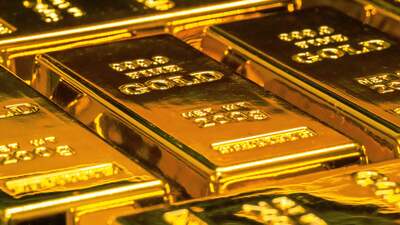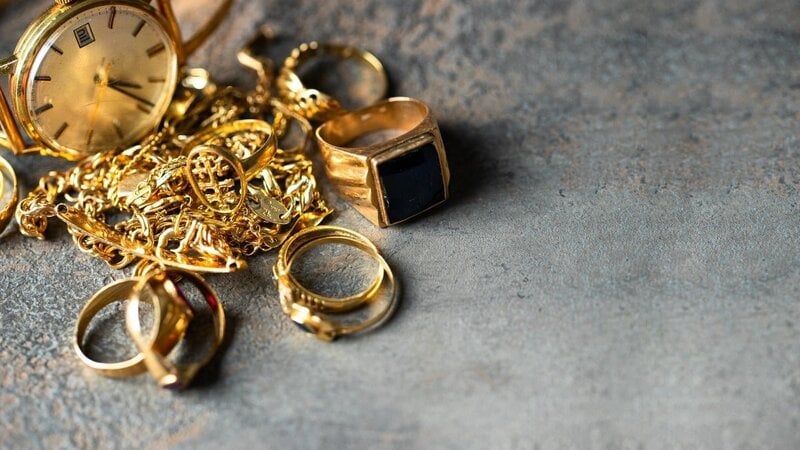
Anyone sitting on old jewelry, coins or small gold and silver bars has spent the past few weeks in doubt. After the records set at the start of the year, prices have fallen sharply, and on Wednesday, October 14 they took another hit: gold (XAU/USD) lost 2% in a single session, dropping to $4,075 an ounce, while silver (XAG/USD) shed roughly 6%. Is it better to sell now, before prices slide further, or to wait for the rebound many analysts consider probable?
No one can say with certainty where prices are headed in the coming weeks. What you can do is understand what is moving the market, what the metal in your drawer is actually worth today, and which mistakes to avoid at the moment of sale, which often matter as much as the timing.
What gold and silver are worth today
At 10:30 a.m. CET on Thursday, October 15, gold was trading at $4,156.99 an ounce (+1.26%), recovering after the previous session’s drop. Silver stood at $56.84 an ounce.
Converted into euros at the October 14 closing rate ($1.1158 to the euro), that works out to roughly €119.8 per gram (about $133.70) for pure gold and roughly €1.64 per gram (about $1.83) for pure silver.
For anyone selling jewelry, though, what counts is the fineness of the metal. A gram of 18-karat gold contains 75% pure gold and is therefore worth, as metal, about €89.8 (roughly $100.20), while a gram of 14-karat gold is worth about €70.1 (roughly $78.20). For 925 sterling silver, the grade most common in flatware and jewelry, the metal is worth about €1.52 per gram (roughly $1.70). These are reference values, and buyers always pay somewhat less, to cover costs and margins.
Why gold and silver prices are falling
Measured against the all-time highs reached in late January — $5,589.38 for gold and $121.67 for silver — the decline is deep: gold has lost about 26%, silver more than 53%.
The most recent blow came from US inflation data, which showed consumer prices rising 0.6% in September from the month before, the fastest increase since April, driven by energy costs tied to the conflict with Iran. On an annual basis, inflation stands at 3.7%. Markets responded by raising to roughly 30% the probability of another Federal Reserve rate hike at the October 27–28 meeting. Higher rates make interest-bearing assets such as bonds more attractive, while gold yields nothing. They also strengthen the dollar, and a strong dollar makes the metal more expensive for buyers using other currencies. Austan Goolsbee, president of the Chicago Fed, called the inflation figures «discouraging».
Silver has suffered more because, on top of being a safe-haven asset, it is an industrial metal, and so it is exposed both to rate expectations and to expectations about the economy. That is why it always swings more widely than gold, on the way up as on the way down.
Why many analysts remain optimistic
Alongside the short-term factors, others continue to support gold over the long run. According to the Financial Times, several fund managers expect the metal to reach new all-time highs within 24 months.
Speaking on Wednesday at the Precious Metals Symposium organized by the British newspaper, Charlotte Yonge, a portfolio manager at Troy Asset Management, forecast a new record within 12 to 18 months. For Yonge, gold is the ideal hedge against deteriorating public finances, starting with the growing US debt, and against the expectation that central banks will return to printing money «the next time we go into a recession». «Gold cannot be printed in the same way», she added.
Paul Carne, chief investment officer for Europe, the Middle East and Africa at Aon Investments, takes the same line, seeing new highs within two years. His reasoning concerns the role of the dollar: «When you weaponize the dollar, don’t be surprised if people stop using it. What will they use instead?» The answer, for Carne, is gold.
Significant support is coming from central banks themselves, particularly those of emerging countries looking for an alternative to the dollar as a reserve currency. According to provisional World Gold Council figures, compiled from central bank and International Monetary Fund data, their purchases reached roughly 63 metric tons in September, the highest monthly level since November 2024. China’s central bank continues to add to its reserves, which have reached about 2,410 metric tons, or 9% of the total.
Suki Cooper, global head of commodities research at Standard Chartered, told the Financial Times that central bank demand remains «very strong», but that this year some have also sold gold to raise liquidity after the outbreak of the war with Iran.
More cautious voices are not in short supply either. In July, Bank of America flagged the risk of a further correction in gold, after its worst quarter in 13 years, while UBS pointed to a possible buying zone for silver between $48 and $50, below current levels. And the forecasts major banks issued at the start of the year, which had gold above $6,000 by the end of 2026, have so far proved too optimistic.
Is a rebound in gold and silver imminent? No one can know
That gold may climb again over the long term is a widely held view. Whether it will do so in the coming weeks is another question entirely. In the short run, prices depend above all on inflation data and Fed decisions, and the next meeting could push them in either direction.
Even among the more optimistic market participants, no one names a date. Ian Cockerill, chief executive of the producer Endeavour Mining, told the Financial Times that the macroeconomic backdrop and the loss of confidence in traditional currencies offer «very strong» support for the price. But he was cautious about the turning point: «Is $4,000 the floor? I don’t know. But if it isn’t, we’re very close to it».
To return to January’s highs, gold would have to rise about 34%, and silver would have to more than double, gaining roughly 114%. Anyone waiting for «a return to the highs» could be waiting years, or may never see them at all.
Sell now or wait?
Rather than trying to second-guess the market, it makes more sense to start from your own situation, and in particular from your need for cash. Someone selling because they need the money for a definite expense has little room to bet on prices: a further 10% drop would hurt more than a rise of the same size would help. Someone who is not in a hurry can afford to wait, while bearing in mind that waiting is itself a bet.
One simple question helps clarify whether holding the metal truly makes sense: if you had the value of that jewelry in cash today, would you use it to buy gold? If the answer is no, holding on purely in the hope of a rebound amounts to making an investment you would not make from scratch.
The quantity changes the calculation too. Selling everything on a single day ties the outcome to a single quotation, whereas anyone with a significant holding in gold can consider selling in tranches, over a span of weeks or months. You do not get the best price, but you avoid selling the lot on the worst possible day.
Then there is an aspect that often gets overlooked: sentimental value and craftsmanship. A piece of jewelry sold to a cash-for-gold dealer is paid by weight, as metal; the workmanship, the maker’s name and any historical value count for nothing. For a fine piece, it can be worth seeking an appraisal from a jeweler or an auction house before it is melted down.
How to sell without losing out
Timing matters, but who you sell to often matters just as much. The more reputable dealers pay between 90% and 95% of the value of the metal contained. Take 50 grams of 18-karat gold: at today’s prices the metal is worth about €4,490 (roughly $5,010), and the gap between a 90% offer and a 95% one comes to about €225 (roughly $250) — about half the effect of a 10% move in the gold price itself.
The checklist below reflects Italian rules, where the original article was published, but the principles travel: requirements vary by country, so check what applies where you sell. Before selling, it is worth verifying:
- that the dealer is listed on the cash-for-gold operators’ register kept by the OAM, Italy’s Organismo Agenti e Mediatori (the national body for agents and brokers), as required by legislative decree 92 of 2017;
- that the fineness of the metal is tested in front of you, and that the receipt records weight, fineness and amount;
- that, for amounts of €500 or more, payment is made by traceable means such as a bank transfer or a non-transferable check;
- which daily quotation is being used, and what percentage of it you are being offered.
And what about taxes?
Tax treatment changes depending on what you are selling, and the rules below are Italy’s; other jurisdictions treat precious metals differently. Under the prevailing interpretation, the sale of used jewelry by a private individual generates no tax, because it does not qualify as investment gold.
For investment bars and coins, by contrast, the capital gain — the difference between the sale price and the purchase price — is taxed at 26% and must be declared on the income tax return. If you have no documentation of the price paid, the gain is calculated on a flat-rate basis at 25% of the proceeds, so the tax works out to 6.5% of the amount received. This is why it is always worth keeping purchase invoices and receipts.
This article is for informational purposes only and does not constitute financial or tax advice, nor a solicitation to invest. Past performance is not indicative of future results. For your own tax situation, consult a qualified professional.
Editor’s note
This article was originally published in Italian on money.it by Flavia Provenzani on October 15, 2026 as «Se ho oro e argento da vendere, meglio aspettare o sbrigarsi a monetizzare prima che i prezzi scendano ancora?». It has been translated and adapted for an international audience by the Money.it International desk.