

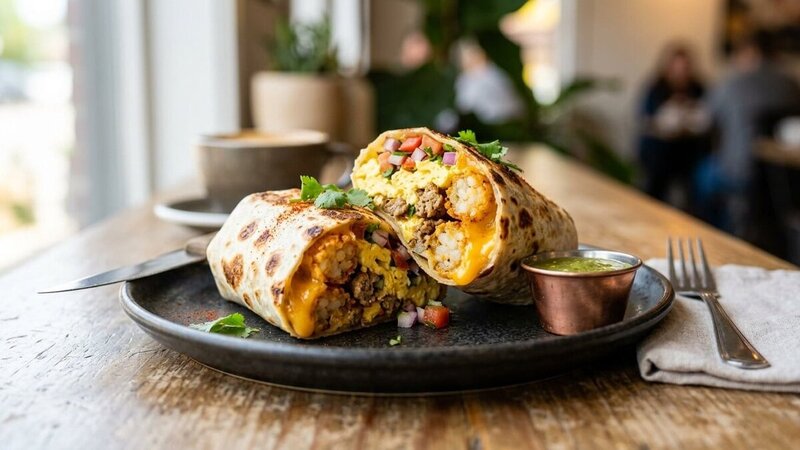
Launching a restaurant out of a 200-square-foot box in the parking lot of a hardware store isn’t the kind of opening chapter you’ll find in a standard entrepreneurship handbook. Yet that is exactly the formula that allowed Lydia Holmes and John Clarke, an Orange County couple in California, to build a business that crossed $2.3 million in revenue in 2025.
It all began in 2021 with a prefabricated shack parked next to a Home Depot store. Today the operation counts two locations, twenty-nine employees and a third store already in the works.
From a parking-lot shack to a $2 million business
Holmes, 36, and Clarke, 33, met in 2012 while working together at a restaurant. Neither had a culinary background, but both shared the habit of recreating in their own kitchen the dishes that had impressed them on outings to other restaurants. When they heard that a fully equipped kitchen shack was available for sale in the parking lot of a local Home Depot, the opportunity seemed too good to pass up. They had picked the spot deliberately for its location: a ready-made customer base of store shoppers and Home Depot employees.
To buy the shack, the couple spent $95,000, financed by a loan from a family member that they are still paying back in monthly installments. On top of that they pay $1,325 a month in ground rent to Home Depot. When LJ’s Lil’ Cafe opened on September 4, 2021, the first employees were Holmes’s two younger brothers. To keep costs down, the couple was living with her parents.
A rough start, then the breakthrough
The first months weren’t encouraging. Clarke estimates that midweek daily sales hovered between $200 and $300, of which roughly $150 came from Home Depot employees on lunch break. The couple had no marketing experience and not even a business email address, and they essentially built the operation by trial and error.
The original menu featured burgers, sandwiches and hot dogs, but customers kept asking for the same thing: the breakfast burrito. The flagship item, nicknamed the “OG”, owed its reputation to a particularly generous filling — 25 crispy tater tots and roughly a cup of melted Monterey Jack and cheddar cheese per burrito. The price started at $8.75 and is now $15.99, partly to absorb rising egg and meat costs. Spicy and vegetarian versions arrived later.
The real turning point came in 2022, when a freelance journalist published a glowing review on Eater, the national food publication. The effect was immediate: the next day customers were waiting in line in the parking lot before opening, and that same day the shack cleared $1,000 in sales for the first time. From that moment the flow never stopped, to the point that the wait for a burrito climbed to two or three hours.
The second store and the structure of the business
After hiring a general manager in October 2023 to run day-to-day operations at the original location, the couple decided to make the leap and open a second store, this time in a more conventional format. In April 2025 they bought a $148,000 space in Orange, California, financed thanks to a loan backed by Holmes’s grandparents.
The new store, which opened in July, generated almost $1.3 million in sales over the remaining six months of 2025 — outperforming the original parking-lot location, which closed the year just over $1 million. The biggest line items on the cost side are payroll, followed by ingredients and packaging. The two partners split the work along clear lines: Holmes handles administration and social media, Clarke manages supplier relationships and equipment maintenance. The next move is a third location in Cypress, designed in particular to relieve the lines that still form in front of the original shack.
Editor’s note
This article was originally published in Italian on money.it by P. F. on May 10, 2026 as «Così questa coppia ha fatturato oltre 2 milioni aprendo un chiosco di burrito in un parcheggio». It has been translated and adapted for an international audience by the Money.it International desk.