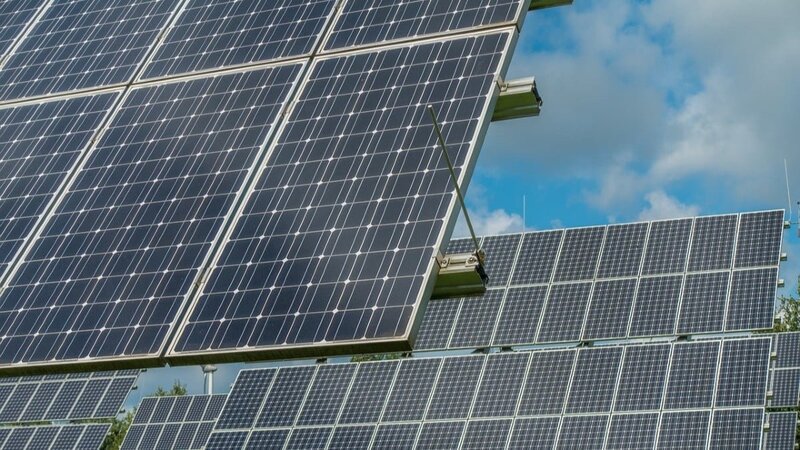
Turning derelict barracks and abandoned plots into what amount to clean-energy mines. That is the bet being placed by the Agenzia del Demanio, Italy’s State Property Agency, which has just published six new tenders to hand eight unused public sites scattered across the country over to private operators.
The goal is to install new photovoltaic capacity without consuming farmland, using space that today represents nothing but a cost to the taxpayer. For companies in the energy sector it is an opportunity worth a close look, especially given that the real bottleneck for renewables in Italy is precisely the shortage of suitable sites that do not collide with landscape protection rules or with existing productive activity. By putting this «dormant» portfolio to work, the state is offering a concrete answer to a well-known bureaucratic and operational choke point.
Where the new solar plants would be built
The six tenders cover roughly 50 hectares (about 124 acres) in total, spread across six Italian regions. All of the parcels have already been formally designated as suitable for hosting solar panels. The lots on offer run the length of the peninsula:
- Lombardy: part of the former Serini barracks at Montichiari (province of Brescia), plus a plot at Montodine (Cremona).
- Piedmont: the former Pietro Mazza barracks at Casale Monferrato (Alessandria).
- Veneto: a strategically located site in the municipality of Belluno.
- Abruzzo: two separate plots in the territory of Chieti.
- Campania: the Fondo Peschiera at Caivano, outside Naples.
- Sicily: a disused industrial site at Porto Empedocle (Agrigento).
As with other state-owned assets earmarked for conversion into hospitality venues, the formula chosen by the agency is a long-term concession or redevelopment lease. Ownership stays public, but management passes to private operators for long enough to recover the investment comfortably. Contracts will run for a minimum of 20 years and a maximum of 50. That kind of time horizon is essential if operators are to amortize the costs of solar technology, grid connection and major maintenance over the decades.
Who can bid, and why energy communities have an edge
The tenders are aimed primarily at ESCOs (energy service companies) and large renewables operators — outfits capable of taking on design, installation and maintenance of the panels. The State Property Agency, however, is not simply looking for the highest bidder, but for whoever can best integrate the project into the surrounding area. The scoring criteria therefore award bonus points to projects that:
- propose the creation of a CER (comunità energetica rinnovabile, or renewable energy community — a local scheme in which residents and businesses share locally generated power);
- include collective self-consumption systems that cut local residents’ electricity bills directly;
- actively involve the municipalities concerned in the governance of the energy produced.
In other words, the preferential lane goes to bidders who team up with the local area and manage to turn the electricity generated into a tangible economic benefit for the people living next to the plants.
Landscape protection and design: no more solar eyesores
Ground-mounted photovoltaics immediately raise the fear of visual impact — an unbroken expanse of panels blanketing the site. On this point the tender documents are explicit: submitted projects must include detailed environmental and landscape mitigation plans. In practice that means a requirement for green screening and the planting of native species, so that the design blends into its surroundings.
The intent is to show that the ecological transition can be clean in every sense, preserving the visual character of the areas that host the plants. The use of recyclable materials will also carry decisive weight in the final assessment. Framed this way, the transition becomes an opportunity for economic and social recovery in some of Italy’s more overlooked areas.
Editor’s note
This article was originally published in Italian on money.it by Emanuela Ceccarelli on July 19, 2026 as «Nuovi bandi per impianti fotovoltaici. Il Demanio mette a disposizione 8 aree in 6 regioni». It has been translated and adapted for an international audience by the Money.it International desk.