

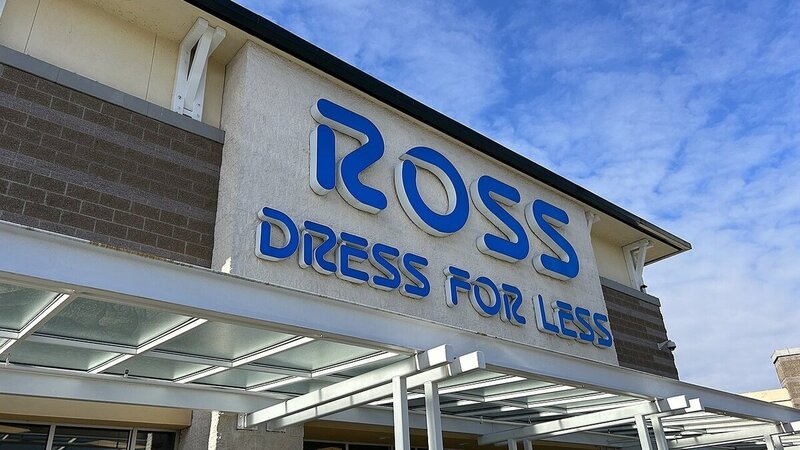
Ross Stores jumped in premarket trading Friday. The off-price retailer rose roughly 8% after reporting second-quarter earnings of $2.66 a share, far above its own guidance of $1.85 to $1.93 and above the $1.94 analysts had modeled. The stock had closed Thursday’s regular session lower, then reversed to about $247 in after-hours trading.
The move matters for more than one ticker. Walmart fell about 9% on Thursday after posting its weakest US comparable-sales growth in more than six years, dragging the whole consumer complex with it. Twenty-four hours later, a chain selling the same customer the same categories at a deeper discount is up 8%. That gap is today’s story.
A quarter that beat on traffic, not price
Sales rose 13% to $6.3 billion in the 13 weeks ended August 1, 2026, up from $5.5 billion a year earlier. Comparable store sales climbed 10% on top of a 2% gain last year. Net income reached $851 million versus $508 million.
The composition is what analysts flagged. In the results filed with the Securities and Exchange Commission, Chief Executive Jim Conroy said comparable-sales growth was «once again primarily driven by customer traffic», and that the gain «was supported by both an increase in new customers and higher engagement from existing customers.» [Ross Stores, Inc., Form 8-K, Exhibit 99.1, filed August 20, 2026] Retailers can buy revenue with markdowns. Winning it on foot traffic is what separates a real share shift from a promotional sugar high.
Conroy raised guidance across the board: comparable sales up 6% to 7% in the third quarter and 4% to 5% in the fourth, with full-year earnings now projected at $8.61 to $8.77 a share against $6.61 last year. The company also lifted its 2026 store opening plan to 115 locations, on a base of 2,328 stores at quarter-end.
The $253 million line nobody modeled
Part of the beat is not operating performance at all. Ross booked approximately $253 million in IEEPA tariff refunds in the quarter, worth about $0.60 a share and 405 basis points of operating margin. Strip it out and margin still expanded 205 basis points, ahead of the 130 to 150 the company had planned — but earnings fall to roughly $2.06 a share, a far narrower beat against the $1.94 consensus than the headline suggests.
That $253 million traces back to February 20, 2026, when the Supreme Court ruled 6-3 that the International Emergency Economic Powers Act does not give the president authority to impose tariffs of indefinite scope. The tariffs terminated four days later, and the Penn Wharton Budget Model has projected up to $175 billion flowing back to importers. Ross is among the first large retailers to run a material slice of that through an income statement, and it will not be the last. Investors should expect similar one-time credits across apparel, footwear and home goods this earnings season — and should discount them accordingly. Trade policy remains one of the live tail risks hanging over global supply chains rather than a settled question.
What Walmart said, and what Ross answered
Walmart’s quarter was not bad. Adjusted earnings came in at $0.81 a share on revenue of $187.9 billion, up 5.9%, and the company raised its full-year adjusted earnings range to $2.80 to $2.87. What broke the stock was the trajectory: US comparable sales up 2.6% against the 3.7% to 3.8% analysts expected, its slowest domestic growth in more than six years, a third-quarter forecast of $0.62 to $0.64 that landed below consensus, and management describing shoppers making «trade-offs» under the weight of higher fuel costs.
Put the two prints side by side and the read is a consumer trading down rather than pulling back. Households squeezed by rising prices at the pump and in everyday categories are not spending less; they are spending the same dollars somewhere cheaper. Off-price is the historical beneficiary of exactly that rotation, which is part of why Ross has been one of the long-run compounders in US retail.
Ross is meanwhile returning cash to shareholders at pace, repurchasing 1.4 million shares for $319 million in the quarter under a two-year, $2.55 billion authorization.
The tape around it
The rebound is narrow. Nasdaq-100 futures led at about +0.5%, with S&P 500 futures near +0.2% and Dow futures up roughly 128 points, repairing part of a session in which the S&P 500 fell 0.87% to 7,641.16, the Nasdaq Composite lost 1% to 26,067.17 and the Dow dropped 703.84 points to 52,759.21.
Bonds are not confirming. The 10-year Treasury yield sat near 4.71% and the 30-year near 5.25%, both higher than Thursday morning despite the Treasury’s buyback expansion. Brent held around $93 a barrel, on track for a second straight weekly gain on the US-Iran impasse, while spot gold traded near $4,540 and headed for a third.
What to Watch for the Open
- 8:00 a.m. ET — BJ’s Wholesale Club hosts its call on second-quarter results released before the open. A second warehouse-club read on trade-down behavior, and the cleanest cross-check on the Walmart-versus-Ross split.
- 9:45 a.m. ET — S&P Global flash PMI for August. The prices-paid components are the first test of whether oil above $90 is feeding into input costs.
- The 10-year at 4.72%. A push through that level would put pressure back on the tech leadership carrying this bounce.
- Ross’s opening print. An 8% premarket gap that fades into the cash session would say the market is treating the tariff refund as noise rather than signal.
- Next Friday, August 28. Fed Chair Kevin Warsh delivers his first Jackson Hole keynote, at a symposium running August 27-29. Everything between now and then is positioning.