
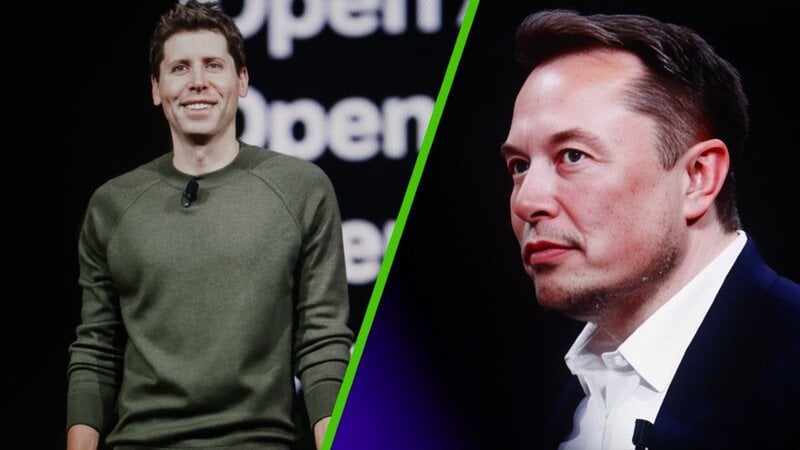
In a verdict reached in less than two hours, a federal jury in Oakland, California has rejected the civil lawsuit Elon Musk had filed to contest OpenAI’s transformation from a non-profit organization into a for-profit company. Jurors focused above all on the timing of Musk’s suit, finding that the world’s richest man had waited too long before turning to the courts.
The outcome sharply reduces the legal exposure of Sam Altman, CEO of the company that develops ChatGPT. The suit had threatened a payout estimated at around $150 billion and the removal of the company’s leadership. For the American entrepreneur, however, the win comes with a bitter aftertaste: the statements that emerged during the trial — in which Altman is described in far from flattering terms — are now in the public record.
Why Sam Altman’s reputation is at risk
Weighing on the OpenAI founder were days of testimony in which former colleagues and other witnesses described him as an «unreliable executive». During cross-examination, Musk’s attorney cited statements from eight witnesses, including Musk himself, according to whom Altman had misled or lied to third parties. From the witness stand, the CEO responded curtly: «I believe I am an honest and reliable entrepreneur».
OpenAI’s general counsel told reporters the Musk team had carried out a «character assassination» without evidence to support the accusations. Speaking in Altman’s defense, OpenAI executive Joshua Achiam testified: «In all my direct experiences with him, I feel he has been honest with me». On the other side, Musk’s defense placed the CEO’s personal credibility at the center of the closing argument delivered by attorney Steven Molo: «Sam Altman’s credibility is directly at stake in this case. If you don’t believe him, they cannot win».
The testimony from OpenAI’s former CTO
Among the exhibits introduced into evidence, a September 2022 memorandum stands out — drafted by former OpenAI Chief Technology Officer Mira Murati and addressed exclusively to Altman. The document, titled «Feedback from Mira to Sam (only Sam had access)», described an internal climate that was anything but calm: «The constant panic around our projects, our people, our goals and so on generates chaos and turnover. We talk about focus, but in practice our approach is to do everything and to do it fast».
In a videotaped deposition shown to jurors, asked whether in the fall of 2023 she considered Altman an honest person, Murati hesitated at length before answering: «Not always», adding that the CEO had undermined her work by turning executives against one another. OpenAI cofounder and former board member Ilya Sutskever also testified, saying he had spent more than a year cataloguing episodes that, in his view, documented Altman’s shortcomings at the helm of the company.
Conflicts of interest take center stage
The trial also surfaced documents attesting to billions of dollars in investments by Altman in companies that hold commercial relationships with OpenAI. The CEO countered that he had always recused himself from decisions involving potential conflicts of interest and had never deceived anyone. Board chair Bret Taylor, who joined the board in late 2023, testified that Altman had consistently disclosed his positions, sending a detailed memo before the board updated the relevant policy.
It is also worth recalling that in November 2023 the board removed Altman from his role, questioning his leadership abilities — only to reinstate him less than a week later thanks to a near-universal mobilization of the company’s employees. OpenAI’s lawyers cited in court the letter in which the majority of staff had demanded his return.
What Altman’s defense argued
OpenAI rejected Musk’s narrative, portraying him as driven by a desire to seize control of the company. According to the defense line, the Tesla founder had long been aware of the need to convert the company into a for-profit entity in order to raise the capital indispensable for the development of artificial intelligence.
The defense further argued that Musk had stalled some of his promised financing and tried to fold the startup into Tesla — a hypothesis incompatible with OpenAI’s original mission. In his testimony, Altman said he had the sense that his «cofounder had not kept his promises and had put the company in a very difficult situation».
Implications for the IPO
The courtroom victory removes the most significant legal obstacle to OpenAI’s public listing, expected by year-end and, according to estimates, potentially worth $1 trillion — which would make it the largest IPO in history. AI and trial lawyer James Rubinowitz noted: «This verdict removes the single biggest legal threat to a public offering».
Rubinowitz also added: «That said, even in victory, OpenAI emerges with the worst evidentiary record on its own governance now permanently in the public domain. Every institutional investor reading the transcript of this trial is doing their own credibility analysis on Altman before putting money in».
On the competitive front, Musk’s defeat also weighs on the plans of xAI, the artificial intelligence startup founded by the Tesla founder and backed by SpaceX. A win for the owner of X could have slowed OpenAI’s run and redistributed the balance of power in the sector. The opposite outcome instead consolidates Altman’s leadership position, leaving room for the hundreds of billions of dollars in planned investment in the data centers needed to power the next generation of models. The clash in the courtroom resolved in favor of the CEO on formal grounds, but the trial transcript is destined to remain reference material for anyone deciding whether to finance the next phase of OpenAI.
Editor’s note
This article was originally published in Italian on money.it by P. F. on May 20, 2026 as «Sam Altman ha sconfitto Elon Musk in tribunale. Ma ora la sua reputazione è compromessa». It has been translated and adapted for an international audience by the Money.it International desk.