

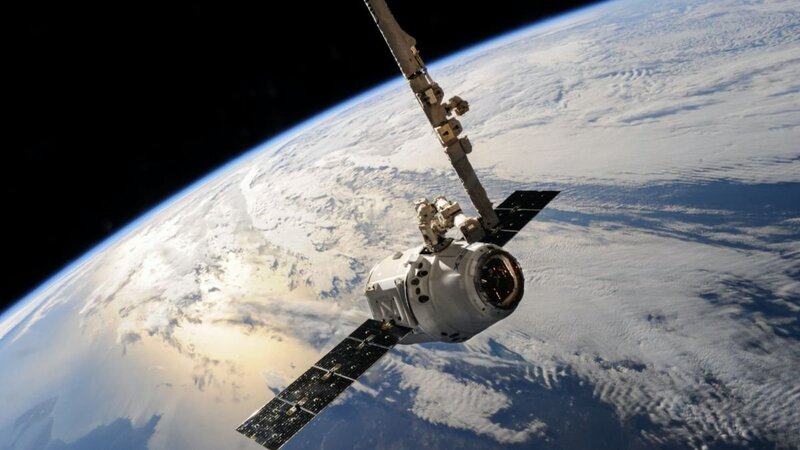
We’re used to thinking of space as a distant place reserved for a lucky few astronauts. But today’s reality is much closer to everyday life than most people realize. Earth’s orbit is turning into a genuine commercial highway, becoming one of the most dynamic financial markets in the world.
Consider that until just a few years ago, a space mission was a luxury reserved for the handful of governments with billions to spend. Today, private companies have opened the door to an unprecedented revolution. The satellites orbiting above our heads no longer serve only to explore the universe — they now support countless everyday activities, from weather monitoring to the maps running on our smartphones.
The technology that slashed the cost of space travel
For decades, the biggest problem in space travel was waste. Every time a rocket launched a satellite into orbit, the launch vehicle itself was either destroyed on reentry or dumped into the ocean. Private companies solved that problem — with SpaceX leading the way — by introducing reusable rocket technology. Today’s rockets are no longer thrown away: after releasing their payload in space, they fly back down and land themselves on a platform. Once refurbished, they’re ready for another launch.
That shift collapsed the cost of every single launch and reshaped the space-shipping market along with it. Companies no longer need to spend a fortune to buy an exclusive launch; instead, they can essentially «buy a ticket» for their own small satellite and share the ride with dozens of other companies, cutting costs dramatically.
Not just SpaceX: India and the 3D-printed «space taxi» boom
Until a few years ago, this low-cost revolution was driven almost exclusively by American giants. Today the competition has widened, and a growing number of countries are following the US lead. China, for instance, is preparing to become the first country in the world to operate its own permanent space station, while India is carving out an increasingly large share of the launch business. The country has opened the sector to private companies, sparking the rise of hundreds of local startups now competing with Western incumbents.
Leading this new wave is Skyroot Aerospace, a startup that has built a lightweight, low-cost rocket — the Vikram-1 — using carbon fiber and 3D-printed components. The real insight behind these new companies is positioning themselves as «space taxis», offering small businesses around the world a fast, customized way to launch their own instruments without waiting in line behind the bigger, more established launch providers.
Radar and agriculture: what is all this orbital traffic actually for?
As fascinating as space may be, it’s worth asking why there’s so much demand for these launches — and, more importantly, what is actually being put into orbit. The answer is less romantic than it sounds: the goal is to extract data that either makes money or saves it back here on Earth. Take, for example, the recent launch by the startup GalaxEye, which flew aboard a SpaceX rocket.
That satellite carries special radar technology capable of photographing the Earth at extremely high resolution, even through clouds or at night. The applications for these images are wide-ranging. In agriculture, they make it possible to monitor the health of thousands of acres of crops, spotting in advance where water or fertilizer is needed and delivering real cost savings. In insurance, these images let companies verify the exact extent of flood or fire damage in real time, without sending an adjuster to the site — speeding up claims. In shipping, the images make it possible to track cargo ship routes across the oceans, helping vessels avoid storms and optimize fuel consumption.
Editor’s note
This article was originally published in Italian on money.it by Emanuela Ceccarelli on July 12, 2026 as «Spazio sempre più affollato, la nuova guerra dei lanci orbitali è iniziata». It has been translated and adapted for an international audience by the Money.it International desk.


