Since the United States and Israel struck Iran on February 28, 2026, the consequences have been felt above all on the energy front. The standoff over the Strait of Hormuz cut crude flows to an average of 4.9 million barrels per day in the second quarter, against 21.6 million in the quarter before the conflict began, according to data from the Energy Information Administration (EIA), the statistical arm of the US Department of Energy. Six months on, the passage remains closed or intermittently half-closed, and the conflict has found no resolution.
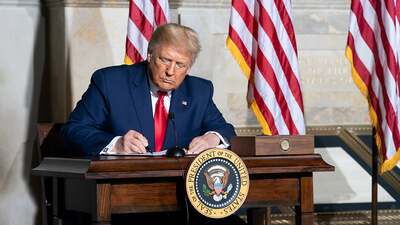
Then came the announcement that set markets moving again. Overnight between Wednesday, August 19 and Thursday, August 20, Donald Trump wrote on Truth Social that he was launching the most devastating economic operation ever undertaken against a country, promising economic war and «unprecedented» isolation. The politically significant passage, however, was not about Tehran at all: any country that allows financial institutions, companies, airports or government bodies to provide a lifeline to Iran will itself face economic consequences. This is the logic of secondary sanctions taken to a scale never attempted before, and Treasury Secretary Scott Bessent has promised to lay out the details at a press conference on Monday, August 24.
Who actually trades with Iran?
Trump’s threat only makes sense against the map of Iran’s trading partners, which Reuters reconstructed in a survey published on Thursday, August 20. The name that matters is China: more than 80% of the Iranian crude that gets loaded takes the Chinese route, with purchases estimated by the analytics firm Kpler at an average of 1.38 million barrels per day in 2025. Over the years Beijing has built a parallel circuit of independent refineries — the so-called teapots — with minimal exposure to the American market, where Iranian oil is labeled as Malaysian or Indonesian, settled in yuan and moved through a chain of intermediaries that is hard to trace. In April the US Treasury had already sanctioned one Chinese refinery and warned the country’s banks about the risk of secondary sanctions.
The second pressure point is the United Arab Emirates, historically Tehran’s financial lung, which supplied 30% of Iranian imports — worth $21 billion in 2024, according to the World Trade Organization — and absorbed 13% of its exports. This week Abu Dhabi suspended all commercial and financial transactions with Iran indefinitely, after accusing Tehran of firing two ballistic missiles at shipping traffic in the Gulf, a charge Iran has rejected.
The other names on the list describe relationships that are harder to sever for structural reasons. Turkey imports Iranian gas, which covers 13% of its import needs, with bilateral trade running at around $5 to $6 billion, and it has given no signal of wanting to scale that back. Iraq passed $10 billion in trade in 2025 and pays Tehran between $4 and $5 billion a year for the gas that fuels its power plants: two Iraqi energy officials told Reuters that new American sanctions would make it very complicated to keep paying for those supplies while staying outside the sanctions perimeter. Then come Oman, the long-standing mediator with $1.5 billion in trade in 2025; Pakistan, where informal trade is worth roughly $4 billion; India, down to $1.63 billion in fiscal year 2025/26 from $17 billion in 2018/19; and the two Caucasus neighbors, Armenia and Azerbaijan, tied to Tehran by energy swap agreements and by logistics routes that are difficult to replace.
Italy is Iran’s second-largest European trading partner
Economic relations between Iran and the European Union mattered for decades: trade touched €23.8 billion (about $25.7 billion) in 2005 and passed €27 billion (about $29.2 billion) in 2011, before sanctions progressively ground it down. The retreat accelerated after the return of UN sanctions through the snapback mechanism in September 2025, which was transposed into European law, and with the EU-wide ban, in force since January 1, 2026, on providing services to Iranian-flagged tankers. At the end of January Brussels added a further package of measures, citing human rights violations and Iranian support for Russia in Ukraine.
According to Eurostat figures, goods trade between the European Union and Iran was worth €3.72 billion (about $4 billion) in 2025 — €760 million of European imports and €2.97 billion (about $3.2 billion) of exports, leaving a surplus of roughly €2.2 billion (about $2.4 billion) in the Union’s favor. Against €4.6 billion (about $5 billion) in 2024, that is a drop of almost a billion in twelve months. Services trade was worth €1.56 billion (about $1.68 billion) in 2024, split between €690 million of imports and €870 million of exports. All told, Iran now accounts for 0.1% of European exports, against well over 1% twenty years ago.
Tehran’s leading European partner is Germany, with 31.8% of the trade: €218 million of imports and €963 million of exports, down from €1.27 billion (about $1.37 billion) in 2024. Italy is second, with 15.6% of the total, €132 million of imports and €447 million of exports. The Netherlands is third at 15.5%, up from 13.3% the previous year. Together, the three countries account for 62.9% of all trade between the European Union and Iran; France and Spain each remain below €250 million.
What is actually inside those flows explains why the American threat, in strictly commercial terms, barely grazes Italy. Italian exports to Iran are made up of industrial machinery for roughly half, then optical and medical instruments, pharmaceuticals, electrical equipment and semi-finished steel products. Imports are iron and steel, dried fruit and nuts, blood-derived products, preserved vegetables, aluminum and spices. There is no oil to be found: the last Iranian crude to land in Italy dates back to 2018, before the American withdrawal from the nuclear deal.
For Italy, the real transmission channel is energy
The risk for Italian companies, if anything, is of a different nature, and it has been familiar since 2018. American secondary sanctions have no direct force in Italian law — the European Union in fact has a blocking statute that bars its own companies from complying with them — but they produce real effects through the risk calculations of banks, insurers and shipping companies, which would rather forgo a few million euros of business than expose themselves to the American market. That is the mechanism that has already, in practice, drained the payment channels toward Tehran over recent years.
The real transmission channel for Italian households and businesses runs through the price of energy. Italy buys nothing from Iran on the energy front, but it is among the European countries most exposed to tensions in the Gulf because of the growing weight of liquefied natural gas in its mix, and Hormuz is the export route for Qatari LNG. In July the IG index published by Italy’s Gestore dei Mercati Energetici (GME, the country’s energy markets operator) averaged €56.16 per megawatt-hour against €36.76 in the same month of 2025: a rise of more than 50% in a year. Italian storage sites are running at fill levels well above the European average, but they were filled at far higher prices than last year, and that cost will feed through to bills over the coming months.
The European Commission, for now, has confined itself to invoking diplomacy, declining to comment on the White House’s threats and saying it does not want to speculate about the consequences for the Union. It is a wait-and-see position that may not hold for long: if Bessent announces measures on Monday that hit European banks or insurers, Brussels would face the same choice it faced in 2018, when the blocking statute proved to be an instrument more symbolic than effective.
Editor’s note
This article was originally published in Italian on money.it by Flavia Provenzani on August 21, 2026 as «Trump minaccia chi commercia con l’Iran. Cosa rischia l’Italia?». It has been translated and adapted for an international audience by the Money.it International desk.