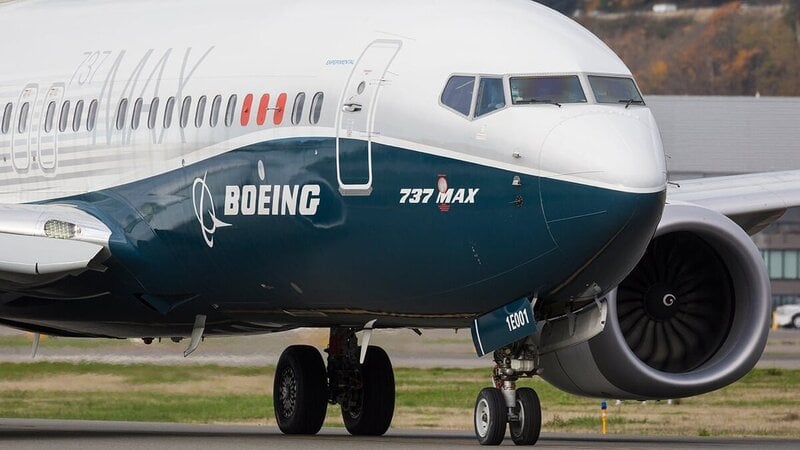
US President Donald Trump left Beijing with what, on paper at least, looks like a historic outcome: China has agreed to buy 200 Boeing aircraft, ending nearly a decade of frost in the bilateral aerospace trade.
Trump himself announced the deal in an interview with Fox News following bilateral talks with Chinese President Xi Jinping. A multibillion-dollar agreement that, in theory, should reopen one of the most strategic markets for the Seattle-based giant — a market in which Boeing has effectively been absent from Chinese buy lists since 2017.
The problem: the markets didn’t buy it. While Trump celebrated, Boeing stock dropped nearly 5% on Wall Street.
Why Boeing stock fell after Trump’s announcement
The answer lies in the gap between expectations and reality. In the days leading up to the summit, the chatter in financial circles pointed to an order of 500, even 600 aircraft. When Trump announced “only” 200, the disappointment was immediate.
But there is a more structural problem: what was communicated is not technically a signed order, but “more of a commitment,” as Trump himself admitted. A distinction that is anything but trivial for anyone holding positions on a stock that hasn’t delivered a single jet to China in over a year.
Making the picture worse is the fact that Airbus has been moving aggressively in the meantime. In the weeks leading up to the summit, China Southern signed a deal for 137 A320 jets, while Airbus’s total orders from China in 2025-2026 reportedly exceeded $55 billion in value.
What to expect from the deal
Beyond the stock-market reaction, the geopolitical substance of the Trump-Xi summit is not without value for the corporate world. The two leaders discussed the creation of a Board of Trade and a Board of Investment to manage bilateral commercial relations, and Trump has already invited Xi to the White House on September 24. That opens a roughly four-month window of relative geopolitical stability — useful for anyone planning investments or renegotiating supply contracts with Chinese or American counterparties.
On the Boeing front, CEO Kelly Ortberg — present in the delegation of 17 major Wall Street CEOs that accompanied Trump to Beijing — had already made clear in recent months the condition needed to truly reopen the Chinese market: “Without administration support, I don’t think we’ll see large orders from China in the short term.”
The political backing is now in place. What is still missing is the contractual signature, the delivery timeline, and the certainty that bilateral relations will hold long enough to turn a diplomatic commitment into a real industrial order.
Editor’s note
This article was originally published in Italian on money.it by Redazione Imprese on May 15, 2026 as «Boeing torna in Cina con 200 aerei, ma l’annuncio di Trump non convince i mercati». It has been translated and adapted for an international audience by the Money.it International desk.