A few years ago, the idea of moving AI data centers, increasingly hungry for electricity, into space sounded like a conference provocation. Among the first to speak about it openly was Blaise Agüera y Arcas, a Google researcher and vice president who now leads the Paradigms of Intelligence team, where the project was born.
It was not a joke. On Thursday, October 1, 2026, Google will send a prototype satellite into orbit carrying four artificial intelligence chips, to test whether data can be processed directly in space.
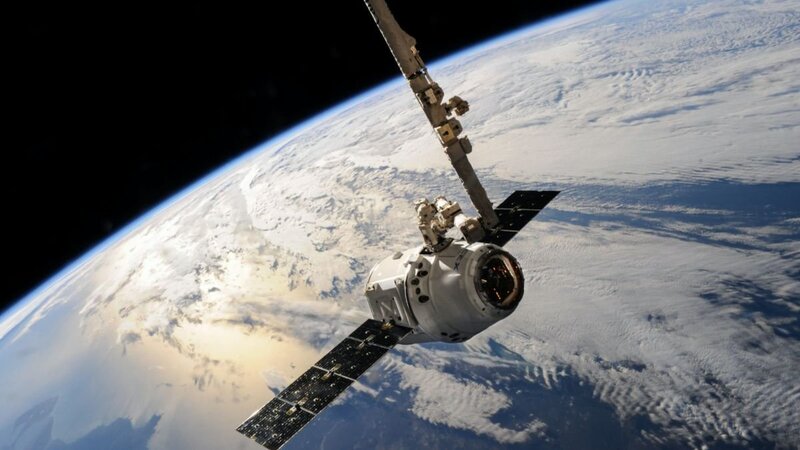
The launch is the first concrete test of Project Suncatcher, the research program through which the Mountain View company wants to find out whether processors designed for AI can work in orbit.
The goal of the mission
Google itself announced the launch in a post on its blog published on September 24. The satellite, developed with satellite imagery company Planet Labs and known internally as MVP (Minimum Viable Product), will lift off from Vandenberg in California aboard a SpaceX Falcon 9 rocket, as part of the Transporter-18 rideshare mission. The program’s original schedule called for the first flight in early 2027: Google has moved it up by a few months.
On board will be four TPUs (Tensor Processing Units, the chips Google designs for artificial intelligence) of the Trillium generation, powered by solar panels of about 1 kilowatt. According to the New York Times, the satellite will run short requests to the Gemini model, in sessions of about 15 minutes each. It is therefore not a data center in orbit, but a test bench: the aim is to understand how the chips behave in real conditions, far from the controlled environments of terrestrial data centers. The mission will last one year.
The tests to pass
Google wants to put its chips through three tests. The first is surviving the stresses of launch: the accelerations and vibrations that electronic components never face in a data center.
The second is radiation resistance. Google has already tested the chips on the ground, exposing them to a proton beam: the Trillium TPUs absorbed a dose of ionizing radiation higher than that expected over a five-year space mission, without significant damage. Their behavior in orbit, where radiation combines with other stresses, remains to be verified.
The third is thermal management, perhaps the most delicate. On Earth, servers are cooled with air or liquids, but in a vacuum the heat produced by the chips cannot be dispersed by convection and must be shed through radiation alone. On top of that come the sharp temperature swings of low Earth orbit. For this reason, the satellite will also test a new cooling system.
Why put data centers in space
In recent years, data centers have become a political and social issue, because of the enormous amount of electricity needed to power them and the water used to cool the servers.
Hence Google’s idea: constellations of satellites equipped with AI chips, powered by solar energy and linked to one another by ultra-high-speed laser connections. If the October test delivers the expected results, the next step is already set: in 2027 the company plans to launch two satellites to test laser communications between one unit and the other.
In theory, the model has its own logic. In a suitable orbit, solar panels can receive sunlight almost without interruption, and moving computing off the planet would reduce the land, electricity and water consumed on Earth. Still, the engineering and economic obstacles remain enormous, from launch costs to maintaining hardware that cannot be reached. Google itself presents large-scale AI computing in orbit as a long-term research goal: a solution that can be applied at scale is, for now, still far off.
Editor’s note
This article was originally published in Italian on money.it by Andrea Fabbri on September 30, 2026 as «Data center nello spazio, Google ci prova davvero. Il 1° ottobre lancia quattro chip AI in orbita». It has been translated and adapted for an international audience by the Money.it International desk.