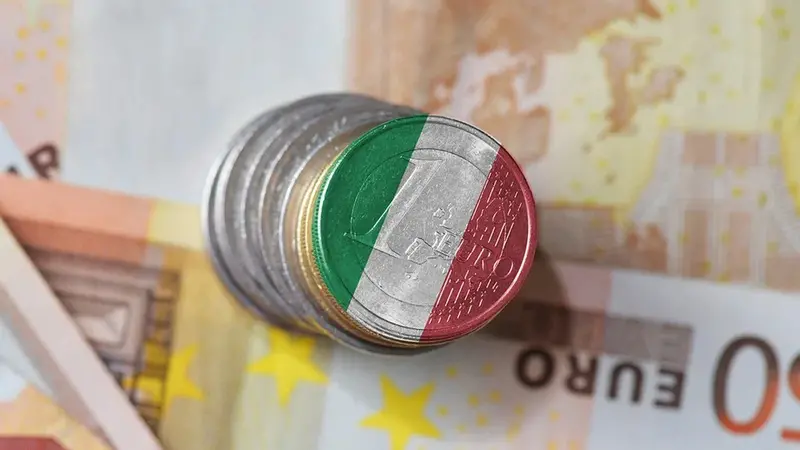
The first issuance of the BTP Italia Sì has been framed as a success for Prime Minister Giorgia Meloni’s administration, which has consistently advocated for increased retail investor participation in Italy’s sovereign debt market.
The broader strategy, summarized in the political slogan “More government bonds in the hands of Italians” has been executed through a series of retail-targeted instruments.
Notable among these is the BTP Valore, a family of sovereign bonds dedicated exclusively to individual investors and retail-classified counterparties, featuring varying maturities and periodic coupon distributions.
Over the past three years, these issuances have captured robust demand from households, advancing the government’s objective of channeling domestic savings into public debt.
Concurrently, Italy’s debt-to-GDP ratio is projected to remain among the highest in the Eurozone, with expectations to surpass Greece this year.
This strategy of incentivizing the domestic absorption of sovereign debt has drawn criticism from several economists, who warn against the risks of an excessive home bias within retail portfolios.
BTP Italia Sì: A New Success for Meloni’s Sovereign Debt Strategy
The BTP Italia Sì issuance itself confirmed robust retail participation, raising approximately €8.8 billion across roughly 281,000 contracts.
The vast majority consisted of small-ticket retail orders, underscoring households’ sustained appetite for sovereign inflation-linked savings products.
As announced by the Ministry of Economy and Finance last Friday, June 19th, this inaugural issuance - which launched on June 15th - concluded with €8,842.593 million raised across 281,140 executed contracts.
The final guaranteed minimum real coupon rate was confirmed at the previously announced level of June 12th, fixed at 1.60% plus the domestic inflation rate, as measured by the ISTAT national FOI index (excluding tobacco).
To evaluate how Italian retail investors should navigate asset allocation in this highly volatile macro environment, Money.it interviewed Mehdi Zare, CFA and co-founder of Bina Capital.
Zare echoed the consensus among analysts who argue that Italian retail investors would achieve superior risk-adjusted returns through globally diversified portfolios, rather than concentrating exposure in domestic assets such as BTPs and local equities.
“Home bias is the most expensive habit in European retail portfolios”
He highlighted three critical risk factors investors must evaluate: currency exposure (particularly unhedged EUR/USD dynamics), energy dependency relative to the United States, and total cost of ownership combined with structural simplicity:
“Three things I would flag specifically. First, currency. You earn and spend in euros, but most of the assets in the headlines are priced in dollars, and the Fed and the ECB are not on the same path. That gap quietly moves your returns, so decide deliberately whether to hedge the currency on your bond exposure rather than letting it ride by accident”.
He then highlighted the structural risk associated with energy dependency:
“Second, energy. Europe imports far more of its energy than the US does, so a sustained oil shock lands harder on European growth and on the European consumer. That is an argument for real global diversification instead of leaning on familiar domestic banks, utilities, and BTPs. Home bias is the most expensive habit in European retail portfolios”.
He outlined the third risk factor that domestic retail investors must evaluate:
“Third, keep it simple and cheap. Broad global UCITS ETFs do the diversification job at low cost, with a deliberate tilt toward quality and some inflation protection, rather than chasing whatever moved last week. And mind the Italian tax treatment on your chosen wrapper. That detail is worth a conversation with a local advisor, since it changes the after tax math more than most people expect”
.
BTPs? The advice: “Not lean on it to the point of over-concentrating at home”
Money.it also interviewed Stanislav Polezhaev, CFA, Bondfish Founder and former investment banker, who noted that at present “Italian savers are in a genuinely good spot, because the home government bond pays a real yield again - the 10-year BTP is around 3.7% - and it’s taxed at a favourable 12.5%, against 26% on most other financial income”.
However, Polezhaev also cautioned against excessive geographic concentration in domestic sovereign debt:
“I’d use that advantage but not lean on it to the point of over-concentrating at home. A sensible approach is to build a BTP ladder - and then diversify outward: euro and global investment-grade corporates, some global equity ETFs, while keeping an eye on euro-dollar risk if you buy any dollar bonds”.