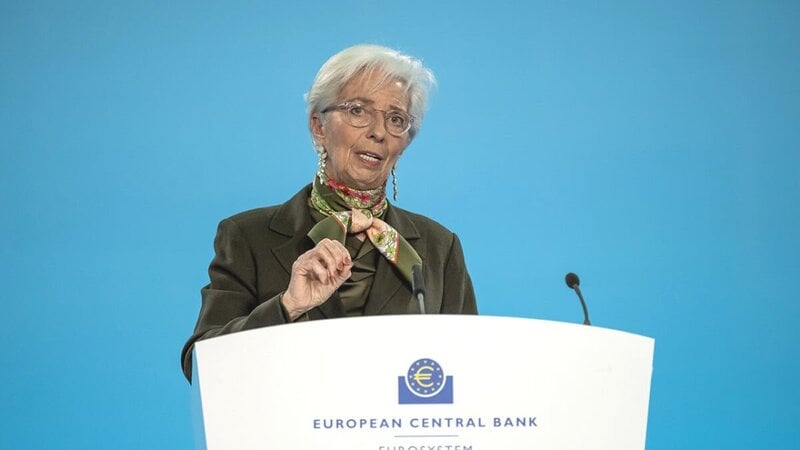
Christine Lagarde has announced that she will step down as President of the ECB, the European Central Bank, and she also gave the date:
“I have just informed my colleagues that I will step down as President of the European Central Bank (ECB) on February 7, 2027. It has been a source of great pride to serve this institution. I thank all of those who have supported me on this journey over the past seven years.”
Christine Lagarde’s announcement post on X: I am leaving the ECB presidency on February 7, 2027
Lagarde made the announcement in a post on X on Thursday, October 29, 2026. She gave no reasons. At 2:15 p.m. CET the same day, markets learn the outcome of the European Central Bank’s Governing Council meeting, that is, its decision on euro-area interest rates.
I have just informed my colleagues that I will step down as @ECB President on 7 February 2027.
It has been a source of great pride to serve this institution.
I thank all of those who have supported me on this journey over the past seven years. https://t.co/eSLLTaDAej
— Christine Lagarde (@Lagarde) October 29, 2026
Lagarde speaks at 2:45 p.m. CET after the euro rate decision. The ECB’s statement on her departure
Lagarde speaks from 2:45 p.m. CET today, at the press conference that follows half an hour after the release of the statement on the monetary policy decisions taken by the Eurotower, as the ECB’s Frankfurt headquarters is known.
Expect the questions to focus on her exit perhaps even more than on the direction of rates, and on why she is leaving the ECB’s helm ahead of schedule.
The announcement was made by the European Central Bank itself, as its website states:
“The President of the European Central Bank (ECB), Christine Lagarde, today informed the ECB’s Governing Council and the President of the European Council, António Costa, that she will step down from her post on February 7, 2027. Lagarde’s successor will be appointed by the European Council, under the procedure set out in Article 283 of the Treaty on the Functioning of the European Union. The Governing Council warmly thanked President Lagarde, giving her a long standing ovation.”
That line from Lagarde: the captain does not leave the ship. Then, the opening to a departure
Speculation over the succession started quite some time ago.
Rumors about a possible decision by Lagarde to leave the ECB presidency surfaced several times, and she (almost) always sent them back to sender, insisting that a captain does not leave the ship in times of turbulence. In an interview with Bloomberg back in April, she put it this way: “when there are big clouds on the horizon, the captain doesn’t leave the ship.”
Yet Captain Lagarde will indeed leave the ECB’s ship, early next year.
The former managing director of the IMF, the International Monetary Fund, had opened the door in early July, after the denials. Her term runs to the end of October next year, and she said an earlier exit was possible for reasons tied to French politics.
In an interview with the French daily Les Échos, the ECB’s number one said a run for the Élysée, the French presidency, in next spring’s election was not “at the moment” on her agenda.
On the option of resigning, she said only: “It is possible. I believe a European voice needs to be heard in the French presidential debate.”
The announcement, hours before another ECB rate decision, settles the question.
What happens now: Algebris Investments’ comment on Lagarde’s departure
Silvia Merler, Head of Responsible Investment & Policy Research at Algebris Investments, commented on the announcement:
“Christine Lagarde’s early exit had been in the air for months, but the confirmation turns a slow-moving succession process into a broader negotiation with very tight deadlines. With Isabel Schnabel’s departure on January 3, Lagarde’s resignation on February 7 and the expiry of Philip Lane’s term in May of next year, three of the six seats on the Executive Board are in play at a particularly delicate political moment for Europe. Since the deadline for submitting candidacies for Schnabel’s seat has been extended to the end of November, the December 17-18 European Council looks like the most realistic moment to reach a political agreement. That would leave little more than a month for the confirmation process (against the four months required for Lagarde’s own appointment in 2019), with Parliament and Council needing to move quickly as early as January.”
Merler added that “the new President will inherit a complex situation, marked by strong market attention to French fiscal risk and by rising inflation, driven by the energy supply shock”, noting that “the tight succession will leave little time to settle in and little margin for error: whoever is designated will have been in office for barely ten weeks or so at the first round of the crucial French presidential election and will have chaired just one monetary policy meeting with new projections, which could confront the ECB with a demanding credibility test.”
France votes on April 18, 2027. A possible runoff between the two candidates with the most votes in the first round is scheduled for Sunday, May 2, 2027.
Editor’s note
This article was originally published in Italian on money.it by Laura Naka Antonelli on October 29, 2026 as «BCE, Christine Lagarde si dimette: “Lascio il 7 febbraio 2027”. L’annuncio». It has been translated and adapted for an international audience by the Money.it International desk.