

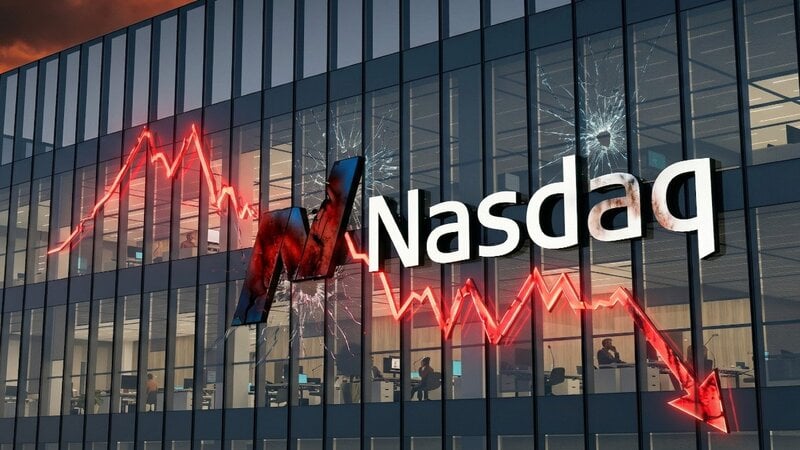
U.S. stock futures dropped Friday as a chip-stock selloff deepened for a second day, pulling the Nasdaq lower and testing investor confidence in the artificial-intelligence rally that has powered Wall Street all year.
S&P 500 futures fell about 0.9% before the bell, while Nasdaq-100 futures slid roughly 1.9%, according to premarket data reported by CNBC and Reuters. Dow Jones Industrial Average futures were modestly lower. The moves followed a losing Thursday session, when the S&P 500 closed at 7,533.77, down 0.51%, the Nasdaq Composite fell 1.47% to 25,881.95, and the Dow slipped 105.67 points, or 0.20%, to 52,552.97.
Why chip stocks are falling
The trigger came from an unlikely place: a strong earnings report. Taiwan Semiconductor Manufacturing (TSM), the main supplier of advanced chips to Nvidia, posted a roughly 77% jump in quarterly profit and beat on revenue, driven by AI demand. But the stock fell more than 4% after the company raised its 2026 capital-spending forecast to between $60 billion and $64 billion, up from a prior range of $52 billion to $56 billion.
That capital-spending hike unsettled investors already nervous about how much the AI buildout is costing. Semiconductor shares tumbled across the board in premarket trading. The iShares Semiconductor ETF fell about 3.7%, while Micron, Advanced Micro Devices, Intel and Broadcom each dropped more than 5%. Nvidia shares were down about 3%. Memory-chip makers were hit hardest for a second straight day, with SanDisk, Western Digital and Seagate falling between 4.6% and 6.5%. In Seoul, the ADR of SK Hynix slid 14%.
A paradox: strong demand, falling prices
Analysts stressed that the slide is not about weak demand for AI chips. TSMC’s results confirmed that orders remain robust. Instead, the selloff reflects profit-taking, stretched valuations and rising anxiety over the payoff from hundreds of billions of dollars in AI infrastructure spending. After a year in which a handful of megacap tech names drove most of the market’s gains, some investors are trimming exposure to the most crowded corner of the AI-fueled rally.
Adding to the mood, Netflix tumbled about 8% in after-hours trading Thursday. The streaming company matched estimates on earnings and revenue but issued third-quarter guidance below Wall Street forecasts, calling for earnings of $0.82 a share on revenue of $12.86 billion, versus analyst expectations of $0.84 and $13 billion. The soft outlook reinforced worries that even strong-performing tech names face tougher comparisons ahead.
Oil and bond yields add pressure
Rising energy prices and firmer Treasury yields gave stocks another reason to pull back. Brent crude climbed above $85 a barrel Friday, up about 2%, while U.S. West Texas Intermediate traded near $79.74. Both benchmarks are up more than 11% this week — their best weekly run since late April — as escalating U.S.-Iran hostilities threaten oil flows through the Strait of Hormuz.
In the bond market, the 10-year U.S. Treasury yield edged up to about 4.56%, with the 2-year note near 4.16% and the 30-year bond above 5.11%. Higher yields raise the cost of capital and tend to weigh most on high-growth tech stocks, whose valuations lean on distant future earnings.
What to Watch for the Open
Traders face a busy economic calendar before the weekend. The Census Bureau releases June housing starts and building permits, the Federal Reserve reports June industrial production, and the University of Michigan publishes its preliminary July consumer-sentiment reading — a gauge markets watch for early signals on inflation expectations. On the earnings side, Travelers (TRV), Truist Financial (TFC) and Fifth Third Bancorp (FITB) report before the bell.
The key question for the session is whether buyers step in to defend the chip trade or let the pullback run. With both oil and yields rising into the close of a losing week, investors weighing broad exposure may study how index-level and diversified funds are positioned. For now, the AI story that lifted markets all year is being tested — not by weak demand, but by the price of admission.