

The day in numbers
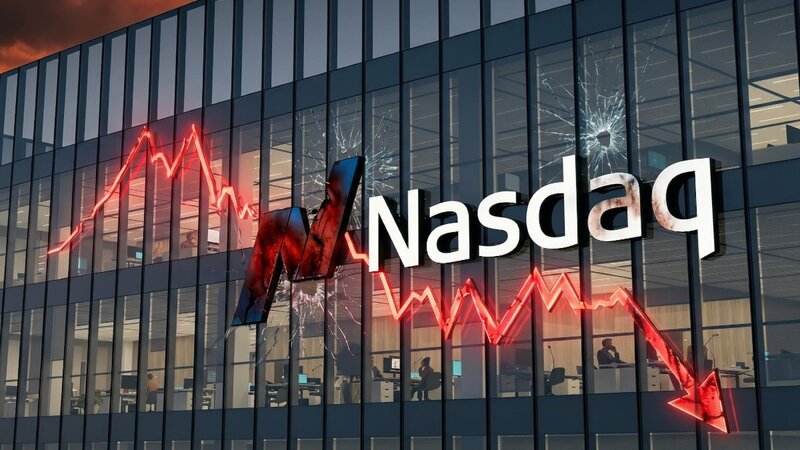
Selling was broad but tech-led. The Nasdaq Composite sank about 4%, its steepest daily drop since the tariff turmoil of early 2025, closing near 25,725.
The S&P 500 fell about 2.6%, pulling back from the record above 7,600 it had touched just days earlier. The Dow Jones Industrial Average — which had closed at a record on Thursday — lost roughly 700 points, or 1.3%, cushioned by its lighter weighting in semiconductors. By one estimate, the slide in semiconductors erased about $1 trillion in market value on the day.
Chips led the decline
The damage started where it had all week: in the semiconductor sector. Micron (MU) tumbled about 6.3%, Marvell Technology (MRVL) shed roughly 8%, Advanced Micro Devices (AMD) fell about 6.3%, and Broadcom (AVGO) lost another 3.8%, extending a slide that began after the company left its annual AI revenue guidance unchanged. Nvidia (NVDA) dropped alongside the group.
Meta (META) added to the pressure, falling more than 6% on reports of a possible new equity capital raise to fund its AI expansion — a reminder of just how much capital the AI race now demands.
Where the money went
This was a rotation, not a reckoning. As traders dumped semiconductors, they bought defensive stocks.
Consumer staples were the best-performing sector among the S&P 500’s eleven, up more than 2%, with gains also in health care, financials, communication services, and real estate.
The day’s blue-chip leaders read like a roll call of everything that isn’t a chipmaker: UnitedHealth (UNH) rose about 5.2%, Goldman Sachs (GS) gained roughly 4.9%, Johnson & Johnson (JNJ) added about 4.6%, JPMorgan Chase (JPM) climbed 3.3%, and Visa (V) rose 2.5%. For anyone uneasy about how dependent the market has become on a handful of names, the session was a live demonstration of why some investors prefer S&P 500 funds built to sidestep the Magnificent Seven.
Bonds, the dollar, oil, and gold
The trigger was in the bond market. After May’s payrolls report, the yield on the 10-year US Treasury jumped above 4.5%, its highest since May 21, while the 30-year yield topped 5% — levels that raise the cost of money precisely for the companies financing the AI build-out. The US dollar strengthened. Gold held near $4,490 an ounce, slipping marginally as rising real yields dulled its appeal. In commodities, WTI crude traded around $92.60 a barrel and Brent near $94.70, both modestly lower as markets weighed mixed diplomatic signals from the Middle East.
Why good jobs data was bad news
The paradox of the day is that the economy looked healthy. The Bureau of Labor Statistics (BLS) reported that «total nonfarm payroll employment rose by 172,000 in May and the unemployment rate was unchanged at 4.3%» — well above the roughly 80,000 to 88,000 that economists had penciled in. On most days that is reassuring. On Friday it was a problem.
A labor market that strong gives the Federal Reserve no reason to cut rates and, at the margin, revives speculation about a possible hike, just as inflation stays elevated. Higher-for-longer rates are specifically toxic to the AI trade, because the sky-high valuations of the AI and semiconductor stocks that have driven the market rest on the present value of profits expected years out, and rising yields erode exactly those future profits. That is why the AI stocks Morgan Stanley had recommended to investors moved in unison on the way down, just as they had on the way up.
What to watch when markets reopen
The question for Monday is whether Friday’s move was a one-day repricing or the start of a deeper unwinding of the year’s dominant trade. Three things will set the tone: the path of the 10-year yield — if it keeps climbing toward and past 4.6%, rate-sensitive growth stocks stay under pressure; whether the rotation into defensives holds or reverses, with bargain hunters returning to chips; and any fresh signal from Fed speakers on how a strong labor market reshapes the rate outlook.
After a week in which the AI trade finally stopped accelerating, the burden of proof has shifted — and the bond market, for now, is the one doing the talking.
Editor’s note
This article was originally published in Italian on money.it by Redazione Finance on June 06, 2026 as «I mercati crollano: il Nasdaq affonda del 4% nella peggior seduta dal 2025, il tracollo dei chip brucia 1.000 miliardi». It has been translated and adapted for an international audience by the Money.it International desk.