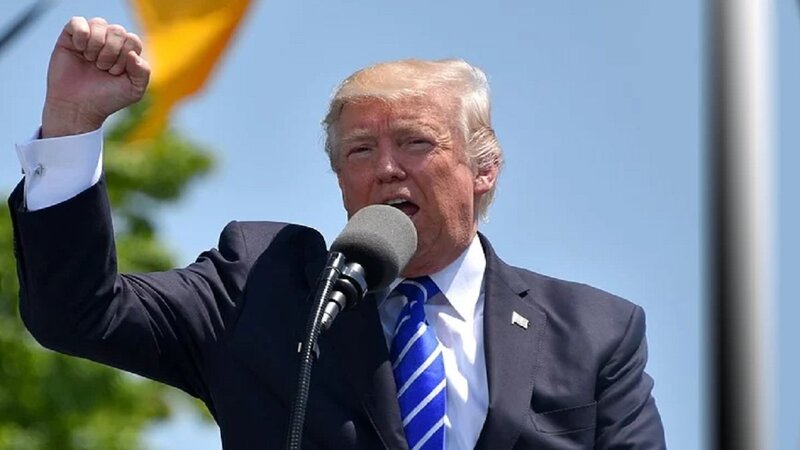
The first three months of 2026 for Donald Trump look less like the schedule of a sitting US president and more like that of a hyperactive trader, with a long series of investments in America’s biggest technology companies. That is the picture that emerges from 122 pages of documents released on Thursday, May 14 by the Office of Government Ethics (OGE), the independent federal agency tasked with monitoring conflicts of interest inside the executive branch. The filings cover roughly 3,700 individual financial transactions for a combined estimated value of up to $750 million.
The trades involved American heavyweights such as Amazon, Apple, Microsoft, Meta, Boeing, Alphabet, Oracle, Goldman Sachs and BlackRock — names that appear in the financial disclosure forms signed by the president himself. On average, the account ran about 58 trades per day, a pace comparable to that of a professional trader.
According to the documents, Trump aggressively sold shares of Microsoft, Amazon and Meta, with individual transactions ranging between $5 million and $25 million, and then redirected part of the capital toward companies such as NVIDIA, Apple and Oracle, alongside additional positions in semiconductors and enterprise software. In the $1–5 million transaction band for Q1 2026, the filings list purchases of ServiceNow, Nvidia, Adobe, Microsoft, Oracle, Broadcom, Motorola, Amazon, Texas Instruments and Dell.
All of this happened while the administration was making decisions that directly affected many of those same companies — exactly the kind of overlap that fuels conflict-of-interest concerns. In parallel, Trump also adjusted his fixed-income exposure: in March he reportedly bought around $51 million in bonds, signaling a tilt of the portfolio toward assets typically considered more defensive.
Suspicious timing
What raises the most questions, however, is the timing of several specific trades. On February 10, Trump reportedly bought between $1 million and $5 million worth of Nvidia shares — just one week before the company announced a major artificial-intelligence deal with Meta. A similar episode allegedly took place on January 6, when the president bought between $500,000 and $1 million in Nvidia stock, exactly one week before the Department of Commerce cleared the sale of certain Nvidia chips to China. In both cases, the stock posted a sharp move higher on the news, generating significant paper gains.
Also on February 10, Trump reportedly bought shares of Axon — the maker of Taser electric weapons — two weeks before ICE (US Immigration and Customs Enforcement) unveiled a $220 million plan to purchase Tasers over the next five years.
Is it just coincidence, or did the Trump administration have advance knowledge of what was about to hit these companies? That is the question many observers are now asking. The “coincidence” defense, repeated several times in the span of just three months, is starting to look very hard to sustain. The White House has stated that Trump’s private assets are held in a trust managed jointly with his children and that no conflicts of interest exist — but the newly released filings make that argument increasingly difficult to defend.
Editor’s note
This article was originally published in Italian on money.it by Alessandro Nuzzo on May 16, 2026 as «Trump nei guai? Le operazioni milionarie con big americane fanno discutere». It has been translated and adapted for an international audience by the Money.it International desk.