

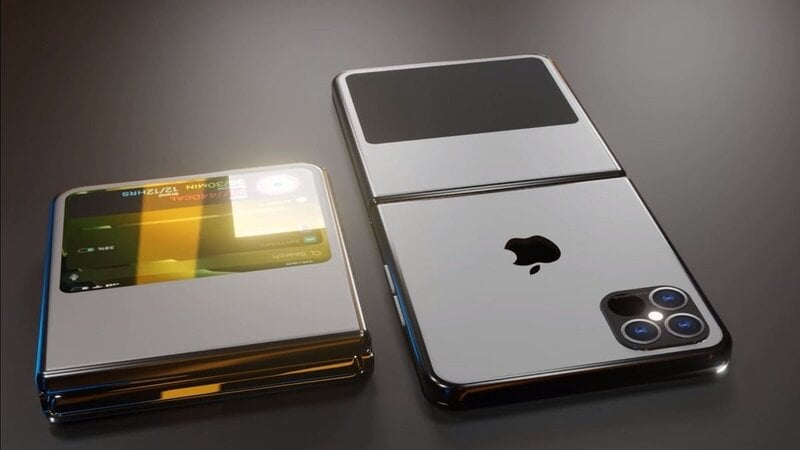
After years of leaks and corridor chatter, everything is in place for the arrival of the first foldable iPhone in history. It will be called iPhone Ultra, and it is expected to launch in the fall of 2026, alongside the iPhone 18 Pro and Pro Max.
Apple appears to be preparing something different from the foldables already on the market, with technologies designed to make the hinge invisible and deliver one of the best in-hand experiences ever seen on this form factor.
Recently, renders and leaks have surfaced that give more specific information about the device, ahead of the official unveiling. In this guide we run through the main specs, the price, and how the iPhone Ultra compares with its main competitors.
How the iPhone Ultra will work
When it comes to foldable phones, one of the most annoying problems has always been the dark line that runs across the middle of the screen when the device is open: the so-called “crease,” which engineers and developers have been trying to solve for years.
Apple seems to have cracked it, eliminating the visible hinge mark that has plagued every previous generation of foldables. How? By leaning on a genuinely new piece of engineering. The Cupertino company plans to use a liquid-metal hinge paired with an alternative display technology.
The model will carry a roughly 7.8-inch display, with an advanced laminated structure and mechanisms that minimize deformation. The PET backplate that normally sits under the polyimide substrate has been replaced with an additional layer of UTG (ultra-thin glass).
In practice, the new design improves rigidity and distributes tension more evenly during folding, so the curve is smoother and the crease is drastically reduced. The end result is a screen that looks continuous even when the device is closed.
Unlocking: Touch ID is back
Apple has made a surprising decision on biometric unlock for the iPhone Ultra. Instead of Face ID — installed on every recent iPhone generation — the side-mounted Touch ID button is making a comeback.
The reasoning is simple. A foldable iPhone has two displays, one external and one internal. Where would Apple place the facial-recognition system? On the outer screen? The inner one? Both? Each option creates a usability headache.
That’s why Apple is going back to Touch ID, which with a single tap on the fingerprint sensor allows instant unlocking regardless of how the phone is being held. It’s a deliberately modern reading of an older feature — though this will be the only current-generation iPhone without Face ID.
Battery life
On battery life, Apple is reportedly focused on making a foldable that lasts. According to leaks so far, the iPhone Ultra will pack a 5,500 mAh cell — a record for an iPhone.
The iPhone 17 Pro Max tops out at 4,823 mAh and is currently the longest-lasting iPhone Apple sells. With a wider case than a traditional book-style foldable, there is more physical room to fit a larger battery.
That should translate into at least 24 hours of real-world endurance, even with the second display adding to consumption. There is no firm information yet on fast charging or whether MagSafe will be supported.
What the iPhone Ultra will look like
Apple has reportedly paid close attention to the industrial design. As mentioned, the inner display should measure around 7.8 inches with a near-invisible crease, while the cover screen will come in at 5.5 inches. The case will be 9.2 mm thick when closed and 4.6 mm per side when open.
For materials, Apple is using reinforced single-piece glass paired with high-strength aluminum to deliver an ultra-thin chassis with rounded edges.
The cameras are also worth a closer look. The rear module will be a pill-shaped unit, in the style of the iPhone Air. The back is expected to carry a dual-camera system with wide and ultra-wide sensors, in a hybrid glass-and-plastic structure. For selfies, a meta-lens-based sensor solves the bulk problem typical of foldables.
The volume rocker will be positioned slightly higher than on the rest of the iPhone lineup, to make two-handed use easier when the device is in tablet mode.
How much the iPhone Ultra will cost
The price of the iPhone Ultra has not yet been officially confirmed, but it is certain to land above any current iPhone. Industry estimates put it in a range of $2,300 to $2,499 in the United States — meaning more than €2,500 (about $2,700) in Italy and other European markets.
That would make the iPhone Ultra the most expensive iPhone ever, by a wide margin. For comparison, the iPhone 17 Pro Max currently sells for between €1,400 and €1,500 (roughly $1,500 to $1,620), depending on storage configuration.
Why the iPhone Ultra is worth buying
There are several reasons that might push you to buy the iPhone Ultra at launch, particularly if you are already a foldable enthusiast. The biggest pro is the display without a visible crease, which delivers a meaningfully different experience from competitors.
On repairability, Apple has reportedly worked to minimize internal cabling, reorganizing the layout of components to make the iPhone Ultra the easiest foldable to repair.
You also have to factor in the larger battery and full integration with Apple’s ecosystem — iPad, Mac, Apple Watch. Finally, there is the latest-generation hardware, with the Apple Silicon A20 chip likely paired with the C2 modem.
On the other side of the ledger, the price is at the very top of the premium segment, and the absence of Face ID could feel like a step backward, at least initially.
Apple is also reportedly planning a relatively limited initial run, with 8-10 million units to be sold in the first year.
How it compares to the competition
To get a clearer sense of the iPhone Ultra’s strengths and weaknesses, it helps to compare it directly with its two main competitors on specs and price: the Samsung Galaxy Z Fold 7 and the Huawei Mate X6.
On displays, the Galaxy Z Fold 7 carries an 8-inch LTPO AMOLED 2X main screen and a 6.5-inch AMOLED on the outside. The iPhone Ultra answers with a 7.8-inch inner display and a near-invisible crease. The Huawei Mate X6 comes in with a 7.92-inch internal LTPO AMOLED and a 6.45-inch external LTPO OLED. Dimensions are almost identical to the iPhone, but the crease is visible, as on Samsung.
For processors, Samsung’s Z Fold 7 runs on the Snapdragon 8 Elite with 12 GB of RAM, the iPhone Ultra will use the A20 chip, while the Huawei carries Huawei’s proprietary Kirin 9020 with 12 GB of RAM.
Finally, the price. Today the Galaxy Z Fold 7 starts at around €1,000 (about $1,080) for the European base configuration, though its list price is closer to €2,000. The iPhone Ultra will start at €2,400-€2,500 (about $2,600-$2,700). The Huawei, for reference, starts at €1,999 (about $2,160).
Editor’s note
This article was originally published in Italian on money.it by Pasquale Conte on May 11, 2026 as «iPhone Ultra, come funziona e quanto costa il primo iPhone pieghevole di sempre». It has been translated and adapted for an international audience by the Money.it International desk.